
On this page
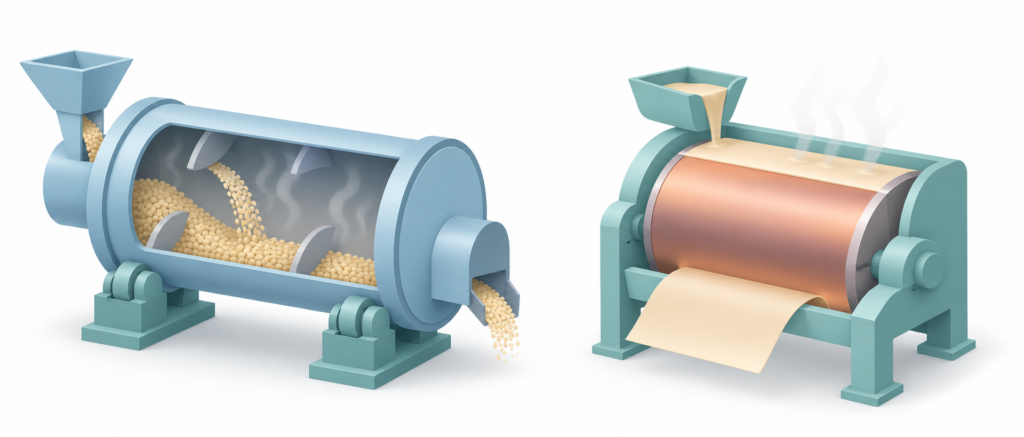
“Drum dryer” can describe two different machines. A rotary drum dryer moves material through a rotating cylinder. A contact drum, or roller, dryer dries a film on the heated surface of a rotating drum. Before comparing quotations, confirm the feed form and the way heat reaches the product.
Rotary dryer diagram: parts and their functions
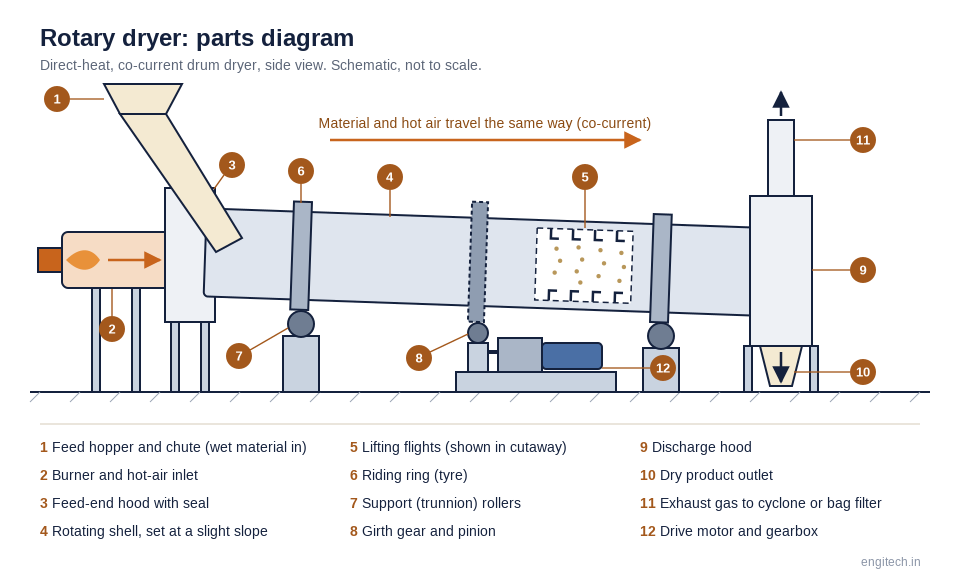
| No. | Part | What it does |
|---|---|---|
| 1 | Feed hopper and chute | Delivers the wet material into the raised end of the shell. |
| 2 | Burner and hot-air inlet | Supplies the hot gas that carries heat to the material. In a co-current dryer it enters at the feed end. |
| 3 | Feed-end hood with seal | Stationary housing that closes the gap between the fixed ducting and the rotating shell and limits air leakage. |
| 4 | Rotating shell | The inclined drum. Its rotation and slight slope move the material steadily toward the discharge end. |
| 5 | Lifting flights | Plates fixed inside the shell that lift the material and shower it through the hot gas stream. |
| 6 | Riding ring (tyre) | Steel ring around the shell that transfers its weight to the support rollers. |
| 7 | Support (trunnion) rollers | Carry the riding rings and let the shell turn. Thrust rollers, not shown, stop the shell sliding downhill. |
| 8 | Girth gear and pinion | A large ring gear on the shell, driven by a small pinion, turns the drum. |
| 9 | Discharge hood | Stationary housing at the lower end where the dried solids and the exhaust gas separate. |
| 10 | Dry product outlet | Dried material leaves by gravity at the bottom of the hood. |
| 11 | Exhaust gas outlet | Moist gas leaves at the top and goes to a cyclone or bag filter, which recovers the dust it carries. |
| 12 | Drive motor and gearbox | Turn the pinion at the low speed the drum needs. |
Download this diagram (SVG)Schematic for learning. Real machines vary by maker and duty.
The distinction matters because a diagram of a bulk-solids rotary dryer does not explain how a roller dryer forms and removes a dried film. This guide compares the basic arrangements and the information a supplier needs; it is not a sizing or operating procedure.
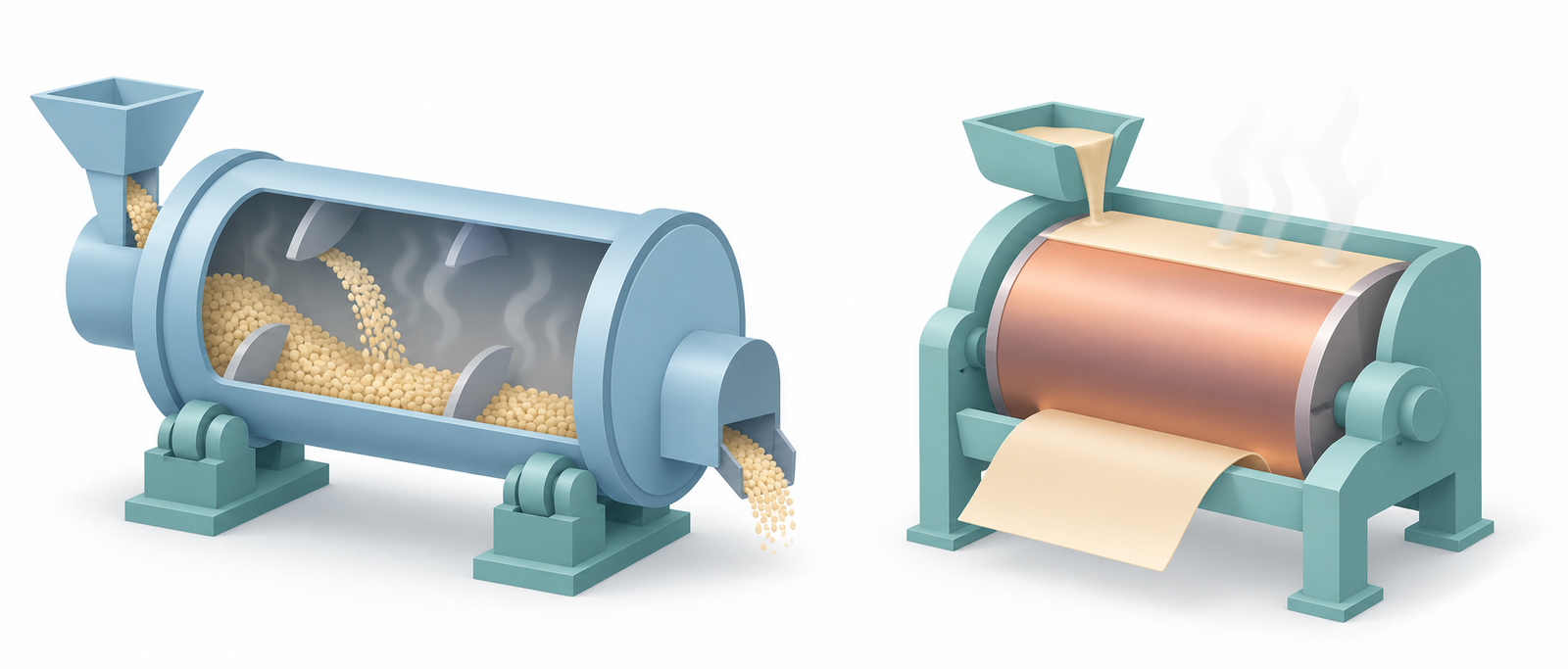
Bulk material → rotating cylinder → dried material
For a direct design, process gas contacts the material inside.
Liquid or paste → film on heated surface → dried film removed
The drum surface supplies heat to the film.
What is the practical difference?
In a direct rotary dryer, a rotating shell carries material through a stream of process gas. Some designs use internal flights to lift and cascade solids through that stream. Indirect rotary dryers also contain a rotating drum, but the material does not directly contact the heating gas. The exact construction varies with the duty. FEECO describes both rotary arrangements.
A contact drum dryer works differently: a pumpable feed is distributed as a film over a heated rotating surface, and dried material is removed from that surface. The feed system, drum arrangement and product handling depend on the machine. GTI describes contact drum drying and its distinction from rotary drying.
See it in 3D
Compare the feed before comparing machines
- Feed form: Is the material a free-flowing solid, a wet cake, a slurry or a liquid? Record how it behaves as received, including variation between batches.
- Required product: Specify the desired output form, moisture target and test method. A dry flake, a granule and a powder are not interchangeable specifications.
- Heat and contact: State the product’s known temperature limits and whether contact with process gas is acceptable. Ask the supplier to explain the proposed heating boundary.
- Handling and cleaning: Include feed preparation, discharge, dust collection where relevant, cleaning and changeover in the proposed scope.
- Evidence: Ask what test or comparable material supports the proposal, what was actually measured, and which assumptions remain open.
A contact dryer is not automatically the right choice for every slurry, and a rotary dryer is not automatically suitable for every wet solid. Adhesion, product quality, contamination sensitivity and the complete process duty need case-specific evaluation.
An illustrative enquiry
This is a constructed example, not a customer project or a test performed by Jignesh. A buyer receives one offer for a “drum dryer” for a pumpable paste and another for a “rotary dryer.” Before comparing prices, the buyer asks each supplier to show where the feed is applied, how heat reaches it, what form leaves the machine and what feed preparation is included. If the two offers assume different feed forms or output products, their quoted capacities and prices are not yet a like-for-like comparison.
Questions to send with your request
- What material form and range of feed consistency does your proposal assume?
- Where does the feed contact the heated surface or process gas?
- What product form and moisture measurement form the acceptance basis?
- Which feed, discharge, cleaning, dust-control and utility items are included or excluded?
- What trial is proposed, what will it measure, and how will the results be used in the final design?
- What operating, maintenance and site-safety information must the responsible team review before installation?
For a visual walkthrough of a rotary machine, see Rotary Dryer Diagram: Components and How It Works. To compare complete supplier scopes, use How to Compare Industrial Equipment Quotations.
Sources and further reading
- FEECO International: Indirect Drying vs. Direct Drying, manufacturer explanation of rotary dryer heat-transfer arrangements.
- GTI: Drum and Roller Dryers, manufacturer explanation of contact drum drying. Both accessed 3 November 2026.
Related reading: Rotary Dryer Diagram: Components and How It Works.
Free tools for this topic: Dryer selection tool · Dryer evaporation, heat and fuel calculator · all free engineering tools
Free tool for this topic
Industrial Dryer Evaporation, Heat & Fuel CalculatorWater evaporation, product output, heat load and fuel or steam consumption for spray, rotary, flash, fluid-bed and paddle dryers. Industrial DryersAgitated Thin Film Dryers: Industrial Drying
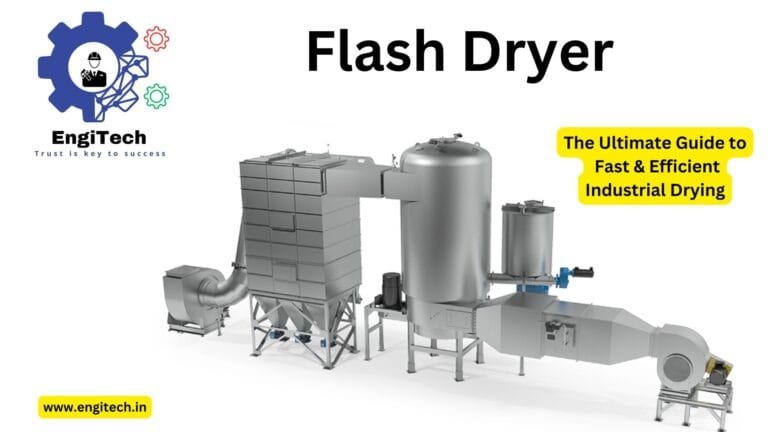 Industrial DryersFlash Dryer: The Ultimate Guide to Efficient Industrial Drying
 Industrial DryersRotary Vacuum Paddle Dryers (RVPD): Solvent Recovery, Heat Transfer & Sizing Guide
 Industrial DryersSludge Drying Economics: Cost per Tonne of Water Evaporated
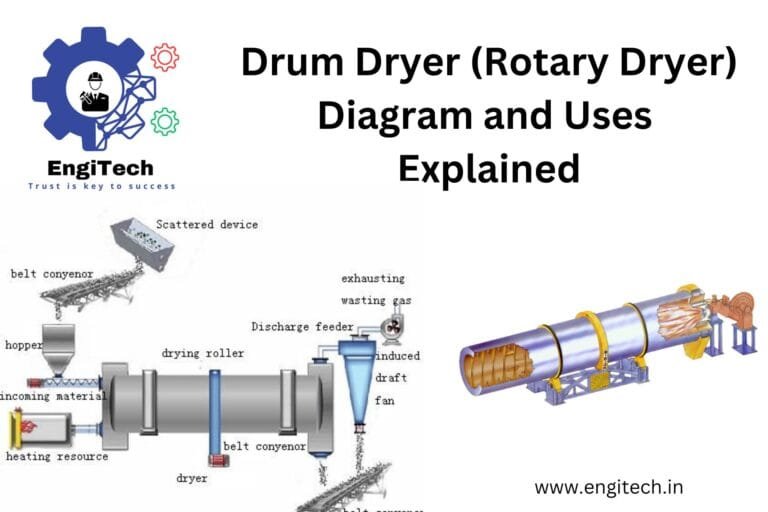 Industrial DryersRotary Dryer Diagram: Components and How It Works
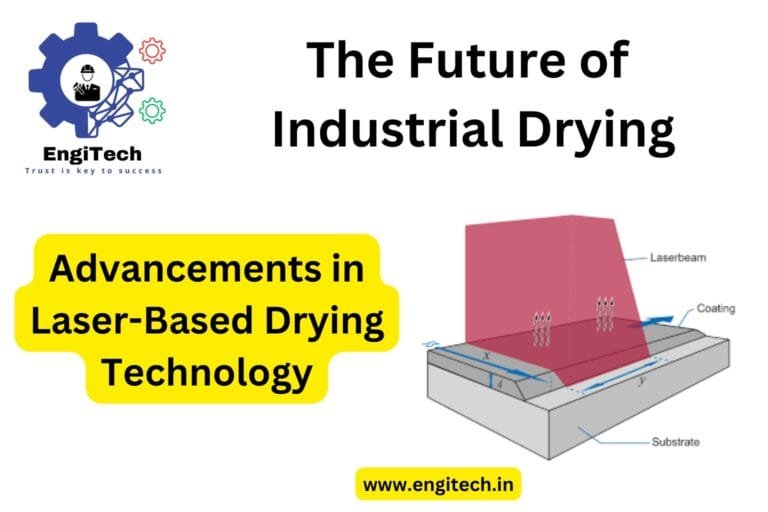 Industrial DryersAdvancements in Laser-Based Drying Technologies: Shaping the Future of Industrial Efficiency