
On this page
- Before the part is moved: involve the right people
- What to include in the laboratory brief
- Keep observations separate from causes
- Questions to ask before cleaning, cutting or shipping
- Illustrative example: a shaft that stopped a line
- What to ask a failure-analysis laboratory
- Frequently asked questions
- Should I clean a broken part before sending it?
- Is a photograph enough to identify the cause?
- Must every investigation use the same tests?
- Sources and further reading
- More on Materials Engineering
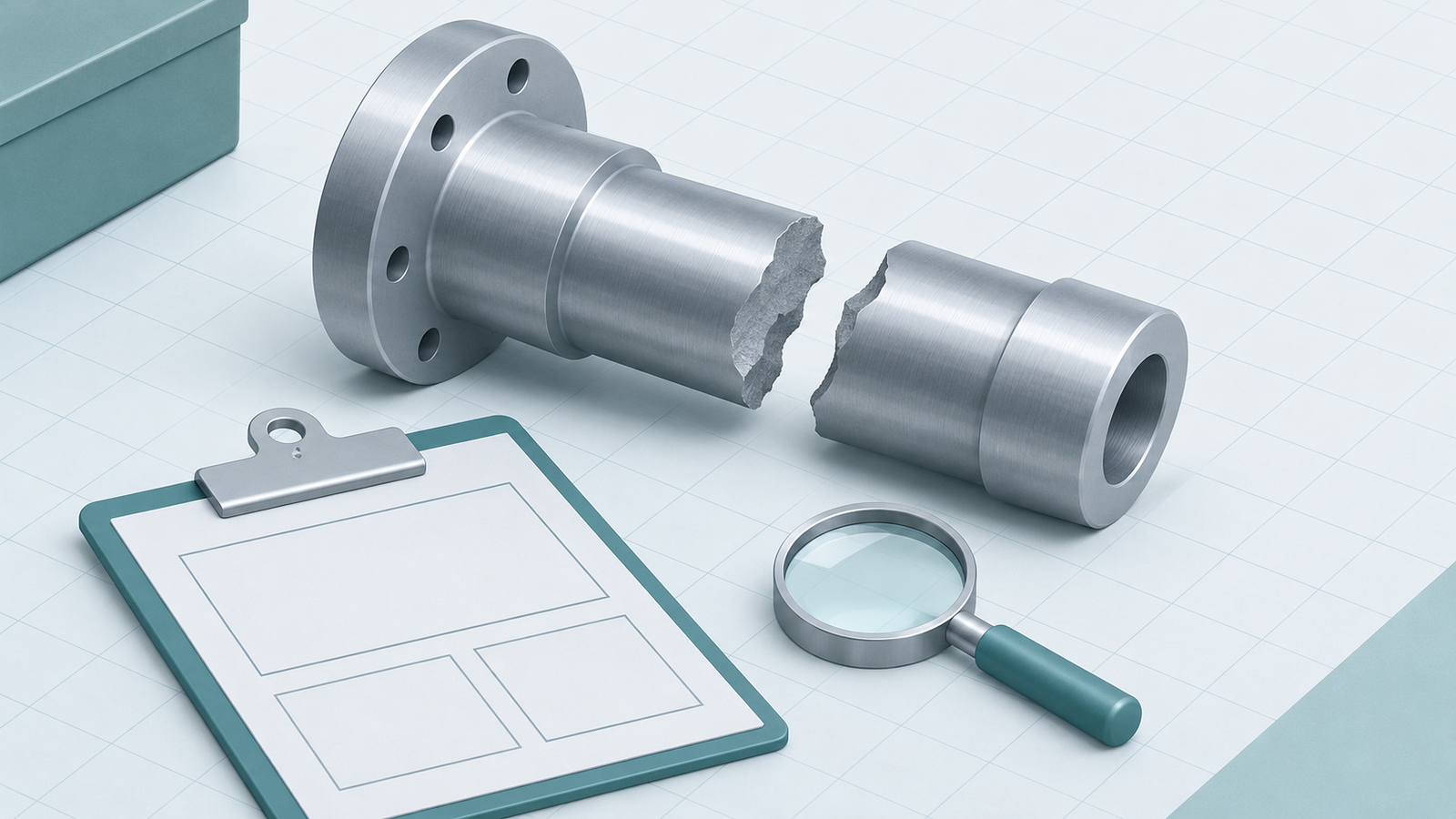
Before sending a failed metal part for analysis, establish a safe handover, preserve the available information and agree the investigation scope with the laboratory. Record what the component did, where it was installed, what happened and which records are available. Treat the cause as an open question until the evidence has been assessed.
A fractured shaft, cracked weld or leaking pipe can raise several different questions. A useful laboratory brief connects the physical item with its operating history. It also makes clear what the recipient is being asked to determine—and what is still unknown.
Before the part is moved: involve the right people
Follow the site’s incident response and safety procedures first. Damaged equipment can involve stored energy, sharp edges, hot surfaces, chemicals or other hazards. The responsible site team decides when access is safe and who is authorized to handle the equipment.
Contact the failure analyst or laboratory early. Ask what information they need, what evidence should be documented in place and how the part should be protected or transferred. The laboratory and site safety team should agree any sampling, cutting, cleaning, packaging and transport arrangements for the actual item and its hazards. This article does not provide an isolation, cutting or hazardous-material shipping procedure.
GATE Energy’s Viking laboratory guidance emphasizes involving an analyst before removal and protecting fracture surfaces from handling damage. The U.S. Pipeline and Hazardous Materials Safety Administration (PHMSA) likewise calls for a planned investigation, documentation and custody controls in its pipeline-failure protocol. The PHMSA document is a pipeline-specific U.S. reference; its detailed procedures are not a universal instruction for every component or jurisdiction.[1][2]
What to include in the laboratory brief
Use this checklist as a starting point. It is acceptable to mark an item “unknown” or “not available”; an accurate gap is more useful than a guessed value.
- Component identity and function. Name the part, equipment, location and intended function. Include a drawing, part number or material designation when available, and say whether each item has been verified.
- Event timeline. Record when the issue was noticed, the operating state, relevant alarms or observations, and what happened immediately before and after discovery. Distinguish observations from later explanations.
- Service history. Provide available operating records, maintenance and repair history, prior damage, replacement history and relevant changes in duty or environment. Mark estimated dates as estimates.
- Visual records. Where the site team confirms it is safe, take overview and close-up photographs that show location, orientation and surrounding conditions. Record who took them and when; follow the investigator’s requirements for scales and labels.
- Condition and handling. Record whether the item was moved, separated, cleaned, repaired or exposed to weather after discovery, and by whom if known. Do not present the current condition as unchanged if the history is uncertain.
- Related evidence. Ask whether an undamaged comparison item, service records or samples of relevant deposits or fluids would help. Collection and handling must be agreed with the responsible specialists; do not collect potentially hazardous material based on a generic checklist.
- Scope and decisions. State the questions the investigation should answer, the decision that depends on the findings, any restrictions on destructive testing, and who can approve the agreed test plan.
- Handover record. Identify each item and document transfers, dates, condition and storage instructions as agreed with the investigation team. Where evidence may be used in a formal investigation, follow the applicable custody requirements set by the responsible authority.
Keep observations separate from causes
“A crack was visible near the mounting area” is an observation if someone documented it. “The crack was caused by fatigue” is a hypothesis until the investigation supports it. A photograph, material certificate or microscope image can be important evidence, but a single feature should not automatically be treated as the complete cause.
Describe the evidence and its limits. For example, a drawing may state the intended alloy while a laboratory report describes the tested sample; those are different records. If an operating history is incomplete, say so. This helps the laboratory explain which conclusions are supported and which questions remain open.
Questions to ask before cleaning, cutting or shipping
- Which surfaces, deposits or adjacent areas should be documented before anything is changed?
- Does the item present contamination, chemical, biological or other handling hazards that the site safety team and laboratory must assess?
- What cleaning, if any, is necessary for safety, and how should it be documented? Do not assume a generic cleaning method is appropriate.
- If removal or sectioning is necessary, who will plan and authorize it, and what information must be recorded?
- How should the item be protected and identified during storage and transit? Ask the receiving laboratory for instructions suitable for that sample.
- Who holds the evidence at each stage, and what transfer records are needed?
Viking’s guidance cautions that cleaning or contact can change evidence on fracture surfaces. PHMSA’s protocol also discusses preserving the failed section and recording custody, but it requires an investigation plan for the specific pipeline case. Neither reference replaces the laboratory’s instructions for a different component.[1][2]
Illustrative example: a shaft that stopped a line
This is a constructed example, not a customer project, test result or claim of personal experience.
Imagine a production line stops and the site team finds a separated shaft. The maintenance record shows the part number and an earlier bearing replacement, but the load history is incomplete. A photograph shows the assembly location; no one has established a cause.
A useful brief would provide the photograph, the available part and maintenance records, the known operating timeline and the missing load-history note. The team would ask the laboratory whether a comparison component and further records would be useful, and would agree safe handling and test permissions with the responsible people. The result of the analysis is not assumed by this example.
What to ask a failure-analysis laboratory
Rather than choosing solely from a list of instruments, ask how the laboratory will develop a case-specific investigation plan. Discuss:
- The analyst’s relevant experience with the component, material and service environment.
- Which initial examinations are proposed, what each can and cannot answer, and when additional work would be agreed.
- How the team will preserve and record evidence and communicate restrictions on destructive tests.
- What background records, comparison items or specialist input are useful.
- How the final report will distinguish observations, methods, findings, limitations and conclusions.
- The scope, expected deliverables, timing and cost assumptions in the written proposal.
For the broader concepts and possible examination methods, see Metallurgical Failure Analysis: Process and Methods. Use the quotation comparison checklist to organize differences between service proposals; adapt its equipment-specific fields to laboratory work.
Free tools for this topic: Steel and metal weight calculator · Sheet metal bend calculator · all free engineering tools
Frequently asked questions
Should I clean a broken part before sending it?
Ask the laboratory and your site safety team first. Cleaning can alter evidence, while some contamination may present handling hazards. They can decide what is safe and how to document any necessary treatment.
Is a photograph enough to identify the cause?
A photograph can help document the scene, but a defensible conclusion may require additional records, examinations or tests selected for the case. The laboratory should explain the limits of what it can conclude.
Must every investigation use the same tests?
No. The investigation plan depends on the component, questions, evidence and constraints. The PHMSA pipeline protocol explicitly describes a sequence in which findings inform later work; it should not be copied as a fixed test list for every component.[1]
Sources and further reading
- PHMSA — Metallurgical Laboratory Failure Examination Protocol, revision 4 April 2019, especially printed pages 2–4. Pipeline-specific U.S. reference; accessed 3 November 2026.
- GATE Energy / Viking — 10 Steps to Safely Handling Failed Parts for Laboratory Testing, 1 March 2024; accessed 3 November 2026. Laboratory perspective; handling decisions must be made for the specific sample.
Free tool for this topic
Motor Running Cost & Energy CalculatorElectrical input power, annual energy use and running cost of a motor from its rating, load, efficiency and operating hours. Materials EngineeringMetallurgical Failure Analysis: Fatigue, Stress Corrosion Cracking & SEM Diagnosis
 Materials EngineeringThe Ultimate Guide to Bag Sealing Machines: Master the Art of Flawless Packaging
 Materials EngineeringVacuum Crystallizer Engineering: Flash Evaporation, Supersaturation & Slurry Yield
 Materials EngineeringPowder Metallurgy: The Future of Material Science and Manufacturing
 Materials EngineeringMetallurgical Engineering: Shaping the Future of Materials
 Machinery and EquipmentThe Best Stone Carving Machines for Artists and Craftsmen: A Comprehensive Guide