

On this page
- Bag filter diagram: parts and their functions
- 1. Capture at the source
- 2. Duct design
- 3. Choosing the collector
- Worked example: sizing a bag filter, duct and fan
- 4. Filter media and cleaning
- 5. Fire and explosion
- 6. Discharge and housekeeping
- What I notice in plants
- Commissioning checklist
- Go deeper: the full guide series
- Frequently asked questions
- What is air-to-cloth ratio?
- Why does my filter pressure drop keep rising?
- Can I add another machine to an existing system?
- Do I need a cyclone before the bag filter?
- How long do filter bags last?
- Sources and further reading
- More on Air Handling and Filtration
Short answer: a dust collection system works when four things are right: the hood captures the dust at the source, the duct keeps it moving, the filter is sized for the airflow, and the fan can overcome the total resistance. Most poor systems fail on the first two, not on the filter that gets all the attention.
Bag filter diagram: parts and their functions
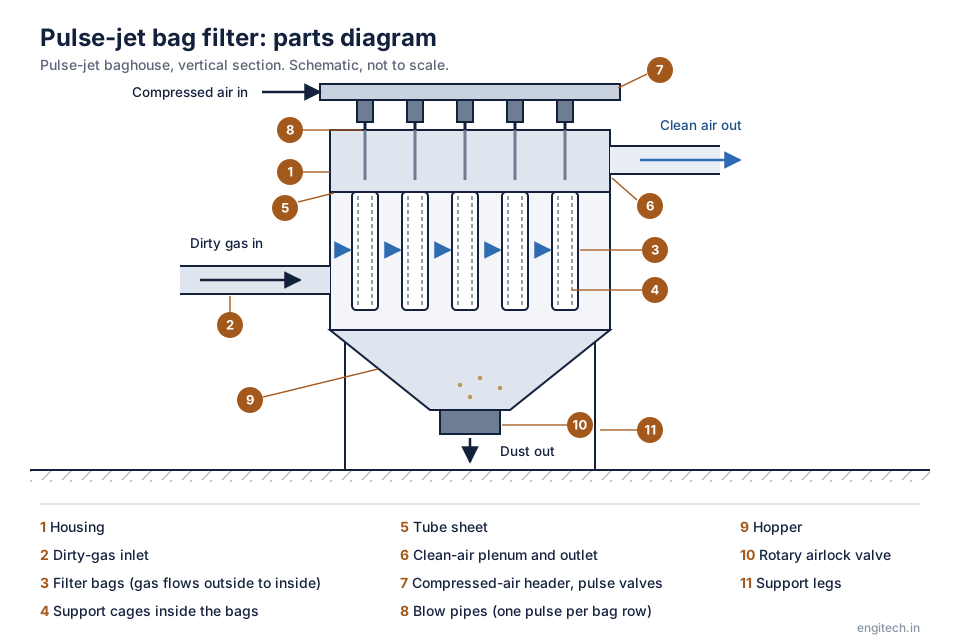
| No. | Part | What it does |
|---|---|---|
| 1 | Housing | The steel casing. The tube sheet divides it into a dirty-gas side below and a clean-air side above. |
| 2 | Dirty-gas inlet | Dust-laden gas enters the housing here, below the bags. |
| 3 | Filter bags | Fabric tubes that trap the dust on their outer surface while the gas passes through to the inside. |
| 4 | Support cages | Wire frames inside each bag that stop it collapsing under the gas flow. |
| 5 | Tube sheet | The plate that holds the top of every bag and seals the dirty side from the clean side. |
| 6 | Clean-air plenum and outlet | Collects the filtered gas from inside the bags and sends it to the outlet duct. |
| 7 | Compressed-air header and pulse valves | Store compressed air. A valve opens briefly to send a pulse down a row of bags. |
| 8 | Blow pipes | Direct each pulse into a bag. The pulse flexes the bag and knocks the dust cake off. |
| 9 | Hopper | Collects the dust that falls from the bags. |
| 10 | Rotary airlock valve | Lets the dust out of the hopper without letting much air in. |
| 11 | Support legs | Carry the filter and keep the hopper outlet clear of the floor. |
Download this diagram (SVG)Schematic for learning. Real machines vary by maker and duty.
I meet a lot of plant owners who bought a bag filter and still have dust on the floor. When we walk the line together, the filter is rarely the problem. The hood is too far from the source, a branch duct was added without checking the fan, or the filter bags are blinded because the pulse cleaning was never set up. This guide follows the order I use when I look at a plant.
1. Capture at the source
Dust is easiest to control where it is made. A hood or enclosure close to the source needs far less air than a large opening far away, because capture velocity falls rapidly with distance. Practical rules:
- Enclose the source as much as possible. A small opening with air drawn in is better than an open hood.
- Place the hood where the dust naturally travels, not against it.
- Do not fight cross-draughts from doors and fans.
- Typical capture velocities at the point of dust release range from about 0.5 m/s for quiet release to 2.5 m/s or more for high-speed processes. The ACGIH Industrial Ventilation Manual gives accepted figures by process.
2. Duct design
The duct must carry the dust without letting it settle, and without wearing through at the bends. For most industrial dusts, design transport velocities of about 18 to 23 m/s are common, with heavier or wet dust needing more. Too low and dust drops out and blocks the pipe. Too high and you waste fan power and wear the elbows.
- Use smooth, long-radius bends. A sharp elbow can have several times the resistance of a good one.
- Join branches at an angle of 30 degrees or less, entering from the side or top.
- Provide clean-out doors at low points and after bends.
- Use a balanced layout, or fit blast gates, so air goes where it is needed.
3. Choosing the collector
| Collector | Good for | Limits |
|---|---|---|
| Cyclone | Coarse, heavy dust; pre-cleaner ahead of a filter | Poor on fine dust below a few microns |
| Pulse-jet bag filter | Fine dust, high efficiency; see bag filters guide | Needs compressed air; wrong media blinds |
| Cartridge collector | Fine, dry dust in compact space | Not for sticky or heavy loads |
| Wet scrubber | Sticky, hot or explosive dusts and gases; see air scrubbers | Water treatment, corrosion |
| Electrostatic precipitator | Large volumes of hot gas, very fine particles; see ESP guide | High capital cost, dust resistivity |
Worked example: sizing a bag filter, duct and fan
A process needs 12,000 m³/h of air to control dust.
- Filter area. With an air-to-cloth ratio of 1.2 m/min: 12,000 / 60 = 200 m³/min, then 200 / 1.2 = about 167 m² of cloth. Fine, sticky or hot dust needs a lower ratio, and coarse free-flowing dust can take a higher one. Check the manufacturer’s data for your dust. The bag filter sizing calculator will do this for you.
- Main duct. 12,000 m³/h = 3.33 m³/s. At 20 m/s, area = 3.33 / 20 = 0.167 m², which is a diameter of about 0.46 m. A 450 mm duct is the nearest practical size.
- Fan power. If total system resistance is 2,000 Pa (hood, ducts, bends, filter and outlet) and the fan efficiency is 65%: power = 3.33 × 2,000 / 0.65 = 10.3 kW at the shaft. Add a margin for the motor and for filter loading. The fan power calculator covers this step.
Filters pick up resistance as dust cakes on the bags, so always size the fan for the dirty-filter pressure drop, not the clean one.
4. Filter media and cleaning
Choose the media for temperature, chemistry and moisture: polyester for general use up to about 130 °C, acrylic and PPS for different chemicals, glass or PTFE-membrane for severe conditions. Pulse cleaning should be triggered by differential pressure rather than a fixed timer. Cleaning too often wears bags, and too rarely lets the cake build. Keep compressed air dry and at the right pressure, or the bags will blind.
5. Fire and explosion
If the dust is combustible, which includes flour, sugar, many plastics, wood, coal and metal powders, explosion protection is part of the design, not an extra. Options include explosion venting, suppression, isolation valves in the ducts, spark detection, and locating the collector outside the building. The right choice depends on test results for the dust. NFPA 652 and NFPA 660 are widely used references, and local rules also apply. Never skip the dust test to save time.
6. Discharge and housekeeping
Use a rotary airlock or double-dump valve so the filter stays sealed while collected dust leaves. Check the hopper for bridging and the airlock for wear. The collected dust has to go somewhere: bags, bins, or back to the process. Include that in the plan.
See it in 3D
What I notice in plants
- Systems are extended year after year with no fan check. The last machine added gets weak suction.
- Operators prop blast gates open or cut holes in ducts to “get more air” from their own point, starving everything else.
- Differential pressure gauges are fitted and never read. A gauge on the board turns a problem you see in six months into one you see this week.
- The cheapest way to improve capture is often to move the hood closer or add a skirt, not to buy a bigger fan.
Commissioning checklist
- Measure airflow at each hood and compare with design.
- Check fan rotation, motor current and speed.
- Record filter differential pressure clean and during operation.
- Confirm pulse timing and compressed air pressure.
- Check the discharge valve and the dust containers.
- Take a smoke test at hoods to see capture working.
Go deeper: the full guide series
These guides cover each stage of a dust and air system, from the hood to the stack.
- Hood and Duct Design for Dust Capture
- Duct Velocity and Pressure Drop in Dust Systems
- Baghouse Troubleshooting: High Pressure Drop and Short Bag Life
- Choosing a Filter Bag Fabric
- Pulse-Jet Cleaning Settings: Pressure, Pulse Length and Interval
- Baghouse, ESP or Wet Scrubber: A Decision Table
- Cyclone Efficiency and Cut Size Explained
- Choosing an ID Fan for a Dust Collector
- Dust Explosion Protection: Venting, Isolation and Suppression
- Stack Emission Monitoring in India: What Gets Measured and How Often
- Wet Scrubber Design and Maintenance
- Welding Fume Extraction: Source Capture or Room Ventilation
- Industrial Ventilation: Air Changes or Heat Load
- Cleanroom Classes: ISO 14644 in Plain Terms
- Activated Carbon Filters for VOC and Odour
- Fan Noise and Silencers in Industrial Plants
- HEPA or ULPA: Which Filter Do You Need
- Duct Leakage: Testing and Cost of Leaks
- Baghouse Commissioning Checklist
Free tools for this topic: Bag filter sizing calculator · all free engineering tools
Frequently asked questions
What is air-to-cloth ratio?
It is the airflow divided by the filter cloth area, expressed in metres per minute. A lower ratio means a larger filter for the same airflow, and longer bag life on difficult dust.
Why does my filter pressure drop keep rising?
Common causes are blinded bags from moisture or oil, weak or mistimed pulse cleaning, wrong media, or an airflow higher than design.
Can I add another machine to an existing system?
Only after checking duct velocity, filter loading and fan capacity. Adding without a check usually reduces suction at every hood.
Do I need a cyclone before the bag filter?
If the dust is coarse or the load is heavy, yes. A pre-separator reduces load and wear on the bags.
How long do filter bags last?
Anywhere from under a year to several years depending on dust, temperature and cleaning. Trend the pressure drop and emissions to decide, not the calendar.
General engineering information. Dust systems can involve fire, explosion and health hazards. Have the design reviewed by a qualified specialist.
Sources and further reading
For standards, data and independent guidance on this topic, see NFPA (combustible dust and fire safety standards), US Chemical Safety Board (dust explosion investigation reports), IECEx (hazardous area equipment certification) and ACGIH (the Industrial Ventilation Manual and exposure limits). Always check the current edition and your site conditions before applying any figure.
Free tool for this topic
Fan & Blower Power Calculator with Fan LawsAir power, shaft power and motor size for centrifugal fans and blowers, plus fan-law results for a new speed. Air Handling and FiltrationHow Sound Attenuators in HVAC Systems Enhance Noise Control and Efficiency
 Air Handling and FiltrationTypes of Fans: The Ultimate Guide to Choosing the Right Fan for Every Space
 Air Handling and FiltrationUltimate Guide to Plenum Boxes: Everything You Need to Know for HVAC Efficiency
 Air Handling and FiltrationPneumatic Conveying Sizing: Dilute vs Dense Phase Velocity, Pressure Drop & CFM Math
 Air Handling and FiltrationHow to Choose the Right Air Compressor for Your Industry
 Air Handling and FiltrationIndustrial Pressure Sensors: Piezoresistive vs Ceramic vs Diaphragm Selection Guide