
On this page
- Centrifugal pump diagram: parts and their functions
- Common pump materials and where they fit
- Four questions to answer first
- Worked example: corrosion allowance
- Abrasive slurries
- Seals, shafts and the “small parts”
- Cost thinking
- What I see in plants
- Worked example: what the cheaper material really costs
- Material selection record (one line per pump)
- Worked example: high-chrome or rubber-lined for a slurry pump
- Data to give for a slurry pump
- Frequently asked questions
- Is 316 always better than 304?
- When is duplex worth the cost?
- Can I use plastic pumps for chemicals?
- How do I find the corrosion rate of a material?
- Sources and further reading
- More on Pumps, Valves and Piping
Short answer: choose pump materials from the liquid first (chemistry, concentration, temperature, chlorides, solids) and the duty second. Cast iron suits clean water, 316 stainless steel handles many mild chemicals, duplex stainless steel resists chlorides and erosion, and rubber or polymer linings suit abrasive slurries and some acids. Never choose on price alone, because a casing that corrodes in a year costs more than one made from the right alloy.
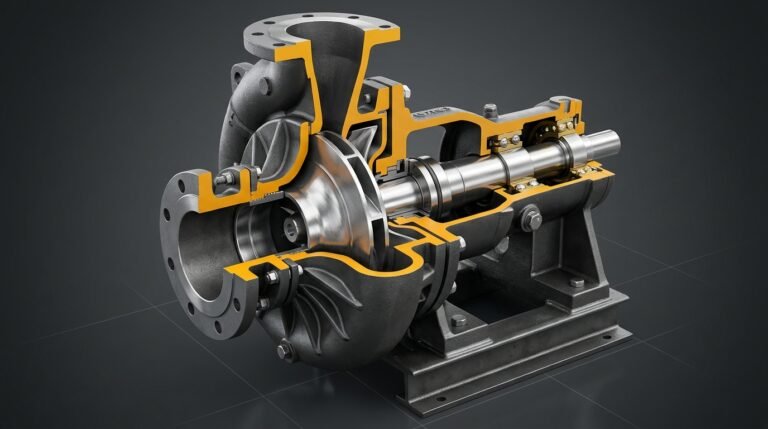
Centrifugal pump diagram: parts and their functions
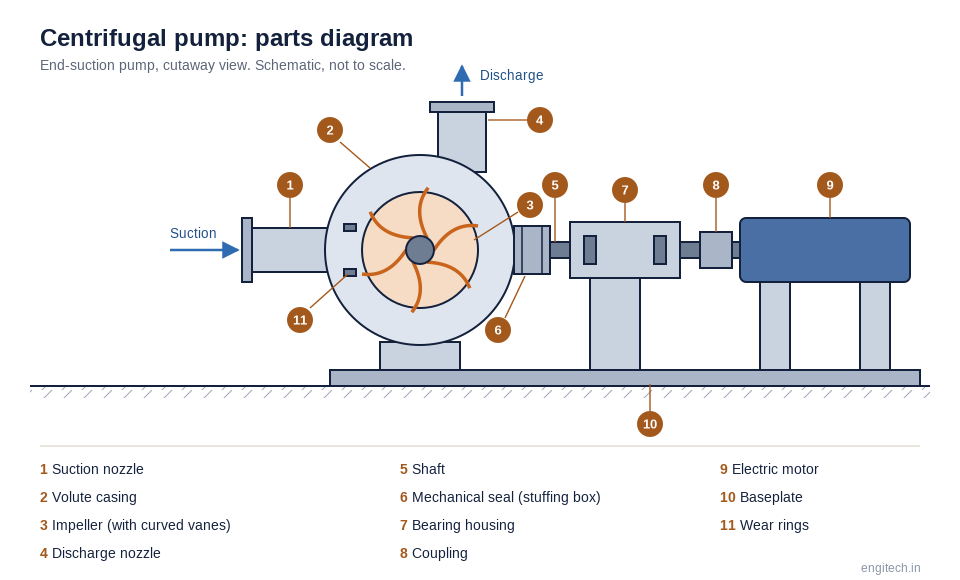
| No. | Part | What it does |
|---|---|---|
| 1 | Suction nozzle | Where the liquid enters, along the axis of the shaft. |
| 2 | Volute casing | The spiral-shaped casing. Its widening passage slows the liquid and turns its speed into pressure. |
| 3 | Impeller | The rotating wheel with curved vanes. It throws the liquid outward and gives it speed. |
| 4 | Discharge nozzle | Where the pressurised liquid leaves the casing. |
| 5 | Shaft | Transmits the torque from the motor to the impeller. |
| 6 | Mechanical seal | Seals the point where the shaft leaves the casing, so the liquid does not leak along the shaft. Some pumps use gland packing instead. |
| 7 | Bearing housing | Holds the bearings that support the shaft and take the loads from the impeller. |
| 8 | Coupling | Connects the pump shaft to the motor shaft and allows for small misalignment. |
| 9 | Electric motor | Drives the pump. |
| 10 | Baseplate | A rigid frame that keeps the pump and the motor aligned. |
| 11 | Wear rings | Replaceable rings that keep a small clearance between the impeller and the casing. They limit leakage from the discharge side back to the suction side and can be replaced as they wear. |
Download this diagram (SVG)Schematic for learning. Real machines vary by maker and duty.
When I meet plant teams who struggle with pump life, the first question I ask is what the liquid really is, not what it was on the purchase order. Process liquids change: a wash acid is added, chlorides creep up, the pH swings, or a new product brings abrasive solids. The pump material was right for the original liquid, and then the liquid changed. Part of the pump troubleshooting series, this guide sits beside the API 610 pump types article.
Common pump materials and where they fit
| Material | Good for | Avoid |
|---|---|---|
| Cast iron | Clean water, oils, neutral liquids at moderate temperature | Acids, seawater, erosive slurries |
| Ductile iron / carbon steel | Higher pressure, hot water, hydrocarbons | Acids, chlorides |
| Bronze | Seawater (with the correct alloy), fresh water | Ammonia, strong acids |
| Stainless steel 304 / 316 | Food, pharma, mild chemicals, many solvents | Hot chlorides (pitting, stress corrosion), strong reducing acids |
| Duplex stainless (2205 and similar) | Chlorides, brackish and sea water, erosive duties, higher strength | Very strong reducing acids, very hot service beyond limits |
| Alloy 20, Hastelloy, titanium | Sulphuric, phosphoric and other aggressive acids; special duties | High cost needs justification |
| Rubber-lined | Abrasive slurries, mining, some acids | Hot oils, solvents, high tip speeds |
| Polypropylene, PVDF, other thermoplastics | Corrosive liquids at lower temperature and pressure | High temperature, solids that erode, high pressure |
| High-chrome iron and hard alloys | Abrasive slurries, ash, sand | Corrosive acid slurries without special grade |
Four questions to answer first
- Chemistry: which chemicals, what concentration, what pH range including cleaning and upset conditions?
- Temperature: corrosion rates rise sharply with temperature.
- Chlorides: even small amounts can pit 316 stainless steel in hot or acidic conditions.
- Solids: size, hardness and concentration, which decide erosion and the need for liners or hardened parts.
Worked example: corrosion allowance
A casing has 3 mm of corrosion allowance. Suppose a corrosion table for the liquid gives these illustrative rates: cast iron 0.5 mm per year, 316 stainless steel 0.02 mm per year.
- Cast iron life = 3 / 0.5 = 6 years at best, but a weakened impeller will fail well before that
- 316 stainless steel = 3 / 0.02 = 150 years, in which case pitting and crevice corrosion, not uniform loss, decides life
Uniform corrosion rates are a starting point only. Use supplier data, corrosion handbooks and your own history. A rate of 0.1 mm per year is generally regarded as acceptable for many duties, and above 0.5 mm per year as unacceptable, but the rule depends on the part. Impellers are thin, and a small loss changes performance quickly.
Abrasive slurries
Erosion rises sharply with velocity, so impeller tip speed is limited for slurry pumps and lined pumps. Tip speed is u = π × D × N / 60.
- A 400 mm impeller at 1,450 rpm: u = 3.1416 × 0.4 × 1,450 / 60 = 30.4 m/s
Rubber-lined pumps are commonly restricted to roughly 25 to 30 m/s, depending on the supplier and rubber type, so this pump would be at or above the limit. A larger pump at lower speed, or a different lining, would be the answer. Ask the supplier for allowable tip speed and solids concentration for your slurry. For more on handling solids, see bulk solids handling.
Seals, shafts and the “small parts”
The casing may be fine while a cheaper part fails. Check the shaft sleeve, wear rings, gaskets, o-rings and fasteners. Elastomers must suit the liquid (EPDM, Viton, PTFE and others differ widely). Seal faces must also suit it. A good-looking pump with a wrong o-ring leaks the first day.
Cost thinking
A stainless steel pump may cost two to three times as much as cast iron, and a duplex pump more. Compare with life, downtime, spares and the cost of leaks of hazardous liquid. Where a stainless pump lasts ten years and a cast iron pump lasts one, the stainless pump wins quickly. Where the liquid is clean water, extra alloy is wasted.
What I see in plants
I see many plants specify 316 stainless steel for everything, “to be safe”, including clean cooling water. That is waste. I see others buy cast iron for a chemical because the first quote was cheaper, and then replace the pump every few months. The better plants keep a short list: liquid, concentration, temperature, material chosen, and why. When someone asks to change the liquid, the list gets checked first.
Operators also know where the liquid has been odd. A line that sometimes carries wash water or acid is a candidate for the more resistant material.
Free tools for this topic: Pump power calculator · Pump affinity laws calculator · Equipment fault finder · all free engineering tools
Worked example: what the cheaper material really costs
A transfer pump on a mildly corrosive liquid. All figures are assumed for illustration; use your own quotes, history and downtime cost.
| Item | Cast iron pump | 316 stainless steel pump |
|---|---|---|
| Purchase price | ₹1.2 lakh | ₹3.0 lakh |
| Expected life on this liquid | 2 years | 10 years |
| Installation per change | ₹0.2 lakh | ₹0.2 lakh |
| Downtime per change (8 h × ₹20,000 per hour) | ₹1.6 lakh | ₹1.6 lakh |
- Cast iron over 10 years: 5 pumps × (₹1.2 + ₹0.2 lakh) = ₹7.0 lakh, plus 4 unplanned changes × ₹1.6 lakh downtime = ₹6.4 lakh. Total ₹13.4 lakh.
- 316 stainless steel over 10 years: one pump, ₹3.0 + ₹0.2 lakh = ₹3.2 lakh, and no change-out within the period.
- Difference: ₹13.4 − ₹3.2 = ₹10.2 lakh in favour of the stainless pump, before counting leaks, clean-up or safety risk.
Reverse the case for clean cooling water, where the cast iron pump also lasts ten years: the stainless pump then simply costs ₹1.8 lakh more for no benefit. The same arithmetic, done honestly, gives both answers.
Material selection record (one line per pump)
- Liquid, concentration range and pH, including cleaning and upset conditions
- Maximum temperature and chloride level, with the source of the data
- Solids: size, hardness, concentration
- Casing, impeller, shaft sleeve, wear ring, elastomer and seal face materials chosen
- Reason for the choice and the supplier’s confirmation in writing
- Date reviewed, and who must be told if the liquid changes
Worked example: high-chrome or rubber-lined for a slurry pump
For abrasive slurries the choice between hard metal and rubber depends on particle size and shape, and the cost per operating hour often decides it. Take an illustrative fine-particle slurry at moderate temperature, where both materials are suitable. Part lives, prices and downtime cost are assumed for the example.
| Item, over 8,000 hours | High-chrome impeller | Rubber-lined impeller |
|---|---|---|
| Life per impeller (assumed) | 4,000 h | 6,000 h |
| Replacements | 8,000 / 4,000 = 2 | 8,000 / 6,000 = 1.33 |
| Part cost | 2 x Rs 1,20,000 = Rs 2,40,000 | 1.33 x Rs 90,000 = Rs 1,20,000 |
| Downtime (8 h at Rs 10,000 an hour per change) | 2 x Rs 80,000 = Rs 1,60,000 | 1.33 x Rs 80,000 = Rs 1,06,700 |
| Total | Rs 4,00,000 | about Rs 2,26,700 |
On fine particles, rubber wins by about Rs 1.7 lakh a year here. With coarse, sharp particles, oil or high temperature, rubber can cut or degrade quickly, and the picture reverses. Ask the supplier for wear life on your own particle size distribution, and record actual life so the next choice uses real numbers.
Data to give for a slurry pump
- Particle size distribution, shape and hardness.
- Solids concentration and slurry temperature.
- Presence of oils or solvents that attack rubber.
Frequently asked questions
Is 316 always better than 304?
It resists chlorides and some acids better thanks to molybdenum, but neither is suitable for hot chlorides. Check the liquid.
When is duplex worth the cost?
For chloride-bearing liquids, seawater, erosion-corrosion or when higher strength allows thinner sections.
Can I use plastic pumps for chemicals?
Yes, within temperature and pressure limits, and usually for low-flow or smaller duties.
How do I find the corrosion rate of a material?
Use supplier compatibility charts, corrosion handbooks, and test coupons in the actual liquid.
Keep reading: Chemical Dosing Pumps: Selection and the Failures to Expect and Pump Efficiency Test: Measuring Duty Point With Gauges and a Clamp-On Meter.
Further reading: Hydraulic Institute (pump standards and user guidance) and American Petroleum Institute (the API 610 and API 682 pump and seal standards).
General guidance. Material selection should be confirmed with the pump supplier against the real liquid analysis.
Sources and further reading
For standards, data and independent guidance on this topic, see US Department of Energy pump systems resources (pump efficiency guidance) and The Engineering ToolBox (engineering reference data and calculators). Always check the current edition and your site conditions before applying any figure.
Free tool for this topic
Pump Power & Motor Size CalculatorHydraulic power, shaft power and recommended motor rating for centrifugal pumps from flow, head, density and efficiency. Pumps, Valves and PipingIndustrial Pump Procurement: Technical RFQ Specifications & Inspection Plan
 Pumps, Valves and PipingCentrifugal Pump Total Dynamic Head Calculation: Formula, System Curves & Worked Example
 Pumps, Valves and PipingCryogenic Piping & Vacuum Jacketed Lines: Heat Leak & Thermal Relief Sizing
 Pumps, Valves and PipingSlurry Piping Flow: Durand Settling Velocity & Pipe Wear Sizing
 Pumps, Valves and PipingIndustrial Piping Procurement & MTO: Material Requisitions, Piping Classes & ITP
 Pumps, Valves and PipingPump Overheating at Low Flow: Minimum Flow Explained With Numbers