
On this page
- Centrifugal pump diagram: parts and their functions
- What temperature tells you
- What noise tells you
- What the lubricant tells you
- Worked example: how much grease?
- The usual root causes
- Take every failed bearing seriously
- What I see in plants
- Worked example: reading a temperature trend
- Simple bearing condition routine
- Worked example: how much life a little extra load takes away
- After any pump or motor change
- Frequently asked questions
- How often should pump bearings be greased?
- Can I mix different greases?
- What temperature is too hot for a bearing?
- Are sealed-for-life bearings maintenance-free?
- Sources and further reading
- More on Pumps, Valves and Piping
Short answer: a pump bearing tells you why it is failing through its temperature, its noise and the condition of its lubricant. Most bearing failures come from lubrication problems, contamination, misalignment or overload, not from age. Reading those three signals correctly lets you fix the cause rather than just changing the bearing.
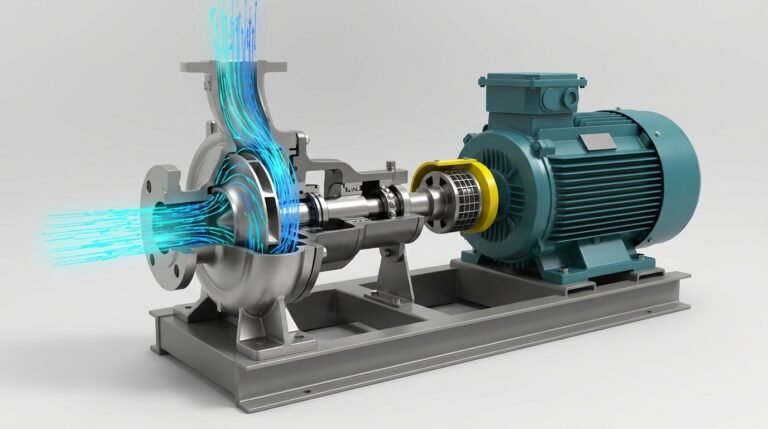
Centrifugal pump diagram: parts and their functions
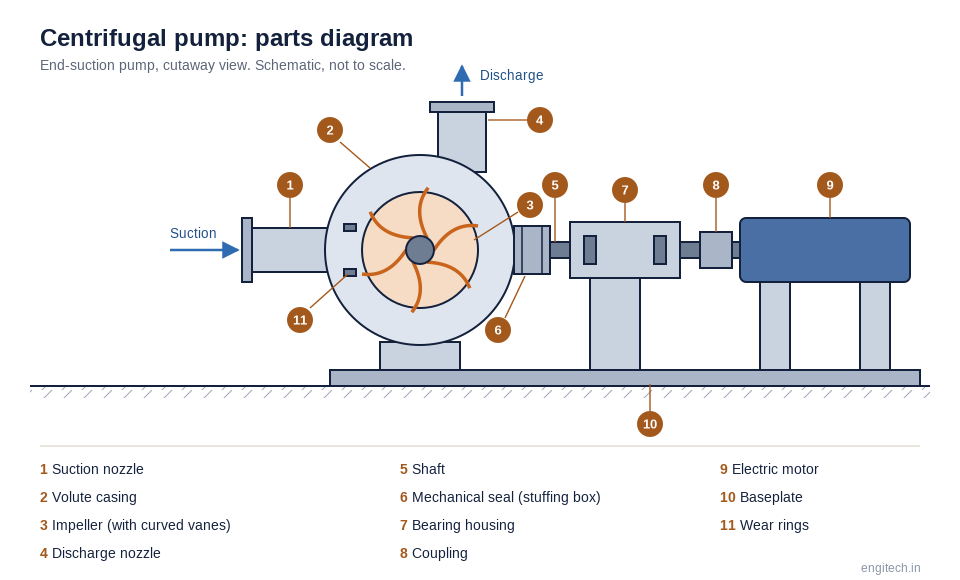
| No. | Part | What it does |
|---|---|---|
| 1 | Suction nozzle | Where the liquid enters, along the axis of the shaft. |
| 2 | Volute casing | The spiral-shaped casing. Its widening passage slows the liquid and turns its speed into pressure. |
| 3 | Impeller | The rotating wheel with curved vanes. It throws the liquid outward and gives it speed. |
| 4 | Discharge nozzle | Where the pressurised liquid leaves the casing. |
| 5 | Shaft | Transmits the torque from the motor to the impeller. |
| 6 | Mechanical seal | Seals the point where the shaft leaves the casing, so the liquid does not leak along the shaft. Some pumps use gland packing instead. |
| 7 | Bearing housing | Holds the bearings that support the shaft and take the loads from the impeller. |
| 8 | Coupling | Connects the pump shaft to the motor shaft and allows for small misalignment. |
| 9 | Electric motor | Drives the pump. |
| 10 | Baseplate | A rigid frame that keeps the pump and the motor aligned. |
| 11 | Wear rings | Replaceable rings that keep a small clearance between the impeller and the casing. They limit leakage from the discharge side back to the suction side and can be replaced as they wear. |
Download this diagram (SVG)Schematic for learning. Real machines vary by maker and duty.
Bearings are cheap compared with the pump, but I see them replaced again and again in plants without anyone asking why. Maintenance heads often tell me they “keep a stock of bearings because they fail.” Good teams treat each failed bearing as evidence and look at it before throwing it away. This guide is part of the pump troubleshooting series.
What temperature tells you
Measure the bearing housing with a contact thermometer or infrared gun, and compare with the baseline reading from when the pump was healthy. Bearing housing temperatures vary by design, but there are useful rules:
- A housing that runs more than about 40 °C above ambient, or well over 80 °C in absolute terms, deserves attention. API 610 sets limits for oil-lubricated pump bearings; follow the manufacturer’s maximum for your pump.
- A sudden rise matters more than a high steady value.
- A hot bearing on one end only suggests a local problem such as misalignment, a seized seal rubbing the shaft, or contamination.
What noise tells you
| Sound | Likely cause |
|---|---|
| Steady rumble | Wear on raceways, or insufficient clearance |
| Squeal | Lack of lubrication, or too little clearance |
| Clicking or knocking | Damaged rolling elements or cage, or loose fit |
| Grinding | Advanced damage, or contamination |
| Gravel in the pump casing | Not the bearing. Likely cavitation |
What the lubricant tells you
- Milky oil: water contamination. Check breather, seals, steam or wash-down exposure.
- Dark oil with metal flakes or glitter: wear in progress.
- Burnt smell or varnish: overheating.
- Grease pushed out in excess: over-greasing, which raises temperature quickly.
- Dry, hard, discoloured grease: under-lubrication, or the grease has been cooked.
Worked example: how much grease?
A common guide for the quantity of grease to add when relubricating a rolling bearing is G = 0.005 × D × B, with G in grams, D the outside diameter of the bearing in mm and B its width in mm. Check the bearing maker’s current method.
For a 6310 bearing (outside diameter 110 mm, width 27 mm): 0.005 × 110 × 27 = about 15 g. Pumping in 60 g because “more is better” fills the housing, raises friction and heat, and can push grease past the seals. A grease gun gives roughly 1 to 1.5 g per stroke on many models, so that is 10 to 15 strokes, not a full cartridge. Calibrate your own gun by weighing the output of ten strokes.
The usual root causes
| Cause | Typical clue | Fix |
|---|---|---|
| Wrong or too little lubricant | Dry, discoloured grease, blue-brown colour on race | Right grade, set interval and quantity |
| Over-lubrication | High temperature after greasing | Controlled quantity; purge excess |
| Contamination by dirt or water | Pitted raceways, rust, milky oil | Better seals, breathers, clean tools, sealed lubricant points |
| Misalignment | Wear pattern off-centre; hot coupling | Re-align; see shaft alignment |
| Excessive load or pipe strain | Heavy wear on one side | Check hydraulic balance, pipe supports, operating flow |
| Incorrect fitting | Early failure, brinelling marks | Use proper tools and heaters, never hammer on the outer race |
| Electrical damage from VFDs | Fluting (washboard pattern) on raceways | Shaft grounding ring, insulated bearing, proper cable and earthing |
| Vibration from other sources | Wear without lubrication problem | Find the source; see vibration diagnosis |
Take every failed bearing seriously
- Photograph it before cleaning.
- Note where the damage is on the race: centred, off-centre, one side.
- Note the condition of the lubricant, seals and housing.
- Record running hours, load and any event before failure.
- Decide the likely cause before fitting the new one.
Over time, a simple sheet of these notes shows patterns that no manual does.
What I see in plants
I often notice that the grease nipple is the most abused part of the pump. Several greases get used from one gun, nipples are dirty, and nobody knows the last time it was greased. A colour-coded gun per grease type, a wipe of the nipple, and a simple chart on the pump make a difference that no analyser can match.
Operators also talk about the “sound” of a pump long before any tool detects a problem. It’s worth asking them and writing it down.
Free tools for this topic: Pump power calculator · Pump affinity laws calculator · Equipment fault finder · all free engineering tools
Worked example: reading a temperature trend
A single bearing temperature means little; the rise above ambient, and how it changes, tells the story. Take an illustrative pump bearing housing that normally reads 65 °C with the room at 35 °C, a rise of 65 − 35 = 30 K. Three weeks later it reads 78 °C with the room still at 35 °C, a rise of 43 K, 13 K more than normal.
On a cooler day the same bearing might read 70 °C with the room at 25 °C. That looks better than 78 °C, but the rise is 70 − 25 = 45 K, so the problem is still there. Many plants treat a sustained increase of around 10 to 15 K above the normal rise as a signal to check lubrication, alignment and load (a rule of thumb; set your own limits from trends). Record ambient temperature with every reading so the rise can be calculated, and compare like with like, at the same point and the same load.
| Reading | Housing | Ambient | Rise above ambient | Change from normal |
|---|---|---|---|---|
| Normal | 65 °C | 35 °C | 30 K | |
| Three weeks later | 78 °C | 35 °C | 43 K | +13 K |
| Cooler day | 70 °C | 25 °C | 45 K | +15 K |
Simple bearing condition routine
- Take temperature at the same marked point each time
- Record ambient temperature and pump load with each reading
- Listen with a stethoscope or ultrasonic tool and note changes
- Check oil level, colour and water content where oil lubricated
- Trend the readings and act on change, not on a single value
Worked example: how much life a little extra load takes away
Bearing life falls with the cube of load for ball bearings, so small extra loads from misalignment or a bent shaft matter more than people expect. Take an illustrative ball bearing with a dynamic load rating of 30 kN, running at 2,950 rpm. The basic rating life is L10 = (C / P)3 million revolutions.
| Case | Equivalent load P | (C / P)3 | Life in hours |
|---|---|---|---|
| Aligned, design load | 2.0 kN | 153 = 3,375 million rev | 3,375,000,000 / (2,950 x 60) = about 19,070 |
| Misaligned, load up 20 per cent | 2.4 kN | 12.53 = 1,953 million rev | about 11,030 |
A 20 per cent rise in load cuts calculated life by about 42 per cent (1 – 11,030 / 19,070 = 0.42). In practice, misalignment also raises temperature and damages the lubricant, so the real loss is often larger. This is why a laser alignment after any motor or pump change is one of the cheapest ways to protect bearings. The rating and loads here are illustrative; use the bearing maker’s data and calculator for your actual bearing.
After any pump or motor change
- Check soft foot before alignment.
- Align with the machine at its normal operating temperature in mind.
- Record the final readings in the pump history.
Frequently asked questions
How often should pump bearings be greased?
It depends on size, speed, temperature and grease type. Follow the manufacturer’s interval, and shorten it for hot, wet or dirty conditions.
Can I mix different greases?
Avoid it unless the maker confirms compatibility. Incompatible thickeners can soften or harden and cause failure.
What temperature is too hot for a bearing?
Follow the pump manufacturer. As a general alert, anything near or above 80 to 90 °C at the housing, or a quick rise, needs investigation.
Are sealed-for-life bearings maintenance-free?
They don’t need regreasing, but they can still fail from misalignment, contamination or overload. They need monitoring.
You may also want: Pump Shaft Alignment: Laser or Dial Gauge, Tolerances and Soft Foot and Gland Packing or Mechanical Seal: Cost, Leakage and When to Switch.
Further reading: Hydraulic Institute (pump standards and user guidance).
General guidance. Follow the bearing and pump manufacturers’ maintenance instructions.
Sources and further reading
For standards, data and independent guidance on this topic, see US Department of Energy pump systems resources (pump efficiency guidance), American Petroleum Institute (pump and seal standards) and The Engineering ToolBox (engineering reference data and calculators). Always check the current edition and your site conditions before applying any figure.
Free tool for this topic
Bearing L10 Life & Bore Number CalculatorCalculate ISO 281 rolling bearing L10 fatigue life in revolutions and operating hours, and decode metric bearing bore codes (00–40) to shaft diameter. Pumps, Valves and PipingVertical Turbine vs Submersible Pumps: Deep Well Sizing & Sump Hydraulics
 Pumps, Valves and PipingAODD Pump Sizing: Air Consumption (SCFM), Slurry & Pulsation Guide
 Pumps, Valves and PipingPipe Thermal Expansion Loops & Flexibility Sizing: Guided Cantilever Math
 Pumps, Valves and PipingPump Specific Speed (Ns) & Suction Specific Speed (Nss): Impeller Geometry
 Pumps, Valves and PipingWhy a Centrifugal Pump Loses Prime and How to Stop It
 Pumps, Valves and PipingCentrifugal Pump Troubleshooting: A Symptom-by-Symptom Field Guide