
On this page
- Centrifugal pump diagram: parts and their functions
- How each one works
- A simple yearly cost comparison
- Where each belongs
- Converting a pump from packing to a mechanical seal
- What I see in plants
- Worked example: the running costs that are easy to miss
- Before you convert: a short checklist
- Cost per year, and what happens when a seal fails early
- Frequently asked questions
- How many drops per minute is normal for packing?
- Can I fit a mechanical seal in a stuffing box designed for packing?
- Why is my new seal leaking?
- Do mechanical seals need flush water?
- Sources and further reading
- More on Plant Maintenance and Reliability
Short answer: gland packing is cheap to buy and easy to fix but leaks by design and wears the shaft sleeve. A mechanical seal costs more upfront but leaks very little, saves product and water, and usually lasts longer when it is correctly selected and flushed. Switch to a mechanical seal when leakage is hazardous, expensive or messy, or when you repack so often that labour and sleeve wear cost more than a seal would.
Centrifugal pump diagram: parts and their functions
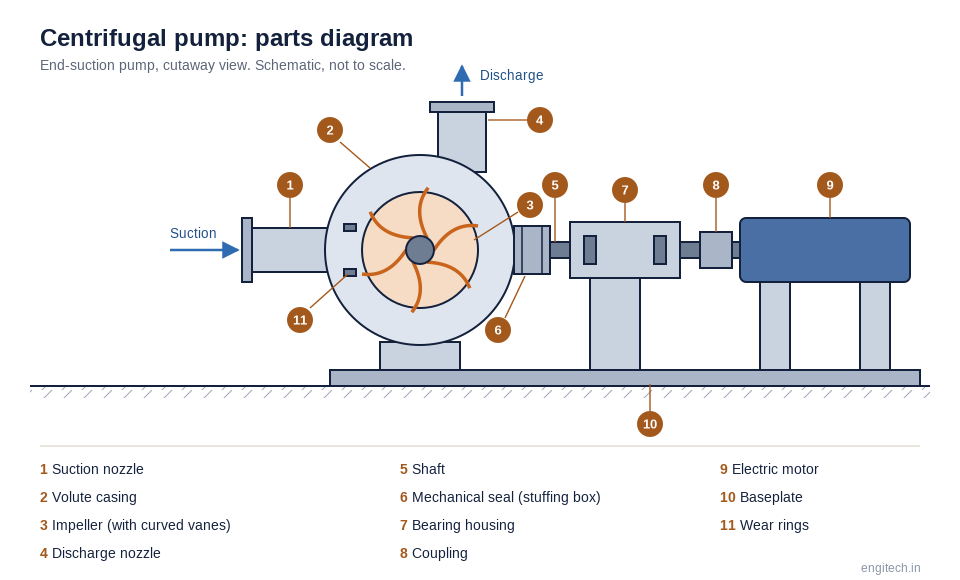
| No. | Part | What it does |
|---|---|---|
| 1 | Suction nozzle | Where the liquid enters, along the axis of the shaft. |
| 2 | Volute casing | The spiral-shaped casing. Its widening passage slows the liquid and turns its speed into pressure. |
| 3 | Impeller | The rotating wheel with curved vanes. It throws the liquid outward and gives it speed. |
| 4 | Discharge nozzle | Where the pressurised liquid leaves the casing. |
| 5 | Shaft | Transmits the torque from the motor to the impeller. |
| 6 | Mechanical seal | Seals the point where the shaft leaves the casing, so the liquid does not leak along the shaft. Some pumps use gland packing instead. |
| 7 | Bearing housing | Holds the bearings that support the shaft and take the loads from the impeller. |
| 8 | Coupling | Connects the pump shaft to the motor shaft and allows for small misalignment. |
| 9 | Electric motor | Drives the pump. |
| 10 | Baseplate | A rigid frame that keeps the pump and the motor aligned. |
| 11 | Wear rings | Replaceable rings that keep a small clearance between the impeller and the casing. They limit leakage from the discharge side back to the suction side and can be replaced as they wear. |
Download this diagram (SVG)Schematic for learning. Real machines vary by maker and duty.
When I talk to maintenance teams about their pumps, the packing versus seal question comes up very often. Older plants lean towards packing because everyone knows how to do it. Newer ones prefer seals because of housekeeping and safety. The honest answer is that each fits particular duties, and the choice should come from cost and risk, not habit.
How each one works
- Gland packing is soft braided rings compressed around the shaft by a gland follower. It is meant to leak a little, as that leakage cools and lubricates the packing. Too tight and it burns the shaft; too loose and it floods.
- Mechanical seal is a pair of flat faces, one rotating and one fixed, held together by springs and fluid pressure. A very thin film of liquid keeps them apart, and leakage is a vapour-like trace.
| Factor | Gland packing | Mechanical seal |
|---|---|---|
| Purchase cost | Low | Higher, rises with pressure, size and special materials |
| Leakage | Visible, adjustable drip | Almost none while healthy |
| Shaft or sleeve wear | Yes, sleeve wears and needs replacement | None, the seal does not rub the shaft |
| Friction power loss | Notable | Lower |
| Dirty or slurry duty | Handles it better, with flush water | Needs clean flush or special seal design |
| Dry running | Tolerates short periods, then burns | Damaged within seconds to minutes |
| Skill to fit | Common skill | Needs care, cleanliness and measurement |
| Hazardous or valuable liquid | Poor choice | Preferred, often double seal |
A simple yearly cost comparison
The figures below are illustrative assumptions. Replace them with your own data.
- Packing: repacked four times a year at ₹1,500 per set = ₹6,000; sleeve replaced once a year at ₹12,000; plus labour for repacking, about two hours each time. Cooling flush water and housekeeping on top.
- Mechanical seal: ₹25,000 for a cartridge seal that lasts two years = ₹12,500 a year; labour for one change in two years.
Hardware costs are close: about ₹18,000 against ₹12,500 a year. The balance tips further toward the seal when you count the lost product, the water flush, the slip hazard on the floor, and the cost of a shaft sleeve that has worn out. Packing wins on first cost for low-pressure, dirty services, or where leakage is harmless and the pump is idle most of the time.
Where each belongs
- Packing is usually fine for: water, low-pressure transfer, slurries with a clean external flush, old pumps where a stuffing box cannot take a seal.
- Seals are better for: chemicals, hot liquids, solvents, hazardous or odorous products, food and pharma lines, and high pressure.
For hydrocarbons and hazardous fluids, standards such as API 682 define seal types and flush plans. Even outside refineries, it is a useful reference for selecting a seal and a flush plan.
Converting a pump from packing to a mechanical seal
- Check the stuffing box dimensions: bore, depth and shaft diameter.
- Measure shaft runout and end play. Excessive shaft whip or deflection kills seals.
- Choose a cartridge seal if possible, as it is preassembled and set at the factory.
- Select face materials for the liquid (carbon against silicon carbide is common for many services).
- Decide on the flush plan: product recirculation, external clean water, or a quench.
- Check that the gland plate fits and the pump seal chamber is vented.
A conversion kit can fit many older pumps. Check with the pump or seal supplier before you buy. See mechanical seal failure analysis for what to expect once it is running.
What I see in plants
I come across seals that are blamed for failing when the pump is out of alignment, running at low flow, or starved on the suction side. Changing the seal changes nothing. A seal is a precision part, and it needs a stable shaft. Before a conversion, I suggest that plant teams check alignment, bearing condition and the flow range of the pump. See low-flow overheating.
The other pattern: packing is tightened every shift until the drip stops. A packing that does not drip is a packing that is burning the shaft. Teach the operators how a correct drip looks.
Free tools for this topic: OEE calculator · Motor running cost calculator · all free engineering tools
Worked example: the running costs that are easy to miss
The hardware comparison above leaves out two running costs: friction power in the packing and the water used for flushing or lost as leakage. Both can be estimated with simple assumptions; replace them with your own measurements.
- Friction: assume the packing absorbs 0.5 kW on this pump and a seal 0.1 kW. The difference, 0.4 kW, over 8,000 running hours is 0.4 × 8,000 = 3,200 kWh. At an assumed ₹8 per kWh, that is ₹25,600 a year.
- Flush water: assume 20 litres per hour of clean flush to the packing, all going to drain. Over 8,000 hours: 20 × 8,000 = 160,000 litres = 160 m³. At an assumed ₹40 per m³ for treated water, ₹6,400 a year.
| Yearly cost item (illustrative) | Gland packing | Mechanical seal |
|---|---|---|
| Hardware (from the comparison above) | ₹18,000 | ₹12,500 |
| Extra friction power | ₹25,600 | – |
| Flush water to drain | ₹6,400 | – |
| Total | ₹50,000 | ₹12,500 |
Check the total: 18,000 + 25,600 + 6,400 = ₹50,000. On these assumptions the friction power is the largest single item, more than the packing and sleeves together. That surprises people, because nobody sees it. You can estimate it on your own pump by comparing motor current before and after a seal conversion at the same flow and head. Seals that need their own flush or barrier system bring back some running cost, so include it in the comparison.
Before you convert: a short checklist
- Measure stuffing box bore, depth and shaft or sleeve diameter
- Check shaft run-out and end play against the seal maker’s limits
- Confirm liquid, temperature, pressure at the seal and solids content
- Choose a flush arrangement with the seal supplier
- Plan for dry-run protection if the pump can lose suction
- Keep one spare cartridge in stock for critical pumps
Cost per year, and what happens when a seal fails early
Hardware costs are easier to compare per year than per purchase. Assume, for one pump, that the packing is repacked every three months at ₹3,000 a time in packing and labour, and the shaft sleeve it wears is replaced once a year at ₹8,000. Assume a mechanical seal costs ₹40,000 plus ₹5,000 to fit, and lasts two years. All figures are illustrative.
| Item | Packing | Seal, 24-month life | Seal, 8-month life |
|---|---|---|---|
| Parts and labour a year | 4 × ₹3,000 = ₹12,000 | ₹45,000 / 2 = ₹22,500 | ₹45,000 × 12 / 8 = ₹67,500 |
| Sleeve replacement a year | ₹8,000 | none | none |
| Total hardware a year | ₹20,000 | ₹22,500 | ₹67,500 |
With a normal seal life the hardware cost is close to that of packing, and the friction and water savings from the example above decide the case. If the seal fails every eight months, the economics turn around. Short seal life usually has a cause: dry running at start-up, poor flush, solids in the seal chamber, misalignment or a bent shaft. Find it before blaming the seal brand, and keep a record of each failure with the pump tag and the condition of the faces.
Frequently asked questions
How many drops per minute is normal for packing?
A common guide is a slow, steady drip, roughly several drops a minute for a typical pump, but follow the packing maker’s instructions for your pump and pressure.
Can I fit a mechanical seal in a stuffing box designed for packing?
Often yes with a suitable seal or conversion kit, but check bore dimensions and shaft condition first.
Why is my new seal leaking?
Common causes include dry running, wrong face material, damaged faces during fitting, shaft misalignment, or incorrect setting length.
Do mechanical seals need flush water?
Many do, in some form. The flush plan depends on the liquid, temperature and pressure.
Next on this topic: Pump Bearing Failures: What Temperature, Noise and Oil Are Telling You and Pump Overheating at Low Flow: Minimum Flow Explained With Numbers. This guide is part of our pumps pillar guide.
Further reading: Hydraulic Institute (pump standards and user guidance) and American Petroleum Institute (the API 610 and API 682 pump and seal standards).
General guidance. Seal choice must be confirmed against the liquid, pressure and temperature with a seal supplier.
Sources and further reading
For standards, data and independent guidance on this topic, see US Department of Energy pump systems resources (pump efficiency guidance) and The Engineering ToolBox (engineering reference data and calculators). Always check the current edition and your site conditions before applying any figure.
Free tool for this topic
Compressed Air Leak Cost CalculatorAir lost, compressor power wasted and annual energy cost of compressed-air leaks by hole size and pressure. Plant Maintenance and ReliabilityAPI 682 Mechanical Seal Flush Plans: Plan 11, 23, 52 & 53 Sizing Guide
 Plant Maintenance and ReliabilityBelt Conveyor Maintenance and Troubleshooting: Working Principle, Specs & Selection
 Plant Maintenance and ReliabilityVibratory Feeders: Working Principle, Specs & Selection
 Plant Maintenance and ReliabilityMechanical Seal Failure Analysis: Leakage Troubleshooting & Face Damage Modes
 Plant Maintenance and ReliabilityLow-Cost PCB Assembly: SMT Stencil Math, Component Placement & Yield Guide
 Plant Maintenance and ReliabilityRibbon Blender Maintenance: Shaft Seals, Ribbon Clearance and Wear