

On this page
- Centrifugal pump diagram: parts and their functions
- Order of work
- Offset and angle
- Typical tolerance values
- Thermal growth: the cold offset
- Worked example
- Laser or dial gauge?
- Common mistakes
- What I see in plants
- Worked example: shims from a rim-and-face reading
- Before taking readings
- Worked example: correcting a rim reading for bracket sag
- Dial gauge habits that avoid errors
- Frequently asked questions
- Why do flexible couplings need alignment?
- How often should pumps be re-aligned?
- Is laser alignment worth it?
- What is soft foot?
- Sources and further reading
- More on Pumps, Valves and Piping
Short answer: align the pump and motor shafts so that their centrelines match within the tolerance for the speed, after fixing soft foot and pipe strain, and set the motor slightly low to allow for heat growth. Laser alignment is faster and more accurate than dial gauges, but a careful reverse-dial alignment still works. A coupling can be flexible; it does not remove the need for alignment.
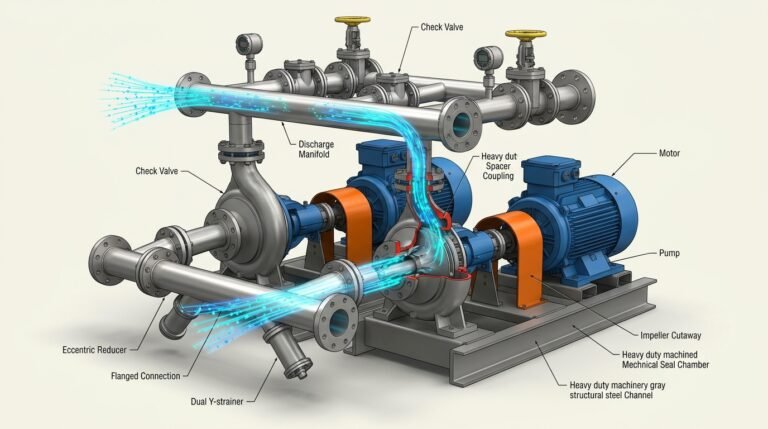
Centrifugal pump diagram: parts and their functions
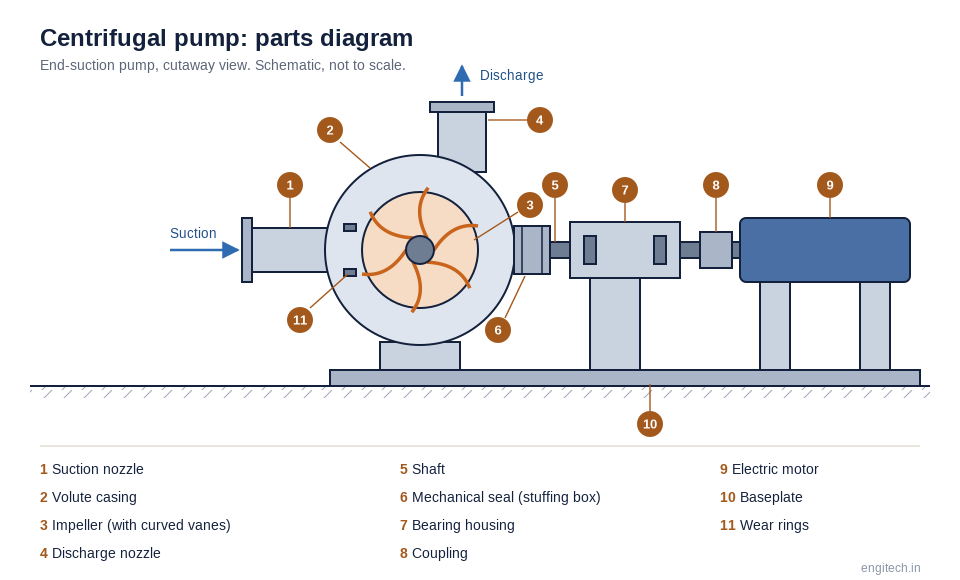
| No. | Part | What it does |
|---|---|---|
| 1 | Suction nozzle | Where the liquid enters, along the axis of the shaft. |
| 2 | Volute casing | The spiral-shaped casing. Its widening passage slows the liquid and turns its speed into pressure. |
| 3 | Impeller | The rotating wheel with curved vanes. It throws the liquid outward and gives it speed. |
| 4 | Discharge nozzle | Where the pressurised liquid leaves the casing. |
| 5 | Shaft | Transmits the torque from the motor to the impeller. |
| 6 | Mechanical seal | Seals the point where the shaft leaves the casing, so the liquid does not leak along the shaft. Some pumps use gland packing instead. |
| 7 | Bearing housing | Holds the bearings that support the shaft and take the loads from the impeller. |
| 8 | Coupling | Connects the pump shaft to the motor shaft and allows for small misalignment. |
| 9 | Electric motor | Drives the pump. |
| 10 | Baseplate | A rigid frame that keeps the pump and the motor aligned. |
| 11 | Wear rings | Replaceable rings that keep a small clearance between the impeller and the casing. They limit leakage from the discharge side back to the suction side and can be replaced as they wear. |
Download this diagram (SVG)Schematic for learning. Real machines vary by maker and duty.
Misalignment is the cause behind a long list of pump failures: bearings, seals, couplings, even shafts. It is also one of the most skipped jobs, because the pump “runs fine” without it. When I talk to maintenance supervisors, the ones with the lowest bearing and seal consumption almost always have a written alignment procedure, and a technician who takes pride in it.
Order of work
- Check the foundation and baseplate. Grout cracks and loose bolts matter more than the alignment tool.
- Check for soft foot. Put a dial indicator on each foot, loosen the bolt and watch the movement. More than about 0.05 mm is commonly treated as soft foot and should be shimmed out.
- Check pipe strain. Align with the pipe flanges bolted up, or check that loosening them doesn’t move the shaft more than about 0.05 mm.
- Check the coupling. Hub condition, runout, and shaft end gap.
- Align vertically then horizontally. Shim for height, then move sideways.
- Recheck after tightening the foot bolts, and do a final check with the pump at operating temperature if possible.
Offset and angle
Two shafts can be out in two ways at once: parallel offset, where the centrelines are side by side but parallel, and angular misalignment, where they meet at an angle. Alignment tools measure both in the vertical and horizontal planes.
Typical tolerance values
The tolerance depends on speed. The figures below are commonly used shop-floor values for rigid-spacer or short-flex couplings. Always use the coupling manufacturer’s limits when they are stricter.
| Speed (rpm) | Parallel offset | Angular (per 100 mm of coupling diameter) |
|---|---|---|
| Up to 1,000 | about 0.10 mm | about 0.10 mm |
| 1,500 | about 0.07 mm | about 0.07 mm |
| 3,000 | about 0.04 mm | about 0.04 mm |
| Above 3,600 | about 0.025 mm | about 0.025 mm |
Treat these as rough guides. Faster shafts need tighter limits because the forces grow with speed.
Thermal growth: the cold offset
When a pump warms up, its shaft centreline rises. The motor warms up too. If the two grow by different amounts, a cold alignment that was perfect becomes misaligned in operation.
Worked example
The motor shaft centreline is 300 mm above its feet. Its casing runs 30 °C above the temperature at which you aligned it. Steel expands at about 12 × 10⁻⁶ per kelvin.
- Growth = 12 × 10⁻⁶ × 300 mm × 30 K = 0.108 mm
The motor centreline rises about 0.11 mm. If the pump handles hot liquid and grows more, the target changes. Where growth is known, the manufacturer gives target cold offsets for the motor to be set low or high. For hot pumps in refinery duty, API 610 and the pump supplier’s alignment instructions specify them. For ordinary water pumps near ambient, the effect is small and can usually be ignored.
Laser or dial gauge?
| Method | Strengths | Limits |
|---|---|---|
| Straight edge and feeler gauge | Quick rough check | Not accurate enough for running alignment |
| Reverse dial indicators | Accurate and cheap; works on long spacers | Needs skill; bar sag must be accounted for |
| Laser system | Fast, shows live moves, stores reports | Cost; needs training and clean optics |
Common mistakes
- Aligning before fixing soft foot, then chasing the numbers for an hour.
- Using a stack of many thin shims. Use as few as possible, and clean ones.
- Moving the pump rather than the motor, and breaking the pipe connection.
- Relying on a flexible coupling to hide misalignment. The coupling lasts, the bearings do not.
- No record. Save the final readings with the date.
What I see in plants
I notice that alignment is often done by eye with a straight edge across the coupling. It looks fine and is out by half a millimetre. When I suggest a basic dial-indicator set, teams discover how much they have been living with. A few plants I speak with now run a laser tool across the whole site in a planned alignment round after every motor change.
Alignment connects with bearing life directly. See our notes on bearing failure causes, and consult the right coupling for the duty.
Free tools for this topic: Pump power calculator · Pump affinity laws calculator · Equipment fault finder · all free engineering tools
Worked example: shims from a rim-and-face reading
Corrections at the motor feet come from the offset at the coupling and the slope, projected to each foot. Take an illustrative reading where, after accounting for gauge sag, the motor shaft is 0.20 mm low at the coupling and slopes down away from the pump by 0.10 mm over a 100 mm face diameter, a slope of 0.10 ÷ 100 = 0.001 mm per mm (1 mm per metre). The front motor feet are 150 mm from the coupling and the rear feet 550 mm.
The correction at each foot is the offset plus slope times distance: front feet 0.20 + 0.001 × 150 = 0.35 mm of shim; rear feet 0.20 + 0.001 × 550 = 0.75 mm. Add the shims, re-measure, and only then correct side-to-side. The sign conventions depend on how your gauges are set up, so draw a simple sketch before calculating; a laser system does this arithmetic for you, but the logic is the same.
| Position | Distance from coupling | Calculation | Shim to add |
|---|---|---|---|
| Front feet | 150 mm | 0.20 + 0.001 × 150 | 0.35 mm |
| Rear feet | 550 mm | 0.20 + 0.001 × 550 | 0.75 mm |
Before taking readings
- Check and correct soft foot first
- Clean the baseplate and feet; use stainless precut shims
- Limit shim packs to a few pieces
- Measure gauge sag on a pipe or bar
- Rotate both shafts together where possible
Worked example: correcting a rim reading for bracket sag
With dial gauges, the bracket that holds the indicator bends under its own weight, so the reading at the bottom is wrong by a fixed amount. Take an illustrative rim reading on a pump coupling: zeroed at 12 o’clock, the indicator reads +0.30 mm at 6 o’clock. A sag check on a straight bar with the same bracket gives -0.08 mm at 6 o’clock.
| Step | Working | Result |
|---|---|---|
| Measured rim reading at bottom | +0.30 mm | |
| Sag correction | +0.30 – (-0.08) | +0.38 mm |
| Vertical offset (half the rim reading) | 0.38 / 2 | 0.19 mm |
| Offset if sag were ignored | 0.30 / 2 | 0.15 mm |
Ignoring sag here understates the offset by 0.04 mm. Against an assumed tolerance of 0.05 mm for a pump at around 3,000 rpm, that is almost the whole allowance. A laser system avoids sag because there is no bracket, which is one reason it gives more repeatable results. If you use dial gauges, measure sag once for each bracket and span and write the value on the bracket.
Dial gauge habits that avoid errors
- Rotate both shafts together so the gauge reads the same point.
- Check that readings return to zero after a full turn.
- Confirm the plus and minus sign convention before calculating shims.
Frequently asked questions
Why do flexible couplings need alignment?
The flexible element accommodates small movements, but any misalignment still loads bearings and seals, and shortens coupling life.
How often should pumps be re-aligned?
After any motor or pump removal, after pipe changes, and when vibration or bearing temperature rises. Many plants also check critical pumps annually.
Is laser alignment worth it?
If you have many pumps, yes. It is faster and gives a record. For a few small pumps, careful dial gauge work is enough.
What is soft foot?
A condition where one machine foot does not sit flat on the base, so tightening its bolt distorts the frame and changes the alignment.
Related guides: Suction Piping Mistakes That Damage Pumps and Pump Bearing Failures: What Temperature, Noise and Oil Are Telling You. This guide is part of our pumps pillar guide.
Further reading: Hydraulic Institute (pump standards and user guidance).
General guidance. Follow the coupling and pump manufacturer’s alignment limits and lock out the drive before working.
Sources and further reading
For standards, data and independent guidance on this topic, see US Department of Energy pump systems resources (pump efficiency guidance), American Petroleum Institute (pump and seal standards) and The Engineering ToolBox (engineering reference data and calculators). Always check the current edition and your site conditions before applying any figure.
Free tool for this topic
Pump Power & Motor Size CalculatorHydraulic power, shaft power and recommended motor rating for centrifugal pumps from flow, head, density and efficiency. Pumps, Valves and PipingCentrifugal Pump Troubleshooting: A Symptom-by-Symptom Field Guide
 Pumps, Valves and PipingIndustrial Process Pumps Selection Guide: Sizing, System Head Curves & Standards
 Pumps, Valves and PipingPump Bearing Failures: What Temperature, Noise and Oil Are Telling You
 Pumps, Valves and PipingDarcy-Weisbach Pressure Drop Calculation: Pipe Flow & Friction Factor Math
 Pumps, Valves and PipingJacketed & Heat Traced Piping Sizing: Steam vs Electric Heat Maintenance
 Pumps, Valves and PipingSteam Piping and Condensate Traps: Design Considerations