
On this page
- Spray dryer diagram: parts and their functions
- Understanding Lab Scale Spray Dryers and laboratory spray drying
- Key Components and Working Principle
- Technical Specifications and Features of laboratory spray drying
- Applications in Scientific Research and Development
- Popular Industries & Use Cases
- Factors Influencing Performance and Efficiency
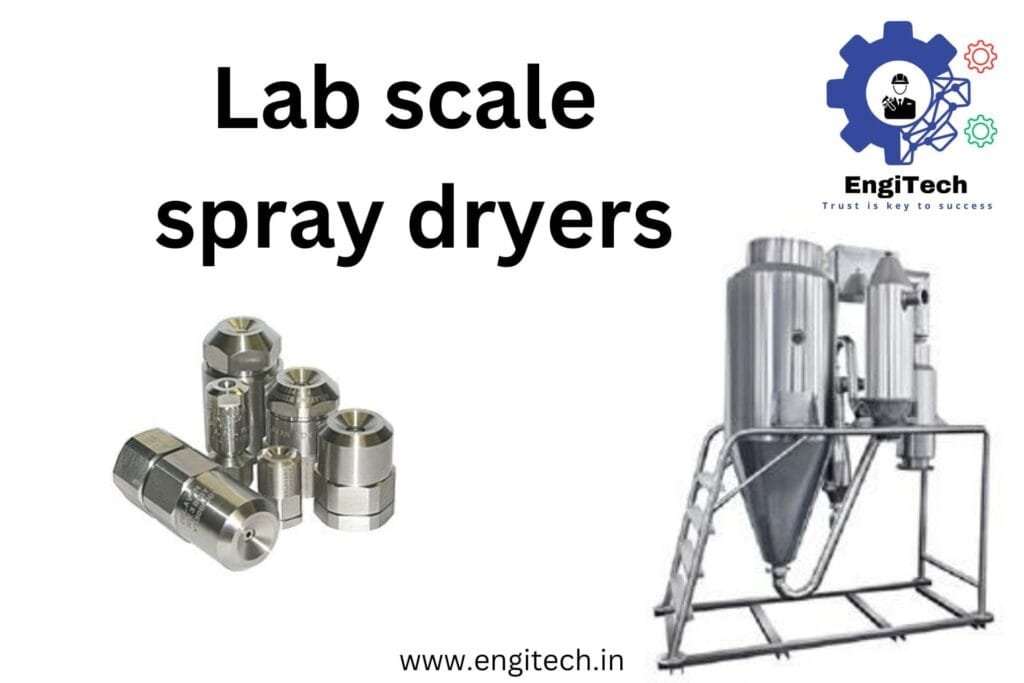
- Types of Spray Nozzles Used in Lab Scale Spray Dryers
- Considerations When Selecting a Lab Scale Spray Dryer
- Business Solutions & Procurement Options
- Resources & Downloads for Lab Scale Spray Dryers
- Technical Support and Assistance
- Frequently Asked Questions (FAQ), Lab Scale Spray Dryers
- Conclusion
- 🛠️ Recommended Engineering Guides & Tools
- Sources and further reading
- More on Industrial Dryers
Laboratory spray drying, Lab-scale spray dryers, including the lab spray dryer, are integral to scientific research and development, facilitate the transformation of liquid substances into dried powders through the process of spray drying. This guide explores the functionality, applications, considerations, and benefits of lab-scale spray dryers, essential for various industries and laboratories.
Spray dryer diagram: parts and their functions
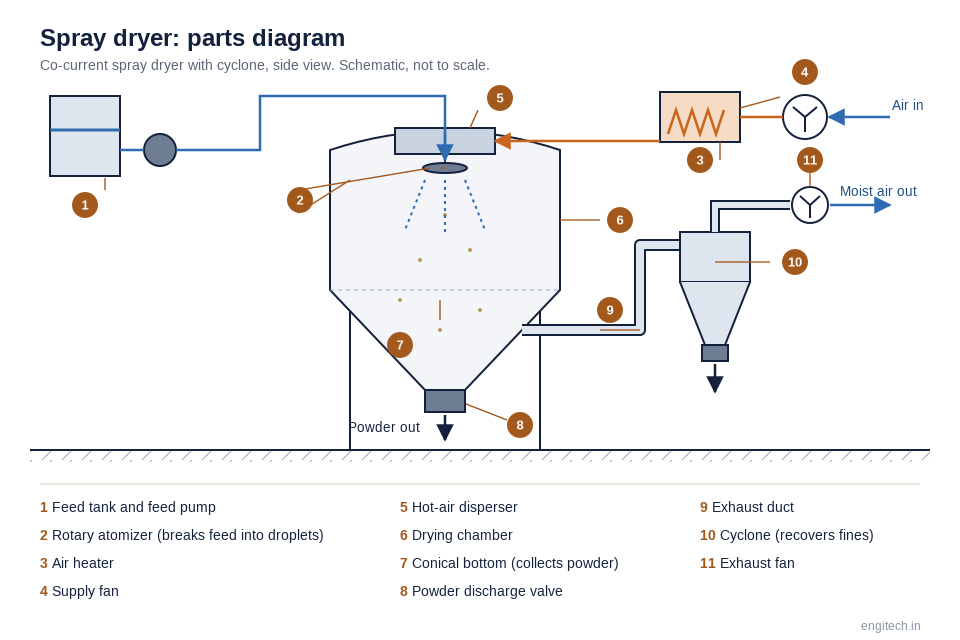
| No. | Part | What it does |
|---|---|---|
| 1 | Feed tank and feed pump | Hold the liquid feed and send it to the atomizer at a controlled rate. |
| 2 | Rotary atomizer | A fast-spinning wheel that breaks the liquid feed into fine droplets. Spray dryers can also use nozzle atomizers. |
| 3 | Air heater | Heats the drying air before it enters the chamber. It can be steam, electric or fuel fired. |
| 4 | Supply fan | Draws in air and pushes it through the heater into the chamber. |
| 5 | Hot-air disperser | Spreads the hot air evenly around the atomizer so the droplets dry in a controlled way. |
| 6 | Drying chamber | Large vessel in which the droplets dry as they fall. Water evaporates quickly because each droplet has a very large surface area. |
| 7 | Conical bottom | Guides the dried powder to the outlet at the bottom. |
| 8 | Powder discharge valve | A rotary valve that removes the powder without letting much air in. |
| 9 | Exhaust duct | Carries the cooled, moist air and fine powder out of the chamber to the cyclone. |
| 10 | Cyclone | Spins the exhaust gas so the fine powder drops out and is collected, which reduces product loss. |
| 11 | Exhaust fan | Pulls air through the system and keeps the chamber at a slight negative pressure. A bag filter or scrubber is often added after the cyclone. |
Download this diagram (SVG)Schematic for learning. Real machines vary by maker and duty.
Understanding Lab Scale Spray Dryers and laboratory spray drying
Lab scale spray dryers, also referred to as laboratory spray dryers made with stainless steel, are compact versions of industrial spray dryers tailored for smaller volumes and precise experimentation in controlled environments. They mimic the spray drying process on a reduced scale, allowing researchers and scientists to study and optimize drying parameters effectively.
Key Components and Working Principle
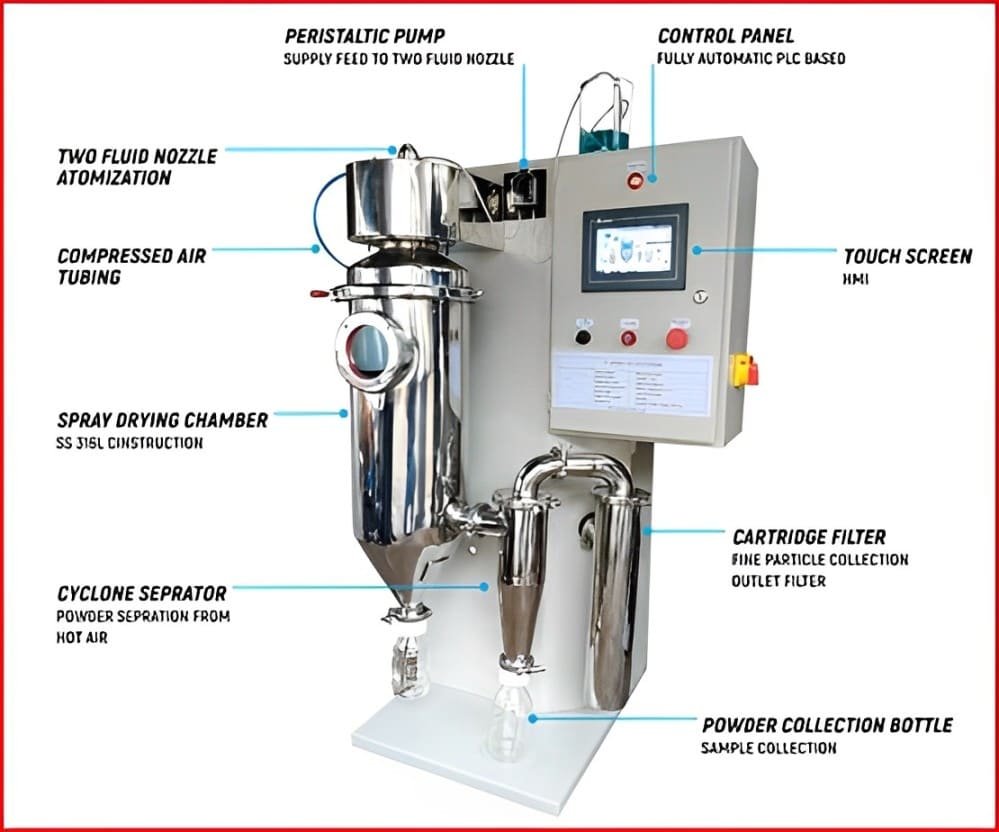
1. Design and Components: Lab-scale spray dryers typically consist of a drying chamber, atomization system (utilising nozzle or centrifugal atomization), heating mechanism (electric or gas-fired), and a powder collection system. These components work together to convert liquid feed into fine dried particles, making them ideal for producing powdered food products.
2. Atomization Techniques: Atomization is essential in spray drying to achieve uniform particle size and shape from the core substance. Nozzle atomization involves forcing the liquid feed through a small orifice to create droplets, while centrifugal atomization uses high-speed rotation to disperse the liquid into fine droplets.
3. Drying Process: The liquid feed is atomised into the drying chamber, where it meets a stream of heated air or gas. The heat evaporates the solvent, leaving behind dried particles. The average drying time is influenced by temperature control and airflow regulation, which are critical for controlling particle characteristics such as size, density, and moisture content.
Technical Specifications and Features of laboratory spray drying
Lab scale spray dryers function as essential tools in the realm of material processing, effectively transforming liquid feeds into liquid solution dry powders through optimized spray drying technology. By generating fine droplets within a controlled environment, these devices ensure the uniformity of the final product, catering to various industrial applications. Key attributes such as temperature control and feed rate significantly affect the average drying time, enhancing repeatability and reliability in producing solid particles from sensitive materials like organic solvents and aqueous solutions.
Applications in Scientific Research and Development
Lab scale spray dryers find diverse applications across various industries and research fields, including chemical applications:
- Pharmaceutical Research: Used for encapsulating drugs, developing inhalable powders, and formulating drug delivery systems.
- Food and Beverage: Applied in producing instant coffee, encapsulating flavors and nutrients, and creating powdered beverages.
- Chemical Engineering: Utilized in catalyst production, polymer research, and developing specialty chemicals.
Popular Industries & Use Cases
In the realm of innovative processing, lab scale spray dryers stand out for their ability to produce uniform powders from liquid solutions. By employing advanced spray drying technology, these devices create fine droplets that undergo rapid evaporation, resulting in solid uniform powders of precise particle size. The controlled environment within the drying chamber, equipped with features like automatic nozzle cleaning and precise temperature control, allows researchers to achieve repeatable results, making them essential tools in academic research and various chemical applications.
Factors Influencing Performance and Efficiency
1. Feed Properties: The viscosity, solids concentration, and chemical composition of the liquid feed impact the spray drying process. Optimal feed formulation ensures efficient drying and high-quality powder production.
2. Particle Characteristics: Control over atomization parameters (like droplet size and distribution) and drying conditions (temperature, humidity) influences particle size, morphology, and flow properties, essential for product performance and application.
Types of Spray Nozzles Used in Lab Scale Spray Dryers
Lab scale spray dryers are essential tools for transforming liquid solutions into fine powders through the spray drying process. By atomizing the liquid feed into fine droplets within a controlled environment, these dryers enable uniform particle size distribution and optimal drying conditions.
It’s essential to ensure precise temperature control and feed flow, as well as effective control system management, to achieve repeatable results, especially for sensitive materials. The use of stainless steel and borosilicate glass construction contributes to the safe operation and durability of these machines in various lab applications.
Considerations When Selecting a Lab Scale Spray Dryer
1. Capacity and Scalability: Evaluate the volume of liquid feed you need to process and consider the scalability of the spray dryer for future production needs. Note that an air compressor will also be required for optimal performance.
2. Operational Costs and Budget: Assess initial purchase costs, operational expenses (energy consumption, maintenance), and long-term cost-effectiveness.
3. Safety and Regulatory Compliance: Ensure the spray dryer meets safety standards and regulatory requirements applicable to your industry and research environment.
See it in 3D
Business Solutions & Procurement Options
Comprehending the mechanics of lab scale spray dryers unveils their central role in modern research and development. These devices use sophisticated spray drying technology to transform liquid feed into fine droplets, achieving uniform powders with precise particle size control.
The drying chamber effectively manages temperature control and feed flow, ensuring optimal conditions for sensitive materials and organic solvents. Features like automatic nozzle cleaning and cyclone separators enhance efficiency, making these spray dryer machines essential for applications ranging from academic research to chemical formulations.
Resources & Downloads for Lab Scale Spray Dryers
A lab scale spray dryer leverages sophisticated spray drying technology to transform aqueous solutions and liquid feed into uniform powders. Within its drying chamber, feed solutions are atomized by a spray nozzle, creating fine droplets that efficiently evaporate due to controlled inlet temperature and airflow.
The design typically incorporates stainless steel components for durability and safety, facilitating sensitive materials’ processing. Achieving repeatable results is essential for academic research and chemical applications, making these machines invaluable in laboratories focused on high-precision outcomes.
Technical Support and Assistance
A comprehensive understanding of lab scale spray dryers reveals their essential role in various scientific applications. By employing advanced spray drying technology, these devices transform liquid feed into dry powder fine powders, offering consistent particle sizes and uniform powders. The drying chamber uses precise temperature control and an efficient control system, ensuring repeatable results.
For sensitive materials such as aqueous solutions and organic solvents, lab spray dryers provide safe operation, enabling researchers to manipulate conditions effectively for optimum drying performance.
Frequently Asked Questions (FAQ), Lab Scale Spray Dryers
Q1. What is a lab scale spray dryer?
A lab scale spray dryer is a specialized machine that converts liquid solutions into fine powders. It does this by spraying the liquid into fine droplets within a controlled drying chamber.
Q2. How does a lab scale spray dryer work?
The spray dryer atomizes liquid into fine droplets, which are then exposed to hot air in the drying chamber. As the moisture evaporates, the droplets turn into dry, uniform powder particles.
Q3. Why is temperature control important in spray drying?
Temperature control ensures sensitive materials are processed without degradation. It also helps achieve consistent particle size and prevents overheating or incomplete drying.
Q4. What role does the feed rate play in spray drying?
The adjustable feed rate regulates how much liquid is introduced into the dryer. This helps researchers maintain uniform particle size, repeatable results, and optimized drying efficiency.
Q5. Can lab scale spray dryers handle sensitive materials?
Yes, these dryers are designed with precise controls to process sensitive materials without compromising their stability or functionality.
Q6. Where are lab scale spray dryers commonly used?
They are widely used in academic research, product development, and small-scale industrial trials across industries such as pharmaceuticals, food, chemicals, and biotechnology.
Q7. What are the key benefits of using lab scale spray dryers?
- Ability to produce uniform, high-quality powders
- Reliable and repeatable processing
- Advanced control systems for precision
- Suitable for both research and industrial applications
Conclusion
Lab scale spray dryers are indispensable tools in scientific research and development, enabling precise control over particle characteristics and supporting innovation across diverse sectors, particularly in handling sensitive materials. Understanding their operational principles, applications, and selection criteria empowers researchers to leverage spray drying technology effectively for breakthroughs in product development and scientific discovery.
For further insights into spray dryers and industrial drying technologies, visit EngiTech. Explore our comprehensive resources and stay updated on the latest innovations and applications in industrial drying.
🛠️ Recommended Engineering Guides & Tools
Related reading: Spray Drying Pharmaceuticals: Process & Benefits; Spray Drying of Milk: Process & Benefits Explained.
Free tools for this topic: Dryer selection tool · Dryer evaporation, heat and fuel calculator · all free engineering tools
Sources and further reading
For standards, data and independent guidance on this topic, see US Department of Energy process heating resources (industrial heating and drying efficiency) and The Engineering ToolBox (engineering reference data and calculators). Always check the current edition and your site conditions before applying any figure.
Free tool for this topic
Industrial Dryer Evaporation, Heat & Fuel CalculatorWater evaporation, product output, heat load and fuel or steam consumption for spray, rotary, flash, fluid-bed and paddle dryers. Industrial DryersATFD Design Guide: Rotor Speed, Blade Clearances & Zero Liquid Discharge (ZLD)
 Industrial DryersSludge Drying Economics: Cost per Tonne of Water Evaporated
 Industrial DryersFluid Bed Dryers: Efficient Drying Solutions Explained
 Environmental EngineeringPaddle Dryer for Sludge: Working Principle, Specs & Selection
 Industrial DryersApplications of Agitated Thin Film Dryers: Unveiling Their Industrial Significance | EngiTech
 Industrial DryersRotary Dryer vs Roller Drum Dryer: What Is the Difference?