
On this page
What matters when selecting a cryogenic pump? Define the actual liquid and its composition, temperature and pressure; the required flow and head over all relevant operating cases; the suction arrangement; heat ingress; materials; and the site’s containment and safety requirements. A pump’s suitability cannot be established from its type alone.
Start with the liquid and duty
LNG is a mixture, while liquid oxygen and nitrogen have different properties and hazards. Give the supplier the composition and credible ranges of temperature, pressure and flow. Identify the lowest and highest liquid levels, expected start and shutdown conditions, and variations in the receiving system. Obtain the liquid properties appropriate to each case rather than assuming every vessel contains saturated liquid.
Suction conditions and heat ingress
Available suction head depends on vessel conditions, liquid properties, elevation and losses in the suction system. Heat ingress and pressure changes can affect the liquid state. Ask the manufacturer and a qualified engineer to evaluate the actual suction arrangement and required margin over the operating range. The general NPSHa overview explains reference points; it does not replace a cryogenic assessment.
Compare equipment using documented data
Different configurations place the pump and driver differently and may have different access, sealing, insulation and maintenance arrangements. Request a pump curve and operating limits for the specified fluid and installation. Verify containment, materials, pressure–temperature ratings, electrical classification and start-up requirements against the equipment documentation and project specifications. Do not assume immersion alone makes equipment explosion-proof or leak-free.
Questions for a supplier
- What operating cases and fluid properties were used to select the pump?
- What are the allowable flow, suction and thermal conditions for the proposed unit?
- What heat ingress, insulation and cooldown assumptions must the system designer confirm?
- What materials, cleaning, sealing and electrical requirements apply to this particular fluid and site?
- What inspection, testing, maintenance access and documentation are included in the offer?
Safety context
Cryogenic liquids can create severe cold-contact hazards. Released nitrogen can displace oxygen in the work area; see OSHA’s fact sheet on liquid nitrogen and carbon dioxide releases. LNG and oxygen present different hazards and require their own fluid-specific assessment, applicable requirements and supplier instructions.
For broader procurement questions see the industrial pump selection guide. Both pages remain subject to technical review.
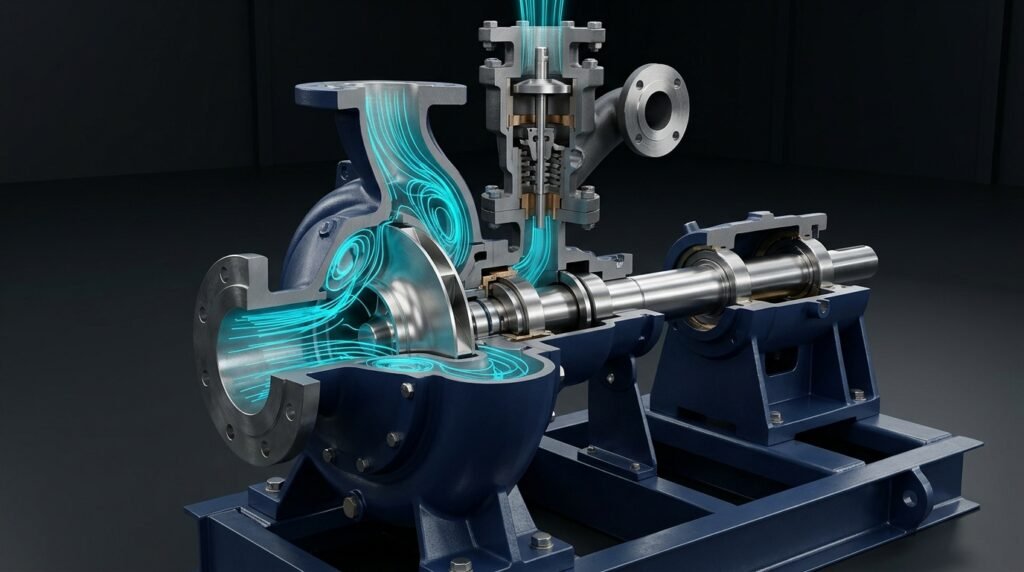
See it in 3D
Related reading: Cryogenic Piping & Vacuum Jacketed Lines: Heat Leak & Thermal Relief Sizing.
Free tools for this topic: Pump power calculator · Pump affinity laws calculator · Equipment fault finder · all free engineering tools
Sources and further reading
For standards, data and independent guidance on this topic, see US Department of Energy process heating resources (industrial heating and drying efficiency), The Engineering ToolBox (engineering reference data and calculators) and Bureau of Energy Efficiency (energy audit and efficiency programmes in India). Always check the current edition and your site conditions before applying any figure.
Free tool for this topic
Heat Exchanger LMTD & Area CalculatorHeat duty, log mean temperature difference and required heat-transfer area for counter-flow and parallel-flow exchangers. Pumps, Valves and PipingAPI 610 Centrifugal Pumps: OH, BB & VS Classifications for Petrochemical Service
 Pumps, Valves and PipingPump Specific Speed (Ns) & Suction Specific Speed (Nss): Impeller Geometry
 Pumps, Valves and PipingCentrifugal Pump Total Dynamic Head Calculation: Formula, System Curves & Worked Example
 Pumps, Valves and PipingReciprocating Metering Pumps: API 675 Sizing & Pulsation Dampener Math
 Pumps, Valves and PipingIndustrial Piping Procurement & MTO: Material Requisitions, Piping Classes & ITP
 Pumps, Valves and PipingSteam Piping and Condensate Traps: Design Considerations