
On this page
- Spray dryer diagram: parts and their functions
- Understanding Spray Dryers
- Historical Evolution
- Working Principles of Spray Dryers
- Types of Spray Dryers
- Applications Across Industries
- Specialized Applications
- Advantages of Spray Dryers
- Disadvantages of Spray Dryers
- Spray dryer working principle, step by step
- Types of spray dryer
- Spray drying applications
- Worked example: evaporation and air flow
- Conclusion
- 🛠️ Recommended Engineering Guides & Tools
- Sources and further reading
- More on Industrial Dryers
Spray dryers are essential industrial tools used to convert liquid or slurry feedstock into dried particles through atomization and rapid evaporation. This comprehensive guide explores the detailed workings, various types, wide-ranging applications, advantages, disadvantages, and critical considerations for selecting the optimal spray dryer.
Spray dryer diagram: parts and their functions
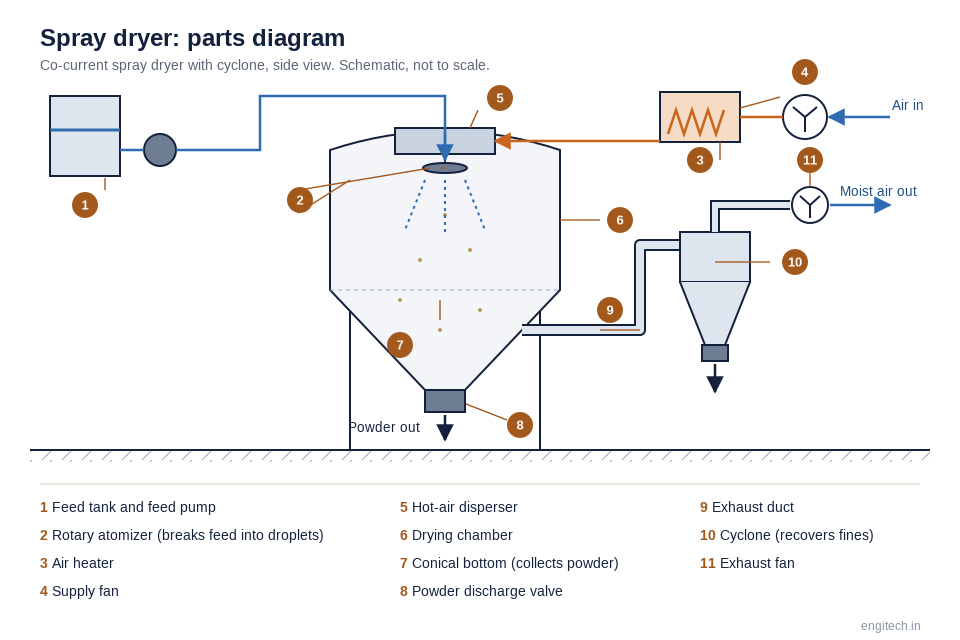
| No. | Part | What it does |
|---|---|---|
| 1 | Feed tank and feed pump | Hold the liquid feed and send it to the atomizer at a controlled rate. |
| 2 | Rotary atomizer | A fast-spinning wheel that breaks the liquid feed into fine droplets. Spray dryers can also use nozzle atomizers. |
| 3 | Air heater | Heats the drying air before it enters the chamber. It can be steam, electric or fuel fired. |
| 4 | Supply fan | Draws in air and pushes it through the heater into the chamber. |
| 5 | Hot-air disperser | Spreads the hot air evenly around the atomizer so the droplets dry in a controlled way. |
| 6 | Drying chamber | Large vessel in which the droplets dry as they fall. Water evaporates quickly because each droplet has a very large surface area. |
| 7 | Conical bottom | Guides the dried powder to the outlet at the bottom. |
| 8 | Powder discharge valve | A rotary valve that removes the powder without letting much air in. |
| 9 | Exhaust duct | Carries the cooled, moist air and fine powder out of the chamber to the cyclone. |
| 10 | Cyclone | Spins the exhaust gas so the fine powder drops out and is collected, which reduces product loss. |
| 11 | Exhaust fan | Pulls air through the system and keeps the chamber at a slight negative pressure. A bag filter or scrubber is often added after the cyclone. |
Download this diagram (SVG)Schematic for learning. Real machines vary by maker and duty.
Understanding Spray Dryers
Spray dryer play a key role in industries by transforming liquids into powders. This process involves atomizing the feedstock into fine droplets and exposing them to a hot drying medium. By doing so, spray dryers ensure precise control over particle size, shape, and moisture content, which is essential for product formulation and downstream processing.
Historical Evolution
The origins of spray drying date back to the 19th century, with significant advancements in the early 20th century, particularly in milk powder production and during World War II for compacting food and materials. The commercialization and widespread adoption of spray dryers expanded in the latter half of the 20th century, driven by technological advancements and diverse industrial applications.
Working Principles of Spray Dryers
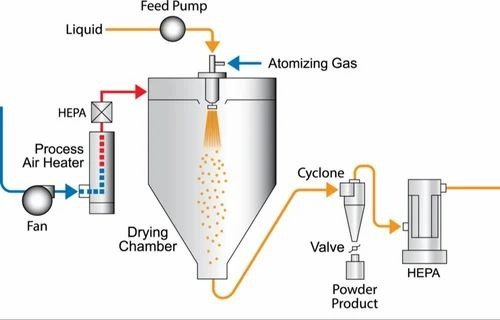
Spray Dryers nozzles

- Atomization: Liquid feedstock is atomized into small droplets using rotary or pressure nozzles, or centrifugal atomizers.
- Interaction with Drying Medium: These atomized droplets then come into direct contact with a hot air, nitrogen, or other gases within a drying chamber.
- Evaporation Process: Heat from the drying medium rapidly evaporates the moisture from the droplets, leaving behind dry particles.
- Particle Separation: The dried particles are separated from the drying gas stream using cyclone separators or bag filters, while the exhaust gases are either vented or recycled back into the system.
Types of Spray Dryers
Spray dryers are categorized based on their design and the type of drying medium employed:
- Open Cycle Spray Dryer: Use atmospheric air.
- Closed Cycle Spray Dryer: Recirculate heated gases.
Applications Across Industries
Spray dryers are indispensable across various sectors due to their versatility and efficiency:
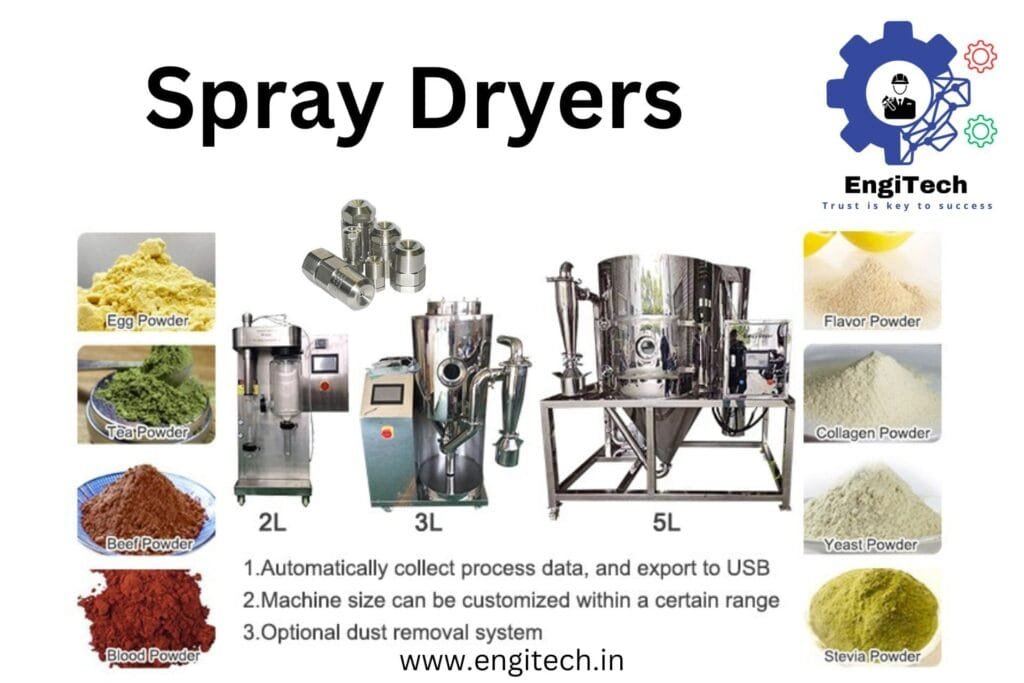
- Food Industry: Used in the production of instant coffee, milk powder, flavors, and encapsulated products.
- Pharmaceuticals: Essential for drying antibiotics, vitamins, and pharmaceutical formulations to enhance stability and shelf life.
- Chemicals: Employed in manufacturing detergents, pigments, ceramics, and catalysts.
- Environmental Applications: Vital for treating industrial waste and drying wastewater sludge to reduce volume and facilitate disposal.

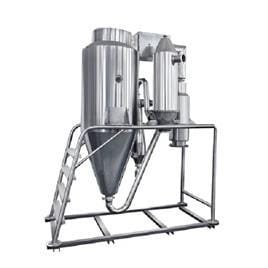
Spray Dryer
Specialized Applications
- Milk Production: Converts liquid milk into powdered form, extending shelf life and facilitating transportation.
- Pharmaceutical Formulations: Produces powdered medicines and formulations that require controlled drying conditions.
- Pilot Scale and Lab Scale Spray Dryers: Utilized in research and development settings for testing new formulations and processes on a smaller scale.
Advantages of Spray Dryers
Spray dryers offer numerous advantages that contribute to their widespread adoption in industrial processes:
See it in 3D
- Efficiency: Rapid drying rates and continuous operation improve productivity and throughput.
- Quality Control: Uniform particle size distribution ensures consistency and quality of the final product.
- Flexibility: Capable of handling a wide range of feedstock viscosities and compositions.
Disadvantages of Spray Dryers
Despite their advantages, spray dryer have certain limitations and challenges:
- Cost Considerations: Initial capital investment and operational costs can be high due to the energy-intensive nature of the drying process.
- Safety Concerns: Handling potentially explosive or flammable materials requires robust safety measures and equipment design.
Spray dryer working principle, step by step
- Feed preparation: a pumpable liquid (solution, emulsion or slurry) is concentrated as far as practical.
- Atomisation: a rotary wheel or nozzle breaks the feed into fine droplets, giving a huge surface area.
- Drying: droplets meet hot air in the chamber; water evaporates in seconds, and evaporative cooling keeps the particles much cooler than the inlet air.
- Separation: powder falls to the chamber cone or is carried to cyclones and bag filters.
- Finishing: fluid beds can after-dry, cool or agglomerate the powder.
Types of spray dryer
| Classified by | Types | Notes |
|---|---|---|
| Atomiser | Rotary disc/wheel, pressure nozzle, two-fluid nozzle | Rotary handles abrasive feeds; pressure nozzles give coarser, free-flowing powders; two-fluid nozzles suit small and lab dryers |
| Air-droplet flow | Co-current, counter-current, mixed flow | Co-current suits heat-sensitive products (food, pharma) |
| Air circuit | Open cycle, closed cycle (nitrogen), semi-closed | Closed cycle for solvents and explosive or oxygen-sensitive products |
| Stages | Single, two-stage, three-stage | Integrated fluid beds lower the outlet temperature and improve energy use |
Spray drying applications
Milk and whey powders, instant coffee and tea, flavours and colours (encapsulation), detergents, ceramics (tile body granules), pigments and dyes, fertilisers, pharmaceutical APIs and amorphous dispersions, and catalysts. See milk powder spray drying, pharmaceutical spray drying and laboratory spray dryers.
Worked example: evaporation and air flow
Assumed values: 1,000 kg/h of feed at 40% solids dried to 4% moisture. Solids are 400 kg/h, powder 416.7 kg/h, and the dryer evaporates about 583.3 kg/h of water. With inlet air at 200 °C and outlet at 90 °C, and about 2,500 kJ needed per kg evaporated, the drying air is roughly 13,100 kg/h before heat losses. Feed concentration matters: every extra percent of solids in the feed reduces this load.
Conclusion
Operational Summary: spray dryers are integral to modern industrial processes, offering efficient and effective solutions for drying various materials across diverse industries. Understanding their operational principles, types, applications, advantages, disadvantages, and selection criteria is essential for optimizing drying processes and achieving desired product outcomes.
For further insights into spray dryer and industrial drying technologies, visit EngiTech. Explore our comprehensive resources and stay updated on the latest innovations and applications in industrial drying.
🛠️ Recommended Engineering Guides & Tools
Related reading: Infrared Dryers: Working Principles, Design, and Applications.
Free tools for this topic: Dryer selection tool · Dryer evaporation, heat and fuel calculator · all free engineering tools
Sources and further reading
For standards, data and independent guidance on this topic, see US Department of Energy process heating resources (industrial heating and drying efficiency), The Engineering ToolBox (engineering reference data and calculators) and Bureau of Energy Efficiency (energy audit and efficiency programmes in India). Always check the current edition and your site conditions before applying any figure.
Free tool for this topic
Industrial Dryer Evaporation, Heat & Fuel CalculatorWater evaporation, product output, heat load and fuel or steam consumption for spray, rotary, flash, fluid-bed and paddle dryers. Industrial DryersFlash Dryer: Guide to Efficient Industrial Drying
 Industrial DryersSpray Drying Pharmaceuticals: Process & Benefits
 Industrial DryersAgitated Nutsche Filter Dryers (ANFD): Working Principle, Specs & Selection
 Industrial DryersApplications of Agitated Thin Film Dryers: Unveiling Their Industrial Significance | EngiTech
 Industrial DryersDryer Moisture Control: Online Measurement and Feed Control
 Industrial DryersHot Air Generation for Dryers: Direct-Fired, Indirect and Electric Compared