
On this page
- Spray dryer diagram: parts and their functions
- What is Spray Drying?
- The Spray Drying Process of Milk
- Types of Spray Dryer Machines for Milk Powder
- Benefits of Using Spray Dryers for Milk Powder Production
- Key Considerations for Choosing a Milk Spray Dryer Machine
- Advances in Spray Drying Technology for Milk Powder
- Milk powder spray drying process, step by step
- Worked example: why the evaporator does most of the work
- Single-stage vs two-stage vs three-stage dairy spray dryers
- Choosing a milk powder spray dryer manufacturer
- Conclusion
- 🛠️ Recommended Engineering Guides & Tools
- Sources and further reading
- More on Industrial Dryers
Spray drying plays a major role in the dairy industry, especially for producing milk powder. This method transforms liquid milk into a fine powder, extending its shelf life and making it easier to transport and store. In this comprehensive guide, we will explore the spray drying process of milk, the machines involved, and the benefits of using spray dryers for milk powder production. Understanding this process helps dairy professionals enhance their operations and ensure high-quality milk powder products.

Spray dryer diagram: parts and their functions
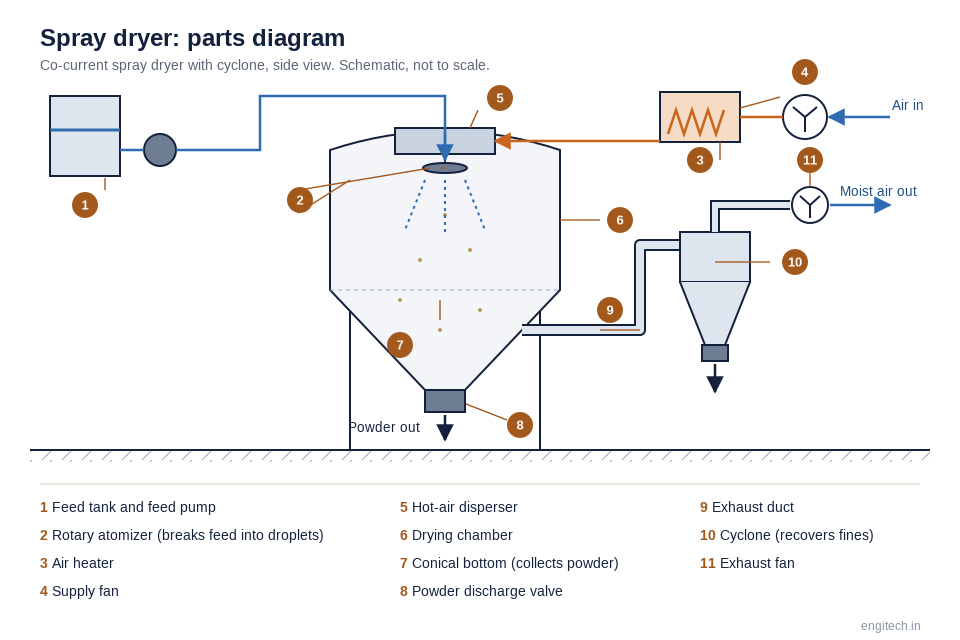
| No. | Part | What it does |
|---|---|---|
| 1 | Feed tank and feed pump | Hold the liquid feed and send it to the atomizer at a controlled rate. |
| 2 | Rotary atomizer | A fast-spinning wheel that breaks the liquid feed into fine droplets. Spray dryers can also use nozzle atomizers. |
| 3 | Air heater | Heats the drying air before it enters the chamber. It can be steam, electric or fuel fired. |
| 4 | Supply fan | Draws in air and pushes it through the heater into the chamber. |
| 5 | Hot-air disperser | Spreads the hot air evenly around the atomizer so the droplets dry in a controlled way. |
| 6 | Drying chamber | Large vessel in which the droplets dry as they fall. Water evaporates quickly because each droplet has a very large surface area. |
| 7 | Conical bottom | Guides the dried powder to the outlet at the bottom. |
| 8 | Powder discharge valve | A rotary valve that removes the powder without letting much air in. |
| 9 | Exhaust duct | Carries the cooled, moist air and fine powder out of the chamber to the cyclone. |
| 10 | Cyclone | Spins the exhaust gas so the fine powder drops out and is collected, which reduces product loss. |
| 11 | Exhaust fan | Pulls air through the system and keeps the chamber at a slight negative pressure. A bag filter or scrubber is often added after the cyclone. |
Download this diagram (SVG)Schematic for learning. Real machines vary by maker and duty.
What is Spray Drying?
Spray drying is a dehydration technique that converts liquid substances into dry powders. The process involves atomizing the liquid into small droplets and then rapidly drying them with hot air. Various industries, including food, pharmaceuticals, and chemicals, widely use this method. It is particularly significant in the dairy industry for producing milk powder.
The Spray Drying Process of Milk
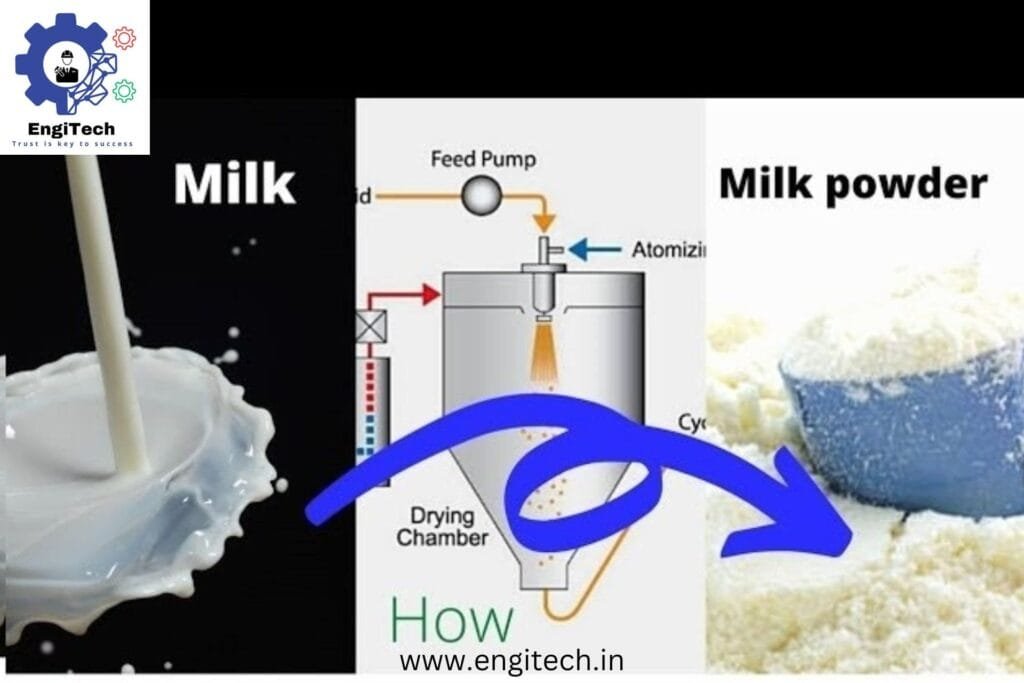
1. Pre-concentration: In the first step of spray drying milk, you need to pre-concentrate the milk. Raw milk contains about 87% water, which you need to reduce before spray drying. Typically, you achieve this through evaporation, heating the milk under reduced pressure to remove a significant portion of the water content. The pre-concentrated milk, which now contains around 45-50% solids, is ready for the spray drying process.
2. Atomization: Atomization converts the pre-concentrated milk into fine droplets. A spray dryer machine for milk powder, which includes an atomizer, performs this task. You can choose between two main types of atomizers used in milk spray dryer machines: rotary atomizers and nozzle atomizers. Rotary atomizers use a high-speed rotating disk to disperse the milk, while nozzle atomizers force the milk through a small orifice to create a spray of fine droplets.
3. Drying: After atomizing the milk, the fine droplets enter a drying chamber where they contact hot air. The temperature of the hot air ranges between 150-300°C, depending on the desired properties of the final milk powder. As the droplets encounter the hot air, the moisture rapidly evaporates, leaving behind dry milk powder particles. Carefully controlling the drying process prevents overheating, which can affect the quality and nutritional value of the milk powder.
4. Powder Collection: You collect the milk powder particles from the drying chamber after drying. Usually, a cyclone separator separates the fine powder from the air. The collected powder then passes through a series of sieves to ensure uniform particle size and remove any oversized particles. The final product is a fine, free-flowing milk powder that you can easily package and store.


Types of Spray Dryer Machines for Milk Powder
Several types of spray dryer machines produce milk powder, each with unique features and advantages. Here are some of the most common types:
1. Rotary Atomizer Spray Dryers: Rotary atomizer spray dryers use a high-speed rotating disk to disperse the pre-concentrated milk into fine droplets. These machines produce uniform particle sizes and high-quality milk powder. They are ideal for large-scale production and can handle a wide range of milk concentrations.
2. Nozzle Atomizer Spray Dryers: Nozzle atomizer spray dryers force the pre-concentrated milk through a small orifice to create a spray of fine droplets. These machines produce milk powder with specific particle sizes and often serve smaller-scale operations. They offer precise control over the droplet size and drying parameters, making them ideal for producing customized milk powders.
3. Fluidized Bed Spray Dryers: Fluidized bed spray dryers combine spray drying with fluidized bed technology to produce milk powder with excellent flow properties and uniform particle size distribution. These machines are particularly effective for drying heat-sensitive products, as you can precisely control the drying temperature. They commonly serve the dairy industry by producing high-quality milk powders with enhanced solubility and stability.
Benefits of Using Spray Dryers for Milk Powder Production
Using spray dryers for milk powder production offers several advantages over other drying methods. Here are some of the key benefits:
1. Extended Shelf Life: Spray drying significantly reduces the moisture content of milk, extending its shelf life and making it less prone to spoilage. This is particularly important for ensuring the availability of milk products in regions with limited refrigeration facilities.
2. Enhanced Nutritional Value: Spray drying preserves the nutritional value of milk by minimizing heat exposure during the drying process. This ensures that essential vitamins, minerals, and proteins remain in the final milk powder product.
3. Improved Solubility: Milk powder produced through spray drying has excellent solubility, making it easy to reconstitute into liquid milk. This is especially important for consumers who rely on milk powder for daily consumption.
4. Cost-Effective: Spray drying is a cost-effective method for producing milk powder, as it allows for large-scale production and efficient use of energy. The process can be easily automated, reducing labor costs and increasing productivity.
See it in 3D
5. Versatility: Spray dryers can produce a wide range of milk powder products with different properties and applications. This includes whole milk powder, skim milk powder, and specialized formulations for infant nutrition, sports nutrition, and other specific dietary needs.
Key Considerations for Choosing a Milk Spray Dryer Machine
When selecting a milk spray dryer machine for your dairy operation, consider the following factors to ensure optimal performance and product quality:
1. Capacity: Choose a spray dryer machine with a capacity that matches your production requirements. Consider the volume of milk you need to process and select a machine that can handle the desired throughput.
2. Type of Atomizer: Select the appropriate atomizer type based on your production needs. Rotary atomizers suit large-scale operations, while nozzle atomizers offer precise control for smaller-scale production.
3. Temperature Control: Ensure that the spray dryer machine provides accurate temperature control to prevent overheating and preserve the nutritional value of the milk powder. Look for machines with advanced temperature monitoring and control systems.
4. Energy Efficiency: Consider the energy efficiency of the spray dryer machine, as this significantly impacts your operating costs. Look for machines that offer efficient energy use and minimize waste.
5. Maintenance and Cleaning: Choose a spray dryer machine that is easy to maintain and clean. Regular maintenance and cleaning are essential for ensuring the longevity of the machine and the quality of the milk powder.

Advances in Spray Drying Technology for Milk Powder
The dairy industry has seen significant advancements in spray drying technology, leading to improved efficiency, product quality, and sustainability. Here are some of the latest innovations in spray drying technology for milk powder production:
1. Advanced Atomization Techniques: New atomization techniques, such as ultrasonic atomization, offer improved control over droplet size and distribution. This results in more uniform particle sizes and enhanced product quality.
2. Energy Recovery Systems: Energy recovery systems are being integrated into spray dryer machines to capture and reuse heat energy from the drying process. This reduces energy consumption and lowers operating costs.
3. Real-Time Monitoring and Control: Advanced monitoring and control systems provide real-time data on the drying process, allowing for precise adjustments to ensure optimal product quality. These systems can detect and correct deviations in temperature, airflow, and other parameters.
4. Sustainable Drying Solutions: Sustainable spray drying solutions focus on reducing the environmental impact of the drying process. This includes using renewable energy sources, waste heat recovery, and efficient water use.
5. Customized Formulations: Innovations in spray drying technology enable the production of customized milk powder formulations with specific nutritional profiles and functional properties. This is particularly important for producing specialized products such as infant formula and sports nutrition powders.
Milk powder spray drying process, step by step
- Reception and standardisation: milk is cooled, clarified and standardised for fat and protein.
- Heat treatment: pasteurisation, with a higher preheat for “high-heat” powders used in bakery and recombination.
- Evaporation: a falling film evaporator concentrates the milk to roughly 45 to 52% total solids.
- Atomisation: the concentrate is sprayed through a rotary atomiser or high-pressure nozzles into hot air, typically around 180 to 220 °C at the inlet.
- Drying: droplets dry in seconds; outlet air is usually about 80 to 95 °C, which keeps the powder itself much cooler than the inlet air.
- After-drying and cooling: an integrated or external fluid bed finishes drying, cools the powder and can agglomerate it into instant powder.
- Powder handling: sieving, packing in bags or big bags, with fines from cyclones or bag filters returned to the process.
Worked example: why the evaporator does most of the work
Assumed values: 10,000 kg/h of skim milk at 9% total solids, concentrated to 48% and dried to 3.5000000000000004% moisture. Solids are 900 kg/h. The evaporator produces 1,875 kg/h of concentrate, removing 8,125 kg/h of water. The spray dryer then makes 932.6 kg/h of powder and removes only 942.4 kg/h. About 90% of the water is removed in the evaporator, which uses far less energy per kilogram than the dryer, so dairies concentrate as far as the concentrate viscosity allows before spray drying.
Single-stage vs two-stage vs three-stage dairy spray dryers
| Design | How it works | Suits |
|---|---|---|
| Single-stage | All drying in the chamber; higher outlet temperature | Small plants, simple powders |
| Two-stage | Chamber plus external vibrating fluid bed for final drying and cooling | Most skim and whole milk powder plants |
| Three-stage (integrated fluid bed) | Fluid bed built into the chamber base plus an external bed; lowest outlet temperature | Large plants, instant and agglomerated powders, infant formula bases |
Choosing a milk powder spray dryer manufacturer
- Hygienic design to dairy standards: CIP coverage, smooth welds, no dead pockets.
- Guaranteed powder moisture, bulk density and solubility for your product.
- Explosion venting or suppression; milk powder dust is combustible.
- Heat recovery on exhaust air and energy use per kg of water evaporated.
- Pilot trials on your concentrate and local service support.
See also: spray dryers explained and choosing a spray dryer manufacturer.
Conclusion
Spray drying of milk is a vital process in the dairy industry, providing a convenient and efficient way to produce high-quality milk powder. By understanding the spray drying process, the types of spray dryer machines available, and the benefits of using spray dryers, dairy professionals can optimize their operations and ensure the production of superior milk powder products. Advances in spray drying technology continue to enhance the efficiency, quality, and sustainability of milk powder production, making it an essential component of the modern dairy industry.
For more in-depth articles and resources on industrial mechanical engineering machines, visit EngiTech.in. Stay updated on the latest innovations and applications in the industry!
🛠️ Recommended Engineering Guides & Tools
Related reading: Spray Drying Pharmaceuticals: Process & Benefits.
Free tools for this topic: Dryer selection tool · Dryer evaporation, heat and fuel calculator · all free engineering tools
Sources and further reading
For standards, data and independent guidance on this topic, see US Department of Energy process heating resources (industrial heating and drying efficiency), The Engineering ToolBox (engineering reference data and calculators) and Bureau of Energy Efficiency (energy audit and efficiency programmes in India). Always check the current edition and your site conditions before applying any figure.
Free tool for this topic
Industrial Dryer Evaporation, Heat & Fuel CalculatorWater evaporation, product output, heat load and fuel or steam consumption for spray, rotary, flash, fluid-bed and paddle dryers. Industrial DryersMaster the Paddle Dryer Working Principle with This Guide
 Industrial DryersAgitated Nutsche Filter Dryers (ANFD): Working Principle, Specs & Selection
 Industrial DryersApplications of Agitated Thin Film Dryers: Unveiling Their Industrial Significance | EngiTech
 Industrial DryersSpray Drying Pharmaceuticals: Process & Benefits
 Industrial DryersHot Air Generation for Dryers: Direct-Fired, Indirect and Electric Compared
 Industrial DryersRotary Dryer Shell Sizing: Hold-Up, Retention Time and Speed