
On this page
- Paddle dryer diagram: parts and their functions
- What is a Paddle Dryer?
- Paddle Dryer Working Principle
- 1. Feed Material Introduction:
- 2. Indirect Heating in Paddle Dryers:
- 3. Heat Transfer in Paddle Dryers:
- 4. Vapor Removal in Paddle Dryers:
- 5. Material Discharge in Paddle Dryers:
- Variations in Paddle Dryer Working Principle: Steam vs. Thermic Fluid
- Steam-Heating Paddle Dryer
- Thermic Fluid-Heating Paddle Dryer
- Advantages of Paddle Dryers
- Components of a Paddle Dryer
- Product Models or Variants of Paddle Dryers
- Unique Selling Points or Differentiators of Specific Paddle Dryers
- Key Elements and Functions of Paddle Dryer Components
- Design Considerations for Paddle Dryers
- Applications of Paddle Dryers
- Paddle dryer heat transfer: a sizing example
- Paddle dryer vs rotary vacuum paddle dryer
- Conclusion
- 🛠️ Recommended Engineering Guides & Tools
- Sources and further reading
- More on Industrial Dryers
In various industrial processes, especially within the chemical, pharmaceutical, and food sectors, paddle dryers have become essential tools. Their versatility and high efficiency make them invaluable for handling a wide range of materials. This blog aims to examine the paddle dryer working principle, exploring how they operate and the variations in configurations that can impact their performance, particularly when using steam and thermic fluid plant options.
Paddle dryer diagram: parts and their functions
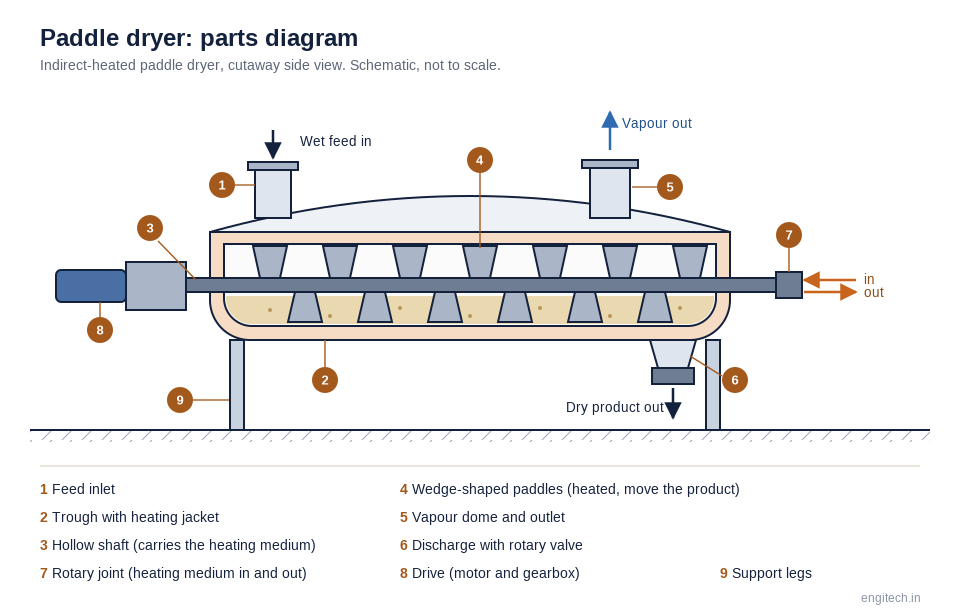
| No. | Part | What it does |
|---|---|---|
| 1 | Feed inlet | Where the wet material, such as sludge or cake, enters the trough. |
| 2 | Trough with heating jacket | The jacket carries steam or thermal oil that heats the wall. This is indirect heating, so the material does not meet the heating medium. |
| 3 | Hollow shaft | The shaft is hollow so the heating medium also flows inside it. This adds more heating surface. |
| 4 | Wedge-shaped paddles | Heated paddles on the shaft stir the material, bring it onto hot surfaces and move it along the trough. |
| 5 | Vapour dome and outlet | The evaporated water leaves here. A small amount of vapour or carrier gas takes it away, so the exhaust volume is low. |
| 6 | Discharge with rotary valve | Dried product leaves at the end of the trough. |
| 7 | Rotary joint | Lets the heating medium flow into and out of the rotating shaft. |
| 8 | Drive | Motor and gearbox that turn the shaft slowly. |
| 9 | Support legs | Carry the dryer. |
Download this diagram (SVG)Schematic for learning. Real machines vary by maker and duty.
What is a Paddle Dryer?
A paddle dryer is a highly efficient piece of equipment used to dry materials by indirect heat transfer drying heating. It consists of a horizontal, cylindrical vessel equipped with rotating paddles that ensure thorough mixing and heat transfer. This design is particularly advantageous for drying materials with high moisture content or those that are sticky and pasty.
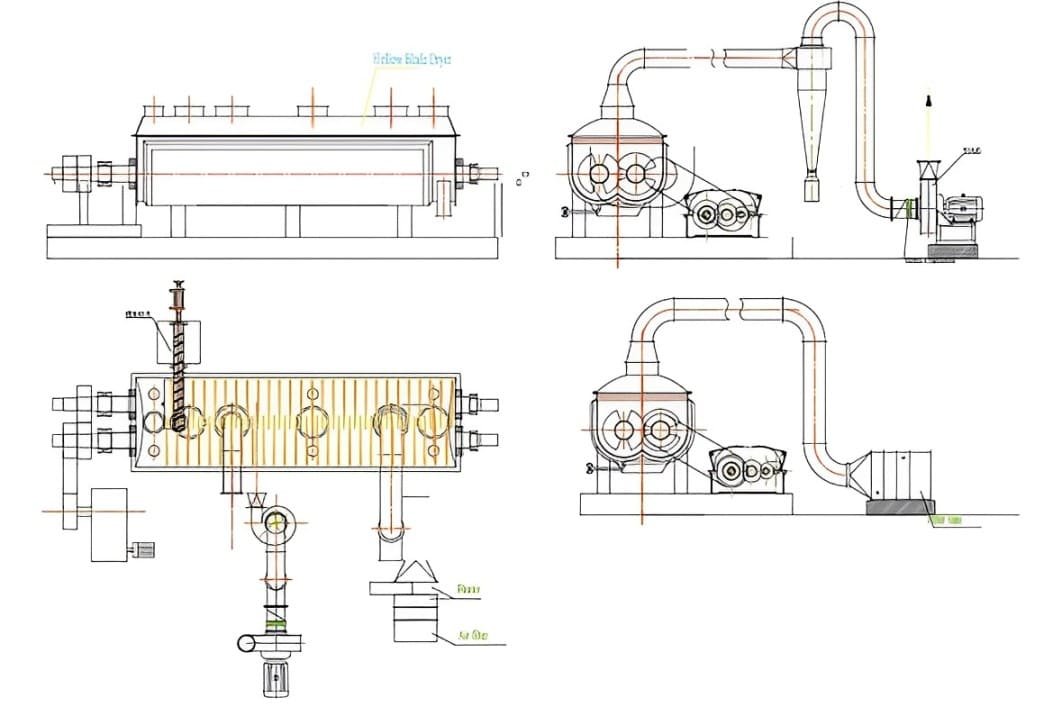
Paddle Dryer Working Principle
At the core of the paddle dryer is its working principle, which revolves around indirect heating. Here’s a step-by-step look at how a paddle dryer operates:
1. Feed Material Introduction:
- The paddle dryer receives the material to be dried through an inlet.
- Ensuring a consistent flow of material is essential for efficient drying.
2. Indirect Heating in Paddle Dryers:
- Paddle dryers use indirect heating, meaning the heating medium (steam or thermic fluid) does not come into direct contact with the material.
- The heating medium flows through the jacket and hollow paddles, transferring heat to the material.
3. Heat Transfer in Paddle Dryers:
- As the paddles rotate, they mix the material, ensuring uniform heat distribution.
- The dryer walls and paddles conduct heat from the heating medium, evaporating the moisture.
4. Vapor Removal in Paddle Dryers:
- The system collects and removes the evaporated moisture via a vapor outlet.
- Some systems include a vacuum to enhance evaporation, particularly for heat-sensitive materials.
5. Material Discharge in Paddle Dryers:
- The system continuously discharges the dried material, maintaining a steady production flow.
Variations in Paddle Dryer Working Principle: Steam vs. Thermic Fluid
The operation of paddle dryers can vary significantly depending on whether they use steam or thermic fluid as the heating medium. Each configuration offers distinct advantages and considerations.
Steam-Heating Paddle Dryer
Steam-Heating Paddle Dryer Working Principle:
- Steam is the heating medium.
- It flows through the jacket and hollow paddles, condensing upon contact with cooler surfaces and releasing latent heat.
- This heat is then conducted through the dryer walls and paddles, drying the material efficiently.
Key Considerations for Steam-Heating Paddle Dryers:
- Temperature Control: Steam temperature can be precisely controlled, ensuring consistent drying conditions.
- Heat Transfer Efficiency: Steam offers high heat transfer efficiency, enabling rapid and uniform drying.
- Pressure Management: Proper management of steam pressure is essential for optimal performance and safety.
Thermic Fluid-Heating Paddle Dryer
Thermic Fluid-Heating Paddle Dryer Working Principle:
- A thermic fluid, such as thermal oil, is the heating medium.
- The fluid flows through the jacket and hollow paddles, transferring heat to the material.
- This heat evaporates the moisture from the material.
Key Considerations for Thermic Fluid-Heating Paddle Dryers:
- Temperature Range: Thermic fluids play a central role in operating at higher temperatures than steam, making them suitable for materials requiring higher drying temperatures.
- Heat Transfer Control: Precise control of heat transfer rates accommodates various drying requirements., including those achieved with vacuum paddle dryers.
- Maintenance: Regular maintenance is required to ensure the thermic fluid remains effective and to prevent degradation.
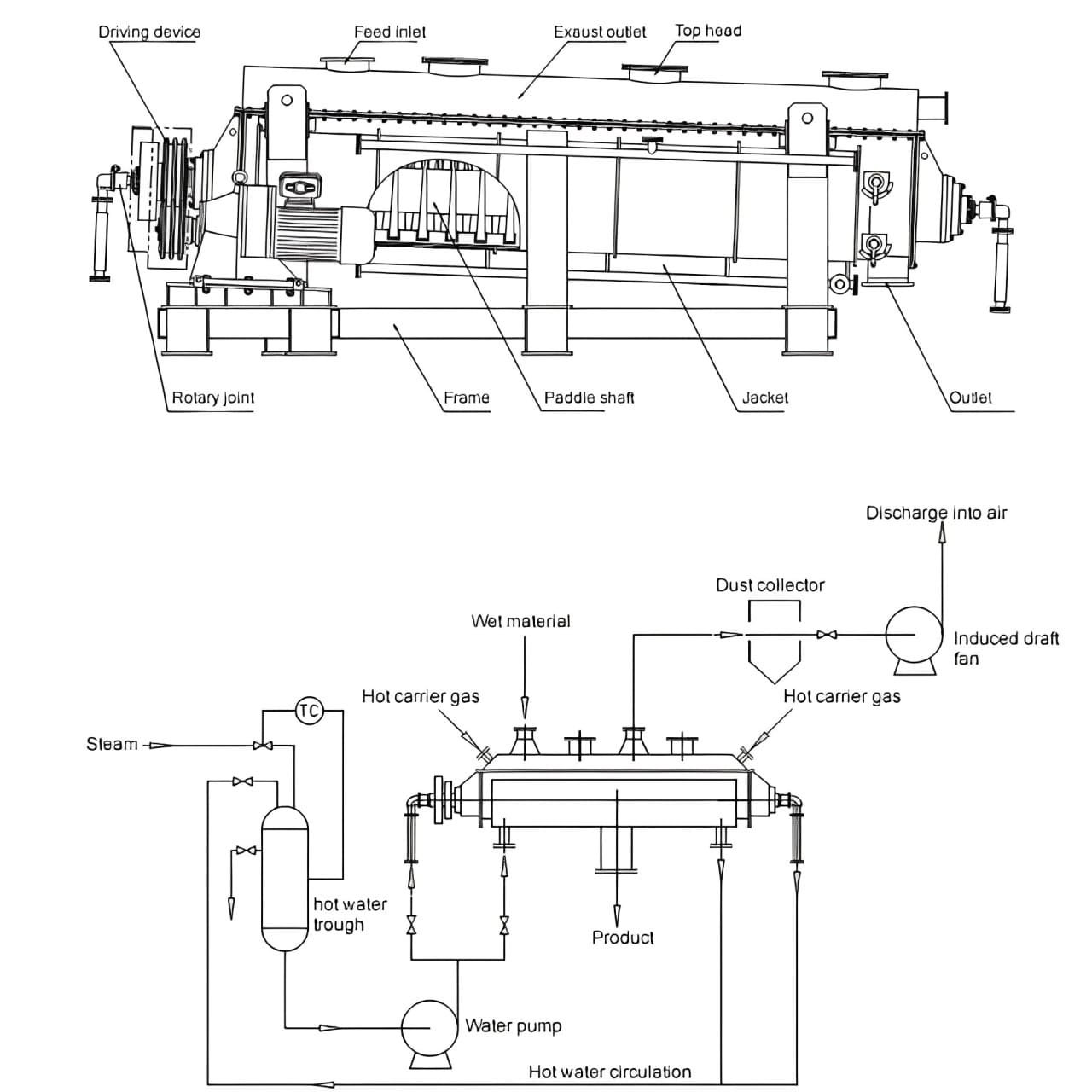
Advantages of Paddle Dryers
Paddle dryers offer several notable advantages that make them a preferred choice across industries:
- Versatility:They can handle a broad range of materials, including slurries, pastes, and granular solids.
- Efficiency:Indirect heating ensures efficient heat transfer, reducing energy consumption and operational costs while using less energy for optimal drying performance.
- Uniform Drying:Rotating paddles ensure thorough mixing and uniform heat distribution.
- Scalability:Available in various sizes and capacities, making them suitable for different scales of operation.
- Controlled Environment:The closed system minimizes contamination risk and allows precise control over drying conditions.
Components of a Paddle Dryer
A paddle dryer consists of several integral components that facilitate its effective operation. The vessel, typically insulated, allows for indirect heating, ensuring uniform heat distribution and minimizing heat loss. Hollow paddles mounted on a shaft enhance heat transfer, enabling efficient drying of various materials. Additionally, a temperature control system ensures optimal performance by maintaining desired moisture content. Auxiliary elements, such as a scraper mechanism, prevent material buildup on the dryer walls, while providing continuous operation, essential for maintaining low operational costs and high efficiency.
Product Models or Variants of Paddle Dryers
Paddle dryers come in various models and variants, each tailored to meet specific industrial needs and applications. Among the most recognized product models are the standard paddle dryer, vacuum paddle dryer, and continuous paddle dryer. The standard paddle dryer is ideal for general drying applications across multiple sectors, thanks to its efficient heat transfer and versatile design.
On the other hand, the vacuum paddle dryer is designed specifically for heat-sensitive materials, allowing for drying under reduced pressure, which minimizes evaporation heat loss. Lastly, continuous paddle dryers are engineered for high-capacity operations, featuring a continuous feed and discharge system that maximizes productivity. Each of these models offers unique features and specifications catering to diverse material types and drying requirements, ensuring that industries can select the most suitable paddle dryer variant for their specific processes.
Unique Selling Points or Differentiators of Specific Paddle Dryers
When it comes to selecting paddle dryers for industrial applications, understanding the unique selling points (USPs) or differentiators of specific models becomes essential in making an informed decision. Each variant of paddle dryer, whether it be the standard, vacuum, or continuous model, presents distinct features tailored to meet particular operational needs. For instance, vacuum paddle dryers stand out for their ability to dry heat-sensitive materials without risking thermal degradation, making them ideal for the pharmaceutical and food industries. Similarly, continuous paddle dryers offer the advantage of uninterrupted operation, allowing for high-volume production while maintaining consistent product quality.
Furthermore, advanced features such as integrated controls for precise temperature management and optimized heat recovery systems differentiate them from conventional dryers, leading to enhanced energy efficiency and reduced operational costs. Overall, these unique selling points enhance the performance and reliability of paddle dryers, as well as provide businesses with compelling reasons to select a model that aligns with their specific process requirements.
See it in 3D
Key Elements and Functions of Paddle Dryer Components
Introducing the feed material into paddle dryers sets the stage for an efficient drying process. Materials are typically conveyed through a series of hollow paddles that facilitate indirect heating, ensuring uniform heat distribution while minimizing heat loss. As the feed material moves, its moisture content gradually decreases thanks to precise control of temperature and heating medium. This method, including the use of a scrubber tank, is especially effective for sensitive materials, making paddle dryers a preferred choice across various industries, particularly food processing and chemical applications.
Design Considerations for Paddle Dryers
Various elements play a central role in the design of paddle dryers to ensure optimal performance. Factors such as heat transfer efficiency, uniform heat distribution, and the selected heating medium, either thermal oil or hot water, are central to achieving efficient drying through advanced heat recovery systems. Additionally, considerations for operational costs, energy consumption, and the specific material type, whether sensitive or sticky, must be taken into account. These elements collectively contribute to a paddle dryer’s energy efficiency and drying capabilities while meeting industrial demands.
Applications of Paddle Dryers
Paddle dryers are employed in various industries due to their versatility and efficiency:
- Chemical Industry:Drying chemicals, intermediates, and catalysts.
- Pharmaceutical Industry:Drying active pharmaceutical ingredients (APIs) and excipients.
- Food Industry:Drying food products, additives, and ingredients.
- Environmental Engineering:Treating and drying sludge and waste materials.
Paddle dryer heat transfer: a sizing example
A paddle dryer is indirectly heated, so its capacity is set by heat transfer through the jacket and hollow paddles: Q = U × A × ΔT, where U is the overall heat transfer coefficient, A the heated area and ΔT the difference between the heating medium and the product.
Worked example (assumed values): with U = 120 W/m²·K, typical of wet sludge and pastes, and steam at about 160 °C against product near 100 °C (ΔT = 60 K), each square metre transfers 7.2 kW. Dividing by the latent heat of water (about 2,257 kJ/kg) gives roughly 11.5 kg of water evaporated per m² per hour. To evaporate 1,000 kg/h, the dryer needs about 87 m² of heated area, before allowing for heating the solids and losses. Real U values vary widely with the material and its moisture, so suppliers confirm them by test. Estimate the full heat load with the dryer evaporation and fuel calculator.
Paddle dryer vs rotary vacuum paddle dryer
| Point | Continuous paddle dryer | Rotary vacuum paddle dryer (RVPD) |
|---|---|---|
| Operation | Continuous, at or near atmospheric pressure | Batch, under vacuum |
| Typical feed | Sludge, filter cake, pastes, chemicals | Pharma intermediates, fine chemicals, solvent-wet cakes |
| Product temperature | Near the boiling point at atmospheric pressure | Low, because vacuum lowers the boiling point |
| Solvent recovery | Possible with a closed vapour system | Standard, through condenser and receiver |
| Capacity | High, tonnes per hour of feed | Lower, batches of a few hundred to a few thousand kilograms |
For the vacuum version see the rotary vacuum paddle dryer guide, and for sludge duty see paddle dryers for sludge.
Conclusion
Understanding the paddle dryer working principle is vital for industries looking to improve their drying processes and enhance their drying efficiency. Whether using steam or thermic fluid, paddle dryers provide versatility, efficiency, and uniform drying. By selecting the appropriate configuration and maintaining optimal operating conditions, industries can achieve consistent and high-quality drying outcomes.
Paddle dryers are essential in chemical, pharmaceutical, food, and environmental sectors, enhancing productivity and product quality. As technology advances, paddle dryers will continue to evolve, offering an efficient solution for even greater efficiency and capabilities.
For more detailed information on paddle dryers and other industrial drying equipment, visit EngiTech. Stay updated with our latest blogs to enhance your knowledge and improve your industrial processes.
We recommended AS Engineers, we are working with them from many year and we highly recommend them for paddle dryer, they are the best paddle dryer manufacturer in India
🛠️ Recommended Engineering Guides & Tools
Related reading: Pan Dryers: Working Principle, Design, Diagram, and Applications; Paddle Dryer for Sludge: A Comprehensive Guide.
Free tools for this topic: Dryer selection tool · Dryer evaporation, heat and fuel calculator · all free engineering tools
Sources and further reading
For standards, data and independent guidance on this topic, see US Department of Energy process heating resources (industrial heating and drying efficiency) and The Engineering ToolBox (engineering reference data and calculators). Always check the current edition and your site conditions before applying any figure.
Free tool for this topic
Industrial Dryer Evaporation, Heat & Fuel CalculatorWater evaporation, product output, heat load and fuel or steam consumption for spray, rotary, flash, fluid-bed and paddle dryers.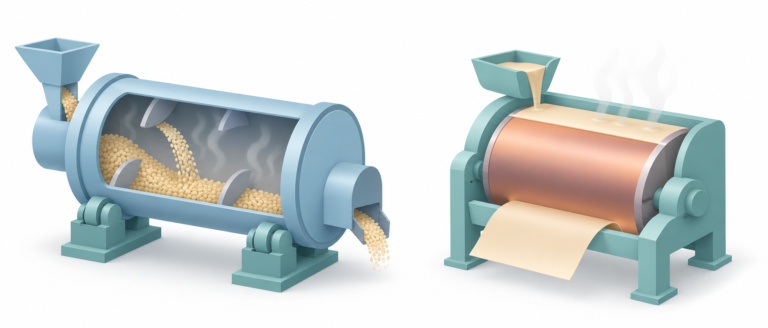 Industrial DryersRotary Dryer vs Roller Drum Dryer: What Is the Difference?
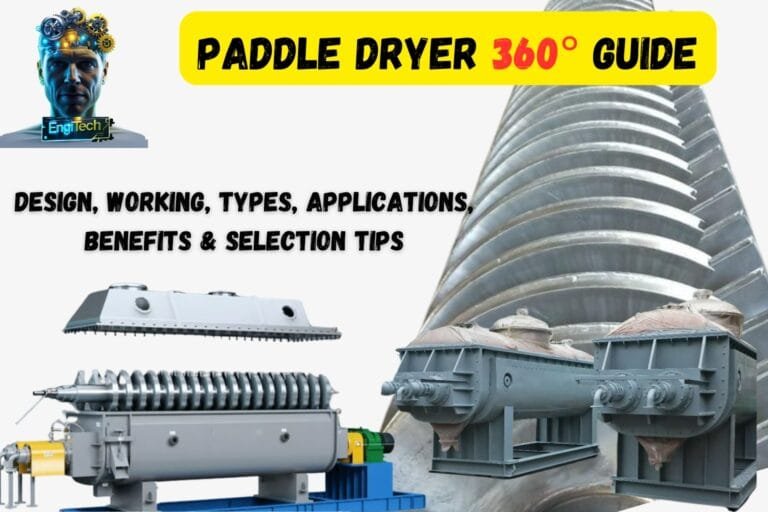 Industrial DryersPaddle Dryers: Types, Applications and Selection
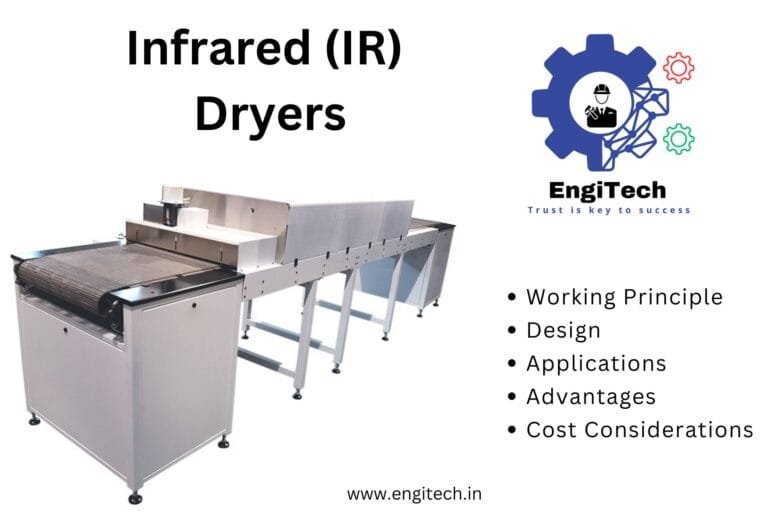 Industrial DryersInfrared Dryers: Working Principles, Design, and Applications
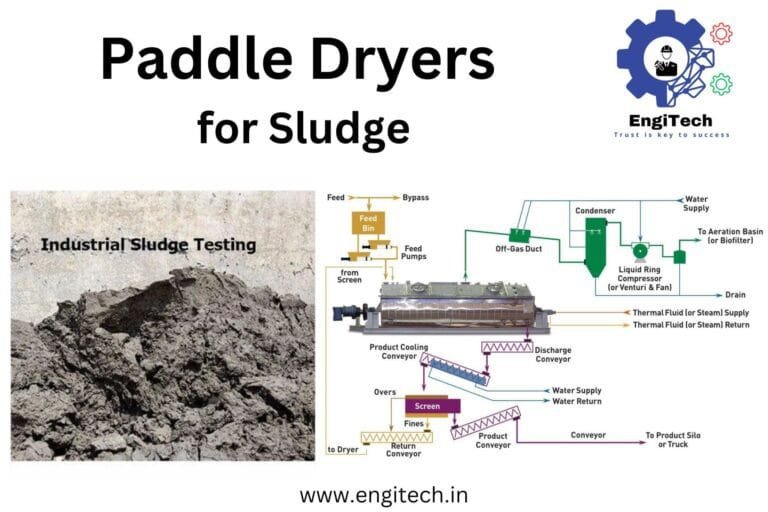 Environmental EngineeringPaddle Dryer for Sludge: Working Principle, Specs & Selection
 Industrial DryersRotary Vacuum Paddle Dryers (RVPD): Solvent Recovery, Heat Transfer & Sizing Guide
 Industrial DryersHow to Choose an Industrial Dryer: Feed, Heat Source and Cost