

On this page
- Fire-tube boiler diagram: parts and their functions
- What is a Boiler?
- How Does a Boiler Work?
- Types of Boilers
- Fire Tube Boiler
- Water Tube Boiler
- Electric Boiler
- Condensing Boiler
- Oil Boiler
- Natural Gas Boiler
- Key Components of Industrial Boilers
- Fire tube vs water tube boiler
- How to calculate boiler efficiency (direct method)
- Statutory inspection and safety
- Applications of Boilers
- Industrial Applications
- Domestic Applications
- Boiler Efficiency and Environmental Impact
- Boiler Maintenance and Safety
- Types of Boiler Fuels
- Conclusion
- 🛠️ Recommended Engineering Guides & Tools
- Frequently Asked Questions (Plant Engineering & Operational FAQ)
- 1. What is the primary difference between fire-tube and water-tube industrial steam boilers?
- 2. How does boiler blowdown control prevent scale formation and carryover into process steam lines?
- 3. What fuel-to-steam thermal efficiency (82% vs 88%) is achieved with economizers and air preheaters?
- Sources and further reading
- More on Boilers, Chillers and Thermal
Steam Generation Engineering Summary: Industrial boilers are sized by steam evaporation capacity (Ton/hr or F&A 100°C rating) and operating pressure (10.5 to 45 bar). Packaged fire-tube boilers suit medium-pressure plant heating up to 25 TPH, while multi-drum water-tube boilers handle high-pressure superheated steam for cogeneration and chemical synthesis.
Fire-tube boiler diagram: parts and their functions

| No. | Part | What it does |
|---|---|---|
| 1 | Shell | The pressure vessel that holds the water and steam. |
| 2 | Furnace tube | The large tube in which the fuel burns. The gas gives up heat to the surrounding water. This is the first pass. |
| 3 | Burner | Mixes fuel and combustion air and fires into the furnace tube. |
| 4 | Reversal chamber | Turns the hot gas around at the rear of the furnace and sends it back through the tubes. |
| 5 | Fire tubes | Smaller tubes through which the gas returns to the front. This is the second pass, and it adds heating surface. |
| 6 | Smoke box and chimney | Collect the cooled flue gas and lead it out of the boiler house. |
| 7 | Steam outlet and main stop valve | Steam leaves from the steam space at the top through the main valve. |
| 8 | Safety valve | Opens automatically if the pressure rises above the set limit and so protects the boiler. Every steam boiler must have one. |
| 9 | Water level gauge | Shows the water level in the shell. Keeping it between the marked limits is essential for safe operation. |
| 10 | Feed water inlet | Treated feed water is pumped in to replace the steam drawn off. |
| 11 | Blowdown valve | Removes sludge and concentrated water from the bottom of the shell. |
| 12 | Water and steam space | The water covers the tubes. The steam collects above the water line. |
Download this diagram (SVG)Schematic for learning. Real machines vary by maker and duty.
Boilers are essential components in various industries and domestic applications. They play a central role in heating and power generation. This guide provides a detailed overview of boilers, including their types, working principles, applications, and maintenance practices. Understanding these aspects will help you select the right boiler for your needs and ensure efficient operation.
What is a Boiler?
A boiler is a closed vessel in which water or other suitable liquids are heated to generate steam or vapor. The generated steam or vapor is used for various purposes, such as heating applications (water heating, central heating), power generation, and other industrial processes. Essentially, boilers work on the same principle as pressure cookers but on a much larger scale.
How Does a Boiler Work?
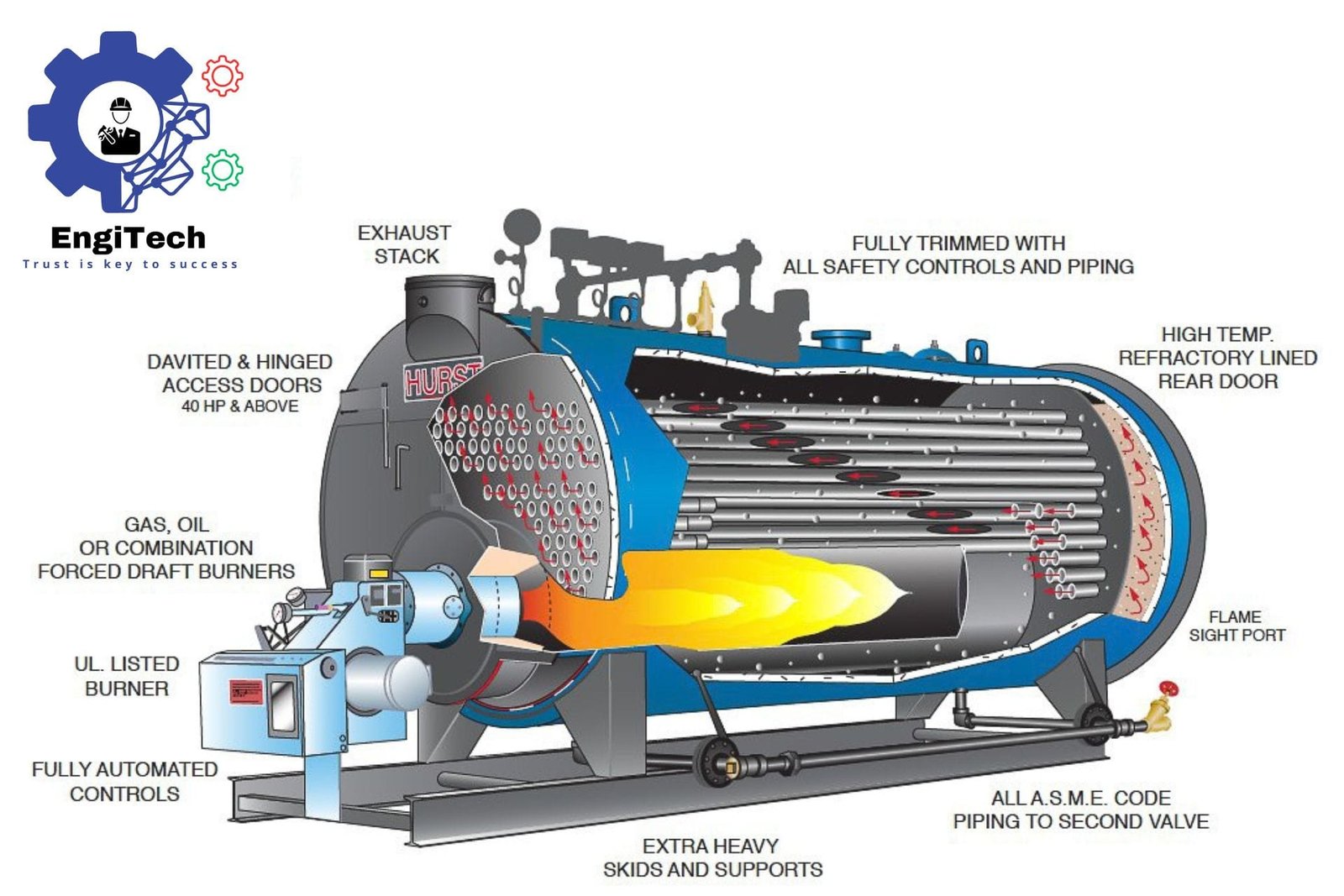
Boilers operate by heating water or other fluids to create steam or vapor. This process involves several key components:
- Burner: The burner initiates the combustion process, heating the fluid.
- Combustion Chamber: The combustion chamber, made of cast iron, withstands high temperatures and burns the fuel to generate heat.
- Heat Exchanger: The heat exchanger transfers the generated heat to the water or fluid, increasing the boiler’s efficiency.
- Steam Drum and Mud Drum: The steam drum collects the steam, while the mud drum collects and removes solid particles periodically.
Types of Boilers
Boilers come in various types, each suited for specific applications and fuel types. Here are some common types:
Fire Tube Boiler
Fire tube boilers are commonly used in small and medium-sized industries. They consist of a series of tubes through which hot gases pass, heating the surrounding water. These boilers are ideal for low to medium-pressure steam requirements and are often factory-made, ready for installation.
- Advantages: Easy to install, compact, and cost-effective for small to medium operations.
- Disadvantages: Limited to lower pressures and capacities, higher risk of explosion.
Water Tube Boiler
Water tube boilers are designed for high-pressure applications, commonly used in large manufacturing plants. They have water-filled tubes that are heated by hot gases. These boilers offer better control over steam pressure and capacity.
- Advantages: High efficiency, suitable for high-pressure applications, rapid steam generation.
- Disadvantages: More complex design, higher initial cost, and maintenance requirements.
Electric Boiler
Electric boilers use electricity to generate heat and produce steam. They are highly efficient and environmentally friendly, as they do not rely on fossil fuels.
- Advantages: No emissions, quiet operation, easy installation, and low maintenance.
- Disadvantages: High operational cost due to electricity prices, limited by power supply capacity.
Condensing Boiler
Condensing boilers use natural gas and feature two heat exchangers to maximize efficiency. They recover heat from exhaust gases, achieving up to 98% thermal efficiency.
- Advantages: Extremely efficient, lower energy costs, environmentally friendly.
- Disadvantages: Higher initial cost, complex design, and requires proper maintenance.
Oil Boiler
Oil boilers use oil as a fuel source and are typically used in residential applications for heating water. They can achieve efficiencies of up to 90% or more.
- Advantages: High efficiency, reliable, and suitable for areas without natural gas supply.
- Disadvantages: Higher fuel costs, requires oil storage, and regular maintenance.
Natural Gas Boiler
Natural gas boilers use natural gas to heat water or generate steam. They are regulated by temperature gauges and thermoelectric devices to minimize fuel wastage.
- Advantages: Efficient, cost-effective, widely available fuel source.
- Disadvantages: Requires gas supply infrastructure, potential safety hazards if not properly maintained.
Key Components of Industrial Boilers
Industrial boilers have several critical components that ensure efficient operation:
See it in 3D
- Burner: Initiates the combustion process by igniting the fuel.
- Combustion Chamber: Burns the fuel to generate heat.
- Heat Exchanger: Transfers heat from the combustion gases to the water or fluid.
- Steam Drum and Mud Drum: Collects steam and removes solid impurities.
- Fuel Source: Can be coal, oil, natural gas, or other fuels.
- Control Systems: Regulate temperature, pressure, and fuel supply to maintain optimal performance.
Fire tube vs water tube boiler
| Point | Fire tube (shell) boiler | Water tube boiler |
|---|---|---|
| How it works | Hot gases pass through tubes inside a shell full of water. | Water and steam flow inside tubes heated by the furnace gases outside. |
| Typical capacity | Small to medium, up to roughly 20 to 30 t/h | Medium to very large, power-plant scale |
| Typical pressure | Up to about 25 bar | High pressures and superheated steam |
| Response to load changes | Large water volume, steady but slow to start | Smaller water volume, faster response |
| Cost and maintenance | Lower cost, simple to operate | Higher cost, needs stricter water treatment |
| Typical users | Food, textile, pharma and process plants | Power plants, refineries, large process industry |
How to calculate boiler efficiency (direct method)
Efficiency = steam output × (enthalpy of steam − enthalpy of feed water) ÷ (fuel input × gross calorific value).
Worked example: a boiler makes 5,000 kg/h of dry saturated steam at 10 bar(g) (enthalpy about 2,781 kJ/kg) from feed water at 80 °C (about 335 kJ/kg), burning 350 kg/h of furnace oil with a gross calorific value of about 42,000 kJ/kg. Efficiency = 5,000 × (2,781 − 335) ÷ (350 × 42,000) ≈ 83.2 per cent. The indirect (heat loss) method in BEE and BIS guidance shows where the losses are: dry flue gas, moisture, unburnt fuel, radiation and blowdown. Steam use itself can be estimated with the steam consumption calculator.
Statutory inspection and safety
In India, steam boilers above the size limits in the boiler law must be registered and inspected under the Indian Boiler Regulations, with periodic inspection and hydraulic tests by the boiler inspectorate, and operated by certified attendants. Other countries apply their own codes, such as ASME in the USA. Whatever the code, keep safety valves tested, low-water cut-offs working, blowdown regular and water chemistry within the maker’s limits: most boiler failures start with poor water treatment.
Applications of Boilers
Industrial Applications
Boilers are widely used in various industrial sectors for multiple applications:
- Power Generation: Boilers generate steam to drive turbines for electricity production.
- Chemical Processing: Used in chemical plants for heating and steam generation.
- Food and Beverage: Essential for sterilization, cooking, and pasteurization processes.
- Textile Industry: Used for dyeing, drying, and printing fabrics.
- Paper and Pulp: Provides steam for the production process and drying paper products.
Domestic Applications
Boilers also play a significant role in domestic settings:
- Central Heating: Boilers provide heating for residential buildings.
- Water Heating: Used in homes for hot water supply in bathrooms and kitchens.
- Cooking: In some regions, boilers are used for cooking applications.
Boiler Efficiency and Environmental Impact
Efficient boiler technology is more critical than ever, given the emphasis on energy conservation and environmental protection. Modern boilers use advanced technologies to maximize efficiency and minimize emissions:
- Natural Gas Boilers: These boilers are more environmentally friendly, as they produce fewer emissions compared to coal or oil boilers.
- Condensing Boilers: They recover heat from exhaust gases, reducing energy wastage and emissions.
- Electric Boilers: They have zero emissions during operation, making them ideal for areas with strict environmental regulations.
Boiler Maintenance and Safety
Proper maintenance is essential for the longevity and efficiency of boilers. Here are some essential maintenance tips:
- Regular Inspections: Conduct regular inspections of the burner, heat exchanger, and other components.
- Cleaning: Clean the combustion chamber, heat exchanger, and fuel lines to prevent soot buildup.
- Calibration: Calibrate control systems to ensure accurate temperature and pressure settings.
- Safety Checks: Install safety valves, smoke detectors, and alarms to prevent accidents.
- Fuel Management: Monitor fuel levels and ensure proper circulation to avoid inefficiencies.
Types of Boiler Fuels
Boilers can use various types of fuels, each with its advantages and disadvantages:
- Coal: Traditional fuel with high energy content but produces significant emissions.
- Oil: Offers high efficiency but requires proper storage and handling.
- Natural Gas: Clean-burning fuel with lower emissions and widespread availability.
- Electricity: Zero emissions during operation but high operational costs.
- Biomass: Renewable fuel source with lower emissions but requires specific handling and storage.
Conclusion
Boilers are indispensable in both industrial and domestic settings, providing essential heat and power. Understanding the different types of boilers, their working principles, and applications can help you choose the right boiler for your needs. Regular maintenance and proper fuel management are essential to ensure efficient and safe operation. As technology advances, modern boilers continue to improve in efficiency and environmental friendliness, contributing to a sustainable future.
For more detailed articles and resources on boilers and related technologies, visit EngiTech.in. Stay updated on the latest advancements and applications in the field!
🛠️ Recommended Engineering Guides & Tools
Frequently Asked Questions (Plant Engineering & Operational FAQ)
Authored by plant consultant Jignesh S Panchal based on field commissioning specifications, ASME/CEMA/TEMA standards, and preventive maintenance data.
1. What is the primary difference between fire-tube and water-tube industrial steam boilers?
In fire-tube boilers, hot combustion flue gases pass inside tubes immersed within a water-filled outer shell; they are suited for low-to-medium pressure applications (<25 bar) with large thermal buffer capacity. In water-tube boilers, water flows inside tubes surrounded by external furnace flames, enabling high operating pressures (>40 to 100+ bar) and rapid steam generation for power generation and heavy processing.
2. How does boiler blowdown control prevent scale formation and carryover into process steam lines?
As pure steam boils off, total dissolved solids (TDS) concentrate in the boiler water. Automatic continuous blowdown monitors water conductivity, purging concentrated bottom water to maintain TDS below 3,000 ppm. This prevents calcium carbonate scale from insulating tubes (which causes tube blistering) and eliminates foaming carryover into steam mains.
3. What fuel-to-steam thermal efficiency (82% vs 88%) is achieved with economizers and air preheaters?
Standard packaged steam boilers operate around 80% to 82% efficiency, venting stack gases at 220°C – 260°C. Installing a feedwater economizer drops stack temperatures down to 130°C – 150°C, recovering waste enthalpy and boosting boiler thermal efficiency to 88% – 92% (with every 20°C flue gas temperature reduction delivering ~1% fuel savings).
Related reading: Peristaltic Hose Pump Sizing: Tube Fatigue, Flow Rate & Pressure Guide; Direct vs Indirect Hot Air Generators: Thermal Efficiency, Burner Sizing & Fuel Math.
Free tools for this topic: Steam consumption calculator · all free engineering tools
Sources and further reading
For standards, data and independent guidance on this topic, see NFPA (combustible dust and fire safety standards), US Chemical Safety Board (dust explosion investigation reports) and IECEx (hazardous area equipment certification). Always check the current edition and your site conditions before applying any figure.
Free tool for this topic
Heat Exchanger LMTD & Area CalculatorHeat duty, log mean temperature difference and required heat-transfer area for counter-flow and parallel-flow exchangers. Boilers, Chillers and ThermalSpiral Heat Exchangers: Comprehensive Guide
 Boilers, Chillers and ThermalQuenching Furnaces: A Comprehensive Guide
 Boilers, Chillers and ThermalA Comprehensive Guide to Furnaces: Understanding Types, Applications, and Expert Insights
 Boilers, Chillers and ThermalA Comprehensive Guide to Furnace Repair: Expert Insights and Practical Tips
 Boilers, Chillers and ThermalExpert Guide to Industrial Boilers: Electric and Steam Systems
 Boilers, Chillers and ThermalCooling vs Antisolvent Crystallization: How to Compare the Methods