
On this page
- 1. Peristaltic Pumping Kinematics & Swept Volume Physics
- 2. Occlusion Shimming Mechanics: Zero Slip vs Cord Destruction
- 3. Tube Flex Fatigue Kinetics & Rotational Speed De-rating
- 4. Worked Engineering Calculation: Sizing an Abrasive Lime Milk Dosing Pump
- Step 1: Calculate Total Differential Operating Pressure
- Step 2: Determine Required Pump Displacement and Frame Size
- Step 3: Hydraulic Work and Shaft Brake Power Calculation
- Step 4: Running Torque, Starting Breakaway Torque & Gearmotor Sizing
- 5. Peristaltic Pump Troubleshooting & Root Cause Analysis
- 6. B2B Engineering RFQ Specification Checklist
- Industrial Peristaltic Hose Pump Technical Specification Guide
- Frequently Asked Questions
- Sources and further reading
- More on Pumps, Valves and Piping
In extreme chemical dosing, abrasive mineral processing, and lime slurry transfer, conventional pumps fail due to mechanical seal erosion, internal valve fouling, or stator de-bonding. Unlike dynamic pumps analyzed in our industrial process pumps selection guide or high-wear slurry units reviewed in our slurry pump sizing guide, heavy-duty peristaltic hose pumps have zero seals, zero check valves, and zero internal metal components in contact with the pumped fluid.
The entire fluid path is contained inside a single replaceable, heavy-walled elastomeric hose reinforced with multi-ply braided textile cords. However, peristaltic pump sizing involves a strict engineering trade-off: operating at high rotational speeds delivers higher flow rates but accelerates hose mechanical flex fatigue exponentially, destroying expensive hoses within weeks.
1. Peristaltic Pumping Kinematics & Swept Volume Physics
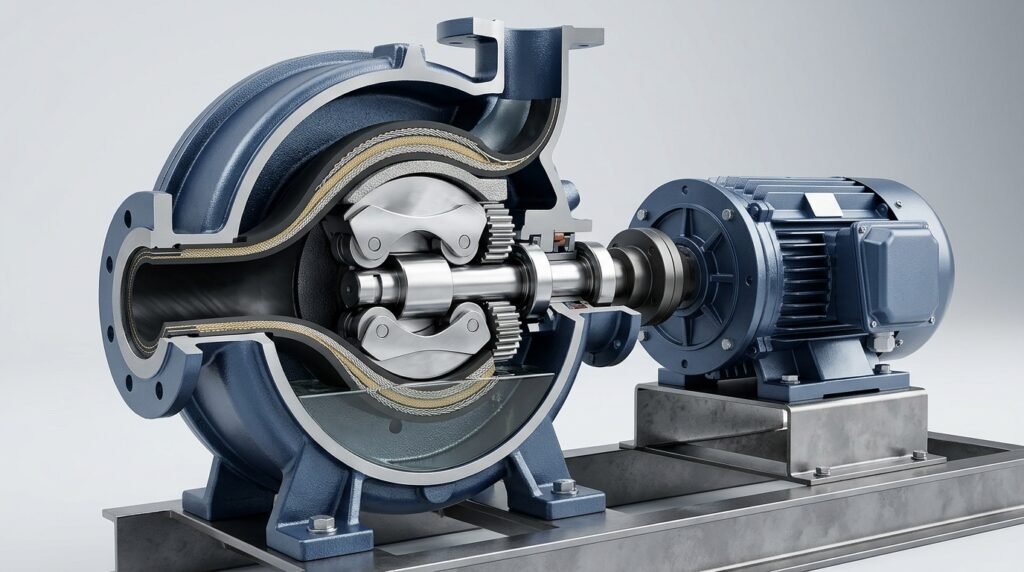
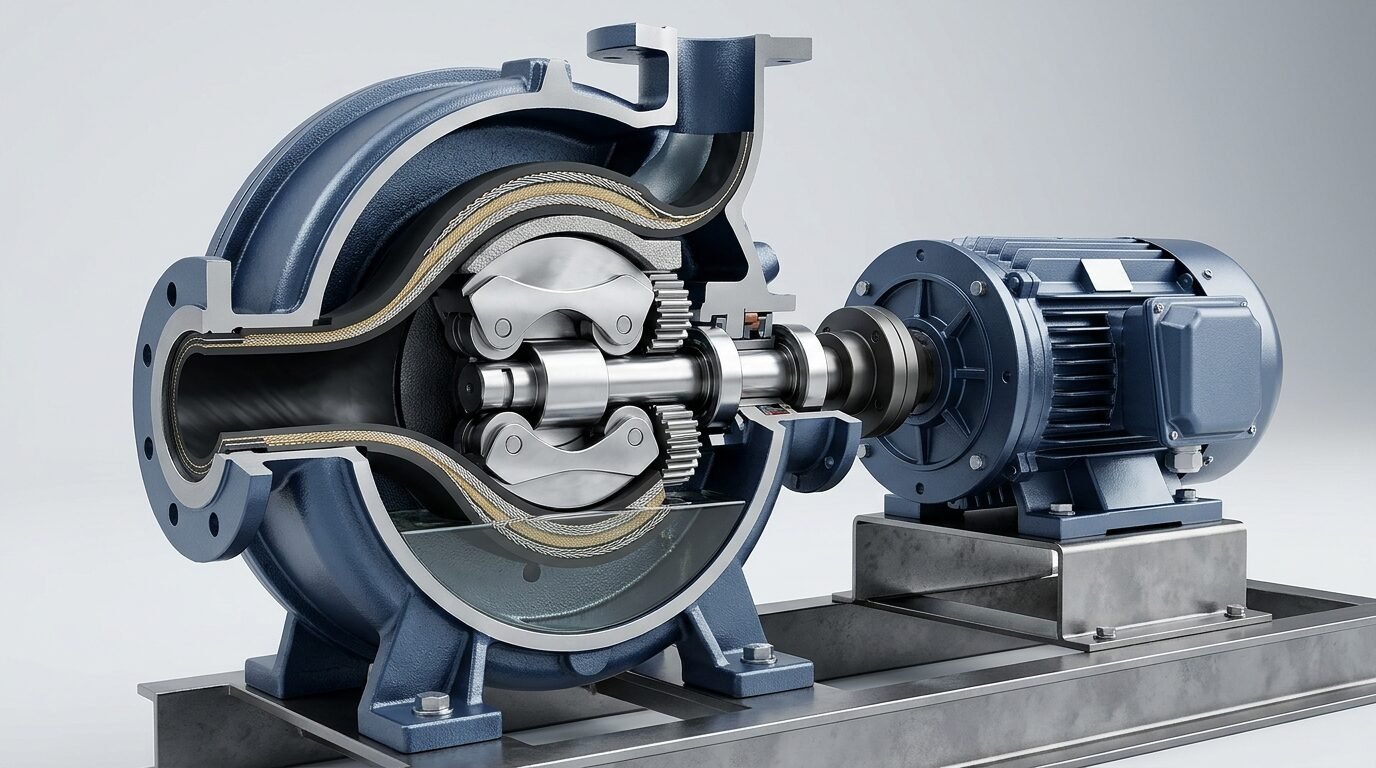
A heavy-duty peristaltic hose pump consists of a reinforced elastomeric hose laid along a semi-circular machined track inside a cast iron casing. A central rotor equipped with two opposing compression shoes (or low-friction rollers) rotates continuously inside the housing:
- Occlusion Phase: As a shoe passes over the hose, it compresses the tube flat against the circular casing track. This flattens the internal bore to zero, creating a positive mechanical seal line that pushes trapped liquid forward into the discharge nozzle.
- Restitution Phase: As the shoe leaves the hose, the natural elastic resilience and textile reinforcement of the tube cause it to recover its circular cross-section immediately. This rapid restitution generates a deep vacuum (up to 0.95 bar suction lift) that draws fresh liquid from the suction line.
Because two shoes compress the semi-circular track (180^° arc each) during one full revolution, the swept volumetric displacement per revolution (Vrev) equals exactly two track lengths of fluid bore volume:
Where:
- Vrev is geometric displacement per shaft revolution (m³/rev or $L/rev$)
- di is the internal bore diameter of the hose (m or mm)
- Dtrack is the centerline pitch diameter of the circular compression track (m or mm)
Theoretical flow rate (Qth) scales with shaft rotational speed (N):
Actual delivered flow (Qact) equals theoretical flow multiplied by volumetric efficiency (ηv):
When the shoe shims are correctly adjusted to provide 100% complete occlusion, backward slip leakage is zero (Qslip = 0), giving a near-perfect volumetric efficiency of ηv = 0.98 → 1.00 (98% → 100%), completely independent of fluid viscosity or discharge pressure.
2. Occlusion Shimming Mechanics: Zero Slip vs Cord Destruction
The most critical maintenance adjustment on a peristaltic hose pump is shoe shimming (occlusion calibration). Shims placed behind the compression shoes dictate the exact compression gap between the shoe face and the casing track.
When a hose is compressed, the required clearance gap (tgap) to achieve 100% occlusion is exactly twice the nominal wall thickness of the hose (twall):
| Occlusion Setting | Physical Mechanical Condition | Hydraulic Consequence | Impact on Hose Life |
|---|---|---|---|
| Under-Occlusion (Gap Too Wide) | Hose is compressed to 2.1 × twall to 2.3 × twall, leaving micro-gaps | Severe internal backward slip flow (Qslip). High-velocity fluid jetting erodes inner rubber liner | Flow rate collapses by 30% to 50%; premature internal liner erosion within 400 hours |
| Exact Occlusion (Calibrated Shimming) | Hose is compressed to exactly 2.0 × twall minus small elastomer compression allowance | Zero internal slip (Qslip = 0). Pump holds full 16 bar rating with 99% volumetric efficiency | Optimal flexural life achieved (2,000 to 3,500 continuous operating hours) |
| Over-Occlusion (Gap Too Tight) | Hose is over-compressed to 1.7 × twall to 1.8 × twall by excessive shimming | Extreme compressive contact stress crushes the embedded high-tensile textile cords | Catastrophic cord delamination; longitudinal hose rupture within 150 to 300 hours |
Pressure-Dependent Shimming Rule: Shimming thickness must match actual discharge operating pressure. Pumping against 2 bar requires less occlusion force than pumping against 12 bar. Over-shimming a low-pressure pump to maximum 16-bar specification needlessly destroys hoses through cord fatigue.
3. Tube Flex Fatigue Kinetics & Rotational Speed De-rating
Every time a compression shoe flattens the hose, the elastomeric compound and textile reinforcement experience severe alternating tensile and compressive strain cycles.
The total accumulated stress cycles (Ncycles) experienced by a peristaltic hose operating for thours with two shoes is:
For example, operating at 60 RPM subjects the hose to 7,200 severe compression flex cycles per hour, or 172,800 cycles per day.
Hose failure follows classical elastomeric flex fatigue kinetics (Wöhler S-N curve). Total operating hours to failure (tfailure) scales inversely with rotational speed (N) and discharge pressure (P):
4. Worked Engineering Calculation: Sizing an Abrasive Lime Milk Dosing Pump
To demonstrate rigorous peristaltic pump engineering, we size equipment for a municipal water treatment facility transferring abrasive lime milk (hydrated calcium hydroxide slurry) for pH neutralization.
Step 1: Calculate Total Differential Operating Pressure
Differential pressure comprises elevation static head plus pipe friction minus suction head:
Practical Takeaway: The peristaltic pump must overcome a net differential operating pressure of 5.535 bar (80.3 psi).
Step 2: Determine Required Pump Displacement and Frame Size
To satisfy our strict wear longevity limit (N ≤ 22 RPM) at a flow rate of 125.0 L/min, assuming 100% volumetric efficiency (ηv = 1.00 on fully occluded hose):
From heavy-duty industrial peristaltic pump catalogs, we select a DN65 (65 mm internal bore) Heavy Hose Pump having:
- Internal hose bore: di = 65.0 mm = 0.065 m
- Compression track centerline diameter: Dtrack = 740 mm = 0.740 m
Calculating nominal swept displacement per revolution:
Actual operating shaft rotational speed is:
Practical Takeaway: Running at only 16.2 RPM is well below our 22 RPM ceiling, providing exceptional hose longevity exceeding 3,000 operating hours.
Step 3: Hydraulic Work and Shaft Brake Power Calculation
Net hydraulic power delivered to the lime slurry:
In shoe-type peristaltic pumps, mechanical friction arises from two primary mechanisms:
- Sliding friction between the steel shoe and lubricated outer rubber hose cover (μfriction ≈ 0.04 in glycerine bath)
- Hysteretic mechanical energy dissipation required to repeatedly deform and flatten the thick reinforced rubber tube
Total mechanical efficiency for a shoe-type peristaltic pump operating at 5.5 bar is determined from dynamometer testing as ηm = 0.480 (48.0%).
Step 4: Running Torque, Starting Breakaway Torque & Gearmotor Sizing
Continuous shaft operating torque:
Cold startup breakaway torque factor on peristaltic pumps is typically 1.85 to account for stationary flattened elastomer set:
Factoring a 1.40 service factor for continuous abrasive lime slurry duty:
We specify a standard 4.0 kW (5.5 HP) 4-pole inverter-duty gearmotor with an integrated helical-bevel reduction gearbox (1440 RPM arrow 16.2 RPM, exact ratio $88.9:1$) driven via an adjustable speed drive (VFD).
| Sizing Parameter | Design Governing Formula | Calculated Engineering Value | Itemized Engineering Status |
|---|---|---|---|
| Delivered Lime Slurry Flow (Qact) | Water treatment neutralization duty | 7.50 m³/h (125.0 L/min) | Process Requirement Met |
| Lime Slurry Density ($ ho$) |
Hydrated lime at 22% solids | 1,180 kg/m³ (SG = 1.18) | Rheology Verified |
| Elevation Static Pressure (Pstatic) | ho · g · Zd / 105 (16.0 m lift) | 1.851 bar (185.1 kPa) | Vertical lift reconciled |
| Discharge Pipe Friction (hfd) | Laminar lime paste flow in DN65 pipe | 3.800 bar (380.0 kPa) | Pipeline resistance verified |
| Total Net Pressure (Δ Ptotal) | Pstatic + hfd – Psuction | 5.535 bar (553.5 kPa) | 100% Itemized Sum |
| Selected Pump Frame Size | DN65 Heavy Industrial Hose Pump | d_i = 65 mm, D_track = 740 mm | Manufacturer Standard |
| Swept Displacement (Vrev) | π² · di² · Dtrack / 4 | 7.714 L/rev | Calculated Swept Volume |
| Operating Shaft Speed (Nactual) | Qact / Vrev | 16.20 RPM | Well below 22 RPM limit |
| Hydraulic Fluid Power (Phyd) | Qact × Δ P / 36 | 1.153 kW | Net fluid work |
| Mechanical Efficiency (etam) | Shoe sliding friction & hose hysteresis | 48.0% | Calibrated Test Index |
| Shaft Brake Power (Pbrake) | Phyd / etam | 2.402 kW | Continuous Shaft Demand |
| Running Torque (Trunning) | Pbrake × 9549 / N | 1,415.8 N·m | Continuous drive torque |
| Breakaway Starting Torque | Trunning × 1.85 | 2,619.2 N·m | Gearbox rated for cold start |
| Specified Electric Motor | Pbrake × 1.40 Service Factor | 4.0 kW (5.5 HP) Geared Motor | Zero Risk of Overload |
5. Peristaltic Pump Troubleshooting & Root Cause Analysis
| Observed Fault Symptom | Primary Root Cause | Engineering Consequence | Corrective Action |
|---|---|---|---|
| Longitudinal Split in Hose Outer Cover | Over-shimming shoes, causing excessive compressive stress that crushes internal textile cords | Hose ruptures along outer spine, leaking product into lubricant bath | Remove shims; re-shim to manufacturer thickness matching actual discharge pressure |
| Sudden 40% Drop in Flow Rate | Under-shimming shoes, allowing internal slip flow (Qslip) backward under pressure | Pump loses volumetric efficiency; back-jetting causes accelerated internal liner erosion | Add shims behind shoes in 0.5 mm increments until backward slip is eliminated |
| Lubricant Sight Glass Shows White/Milky Fluid | Hose punctured or ruptured from fatigue; lime slurry leaking into casing lubricant | Abrasive slurry contaminates rotor bearings and shoe sliding surfaces | Shut down pump immediately; replace hose; flush casing and refill with fresh glycerine lubricant |
| Excessive Casing Temperature (>80°C) | Low lubricant level in casing or operating at excessive rotational speed (>50 RPM) | Elastomer degrades rapidly from thermal softening, causing premature hose delamination | Verify lubricant level to center of sight glass; reduce shaft speed; install external cooling loop |
| Violent Discharge Piping Hammer and Shudder | Reciprocating flow pulsation as shoes leave the track, causing liquid column deceleration | Piping flanges leak; instrument sensors flutter; pipe supports crack | Install an in-line bladder pulsation dampener charged with nitrogen to 75% of operating pressure |
6. B2B Engineering RFQ Specification Checklist
Industrial Peristaltic Hose Pump Technical Specification Guide
- Slurry Rheology & Solids Characterization: Specify fluid specific gravity, dynamic viscosity at operating shear rates, dry solids concentration (%), and particle size distribution. For aggressive abrasive slurries, evaluate upstream de-gritting using hydrocyclone solid-liquid separators to prevent unnecessary piping and hose liner wear.
- Hose Elastomer Formulation: Select hose elastomer compound matching fluid chemistry: Natural Rubber (NR) for high-abrasion slurries and lime milk, Nitrile (NBR) for oily sludges and hydrocarbons, EPDM for corrosive acids and hot caustic, or Hypalon (CSM) for strong oxidizing chemicals.
- Operating Speed & Frame Selection: Mandate continuous shaft operating speed beneath 25 RPM for 24/7 industrial duties. Require vendors to quote the next larger pump frame size if catalog selection requires speeds exceeding 30 RPM.
- Rotor Compression Architecture: Specify shoe-type compression with precision ground shims for heavy discharge pressures above 6 bar. For low-pressure duties beneath 4 bar, evaluate roller-type compression to eliminate sliding friction and reduce drive power.
- Lubricant Bath & Leak Detection: Mandate food-grade vegetable glycerine or synthetic silicone lubricant bath with external sight glass. Specify high-conductivity or optical hose rupture sensors installed in the lower casing drain to trigger immediate emergency pump shutdown upon tube breach.
- Pulsation Attenuation: Require matching in-line flow-through bladder pulsation dampeners equipped with nitrogen pre-charge valves and pressure gauges to absorb hydraulic shock.
Free tools for this topic: Pump power calculator · Pump affinity laws calculator · Equipment fault finder · all free engineering tools
Frequently Asked Questions
Sources and further reading
For standards, data and independent guidance on this topic, see Hydraulic Institute (pump standards and user guidance), US Department of Energy pump systems resources (pump efficiency guidance), American Petroleum Institute (pump and seal standards) and The Engineering ToolBox (engineering reference data and calculators). Always check the current edition and your site conditions before applying any figure.
Free tool for this topic
Pump Power & Motor Size CalculatorHydraulic power, shaft power and recommended motor rating for centrifugal pumps from flow, head, density and efficiency. Pumps, Valves and PipingVertical Turbine vs Submersible Pumps: Deep Well Sizing & Sump Hydraulics
 Pumps, Valves and PipingDarcy-Weisbach Pressure Drop Calculation: Pipe Flow & Friction Factor Math
 Pumps, Valves and PipingOrifice Plate Flow Meter Sizing: ISO 5167 Calculation & Beta Ratio
 Pumps, Valves and PipingPositive Displacement Pumps: Rotary Gear vs Lobe vs Vane Selection Guide
 Pumps, Valves and PipingMagnetic Drive vs Canned Motor Pumps: Zero-Leakage Toxic Sizing Guide
 Pumps, Valves and PipingSelf-Priming Centrifugal Pumps: Working Principles & Priming Time Math