

On this page
- Vacuum crystallizer diagram: parts and their functions
- Start with the solubility question
- Cooling versus antisolvent: comparison
- Why addition and mixing matter
- What to include in a development brief
- An illustrative decision
- Can cooling and antisolvent addition be combined?
- Questions to take to a specialist
- Source
- Sources and further reading
- More on Boilers, Chillers and Thermal
Short answer: Cooling crystallization changes temperature to create supersaturation where the solubility of a product falls as the solution cools. Antisolvent crystallization changes the solvent mixture by adding a liquid in which the product is less soluble. Both approaches can be used in solution crystallization, and a process may combine them. The right choice depends on measured solubility, product quality, solvent handling and the process constraints.
Vacuum crystallizer diagram: parts and their functions
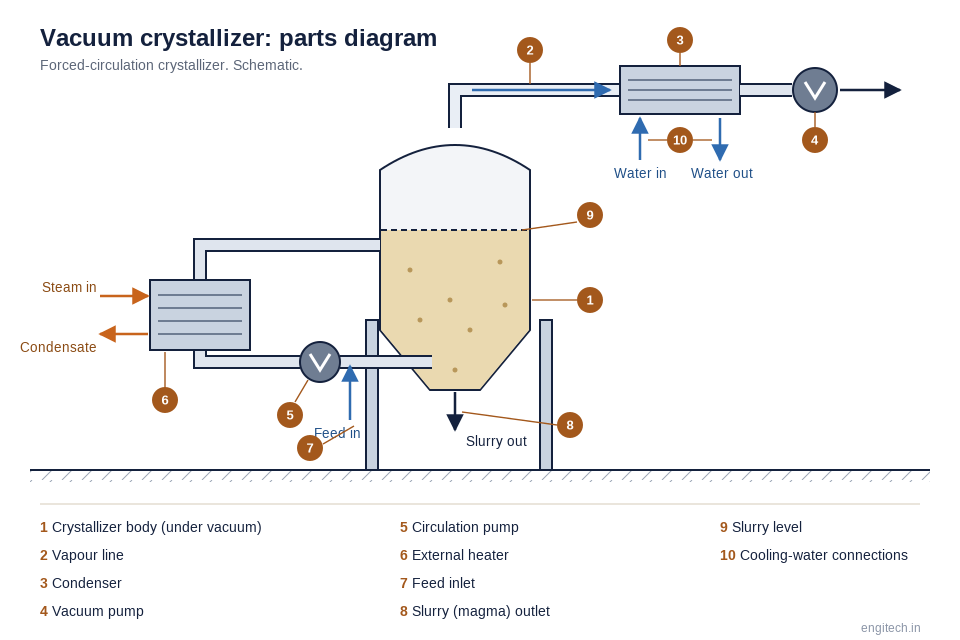
| No. | Part | What it does |
|---|---|---|
| 1 | Crystallizer body | The vessel kept under vacuum. The liquid flashes here, which cools it and removes some of the solvent, so crystals form. |
| 2 | Vapour line | Carries the vapour from the vessel to the condenser. |
| 3 | Condenser | Turns the vapour back into liquid. This also helps hold the vacuum. |
| 4 | Vacuum pump | Removes air and gases that do not condense, so the vessel stays at low pressure. |
| 5 | Circulation pump | Keeps the slurry moving round the loop between the vessel and the heater. |
| 6 | External heater | Warms the circulating slurry. The pressure is kept high enough in the heater to stop it boiling there. |
| 7 | Feed inlet | Fresh solution enters the circulation loop here. |
| 8 | Slurry outlet | The mixture of crystals and mother liquor leaves here, normally to a separator such as a centrifuge. |
| 9 | Slurry level | The surface of the slurry in the vessel. |
| 10 | Cooling-water connections | The cooling water goes into the condenser and leaves it. |
Download this diagram (SVG)Schematic for learning. Real machines vary by maker and duty.
Start with the solubility question
A crystallization team first needs to understand how much of its product dissolves under the conditions being considered. A temperature-dependent solubility curve helps evaluate cooling. For an antisolvent approach, the team also needs solubility information across relevant solvent compositions and temperatures. These data are specific to the product, solvents and conditions; one published example is not a recipe for another material.
Mettler Toledo’s antisolvent application example describes how cooling or changing solvent composition can generate supersaturation, and shows how antisolvent addition rate affected the particles in a particular benzoic-acid system. It is an illustration of process sensitivity, not a universal operating procedure.
Cooling versus antisolvent: comparison
| Question | Cooling approach | Antisolvent approach |
|---|---|---|
| What changes? | Temperature is reduced within the permitted range. | Solvent composition changes as antisolvent is added. |
| Key starting data | Solubility against temperature, thermal limits and desired product properties. | Solubility in solvent mixtures, compatibility, and the conditions under which a solid forms. |
| Process questions | How will temperature, mixing and heat removal be managed at the intended scale? | How will addition rate, location and mixing affect local conditions and particles? |
| Downstream questions | Can the resulting solids be separated and dried to specification? | How will the mixed solvents be separated, recovered or disposed of, and how will residual solvents be assessed? |
Why addition and mixing matter
When an antisolvent enters a vessel, it does not instantly produce identical conditions everywhere. The manufacturer example identifies addition rate, addition location and mixing as factors affecting local supersaturation. A development team can compare these variables with the resulting particle observations, rather than assuming that a successful small-scale result will transfer unchanged to another vessel.
Crystal size, shape and agglomeration influence later handling and separation. They should be measured using an agreed method and evaluated alongside form, purity and yield. A change that improves one property may affect another; document the trade-off and the evidence.
What to include in a development brief
- Material identity and quality target: product and known impurities, desired solid form and relevant particle and purity requirements.
- Solvent information: solvent and potential antisolvent identities, composition ranges, solubility data and the source of those data.
- Process envelope: known temperature restrictions, available equipment, intended scale, mixing and heat-transfer constraints.
- Downstream needs: filtration, washing, drying, solvent recovery and the tests used for product acceptance.
- Safety and environment: chemical compatibility, exposure, flammability where applicable, waste management and site-specific hazard review. Follow current safety data sheets and local requirements.
Do not choose a solvent, addition rate or temperature from a general article. A qualified process team should develop and review the procedure for the specific material and equipment.
An illustrative decision
Hypothetical example: A team finds that a product’s measured solubility changes only modestly across its permitted cooling range. It considers whether changing solvent composition could provide a useful alternative. Before proposing a process, the team asks for mixture-solubility data, product-form testing and an assessment of solvent recovery. This scenario describes a question to investigate; it is not a project performed by Jignesh or a claim that antisolvent addition will work for a particular product.
Can cooling and antisolvent addition be combined?
They can be combined in some solution processes, but the sequence and conditions need development for the material system. The team should evaluate the combined temperature and composition changes, the solid produced and downstream consequences rather than treating either method as automatically better.
Questions to take to a specialist
- What solubility and solid-form information is missing?
- Which particle properties matter to filtration, drying and the final use?
- How will temperature, addition and mixing be monitored at the intended scale?
- What checks are needed for solvent recovery, worker exposure and waste?
- Which experiments or supplier data would resolve the largest uncertainties?
For the wider terminology, see our guide to crystallization methods. Its remaining examples are under editorial review.
Source
Mettler Toledo, Using AntiSolvent for Crystallization, accessed 4 November 2026. The manufacturer’s example concerns a specific material system and instrument setup.
Free tools for this topic: Heating time and energy calculator · Tank volume calculator · all free engineering tools
Sources and further reading
For standards, data and independent guidance on this topic, see NABL (accredited calibration and testing laboratories), NIST (measurement and calibration standards) and Bureau of Indian Standards (Indian standards catalogue). Always check the current edition and your site conditions before applying any figure.
Free tool for this topic
Steam Boiler Efficiency & Fuel Consumption CalculatorCalculate direct steam boiler thermal efficiency, steam-to-fuel evaporation ratio, thermal duty (MW) and fuel heat input. Boilers, Chillers and ThermalCrystallizers and Crystallization: Principles, Types, and Applications
 Boilers, Chillers and ThermalFurnace Repair: Expert Insights and Practical Tips
 Boilers, Chillers and ThermalExplore the Different Types of Heat Exchangers: Guide | EngiTech
 Boilers, Chillers and ThermalExpert Guide to Boiler Services and Installation
 Boilers, Chillers and ThermalFurnaces: Understanding Types, Applications, and Expert Insights
 Boilers, Chillers and ThermalSpiral Heat Exchangers: Working Principle, Specs & Selection