
On this page
- Spray dryer diagram: parts and their functions
- What is Spray Drying?
- The Spray Drying Process in Pharmaceuticals
- Applications of Spray Drying in Pharmaceuticals
- Benefits of Spray Drying in Pharmaceuticals
- Key Considerations in Spray Drying Pharmaceuticals
- Advances in Spray Drying Technology for Pharmaceuticals
- The pharmaceutical spray drying process, step by step
- What spray drying is used for in pharma
- Key process parameters
- GMP and scale-up points
- Conclusion
- 🛠️ Recommended Engineering Guides & Tools
- Sources and further reading
- More on Industrial Dryers
Spray drying plays a major role in the pharmaceutical industry by improving the solubility, stability, and bioavailability of pharmaceutical compounds. This detailed guide explores the spray drying process, its applications in pharmaceuticals, the benefits it offers, and the latest advancements in this field.
Spray dryer diagram: parts and their functions
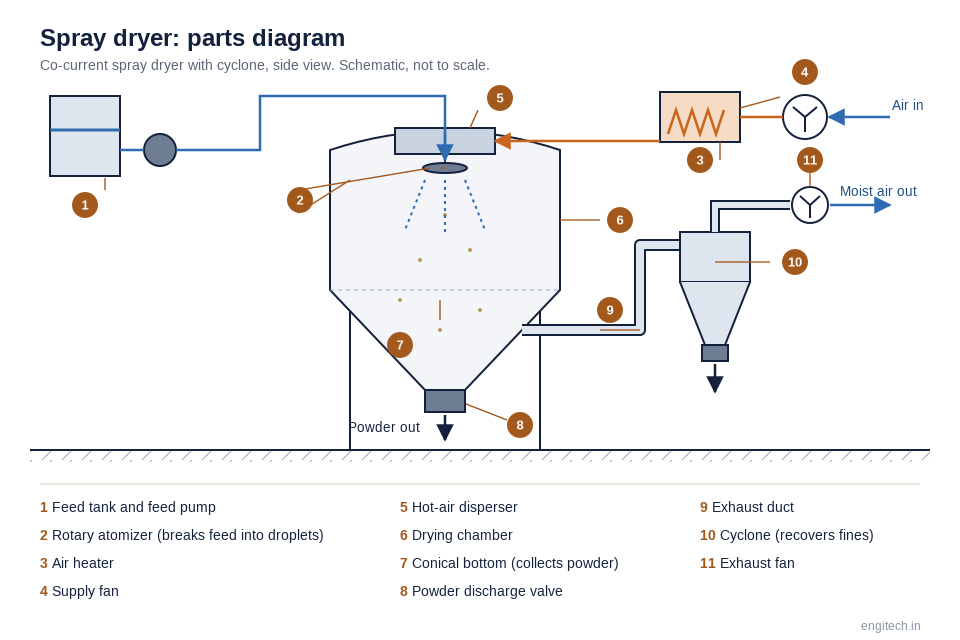
| No. | Part | What it does |
|---|---|---|
| 1 | Feed tank and feed pump | Hold the liquid feed and send it to the atomizer at a controlled rate. |
| 2 | Rotary atomizer | A fast-spinning wheel that breaks the liquid feed into fine droplets. Spray dryers can also use nozzle atomizers. |
| 3 | Air heater | Heats the drying air before it enters the chamber. It can be steam, electric or fuel fired. |
| 4 | Supply fan | Draws in air and pushes it through the heater into the chamber. |
| 5 | Hot-air disperser | Spreads the hot air evenly around the atomizer so the droplets dry in a controlled way. |
| 6 | Drying chamber | Large vessel in which the droplets dry as they fall. Water evaporates quickly because each droplet has a very large surface area. |
| 7 | Conical bottom | Guides the dried powder to the outlet at the bottom. |
| 8 | Powder discharge valve | A rotary valve that removes the powder without letting much air in. |
| 9 | Exhaust duct | Carries the cooled, moist air and fine powder out of the chamber to the cyclone. |
| 10 | Cyclone | Spins the exhaust gas so the fine powder drops out and is collected, which reduces product loss. |
| 11 | Exhaust fan | Pulls air through the system and keeps the chamber at a slight negative pressure. A bag filter or scrubber is often added after the cyclone. |
Download this diagram (SVG)Schematic for learning. Real machines vary by maker and duty.
What is Spray Drying?
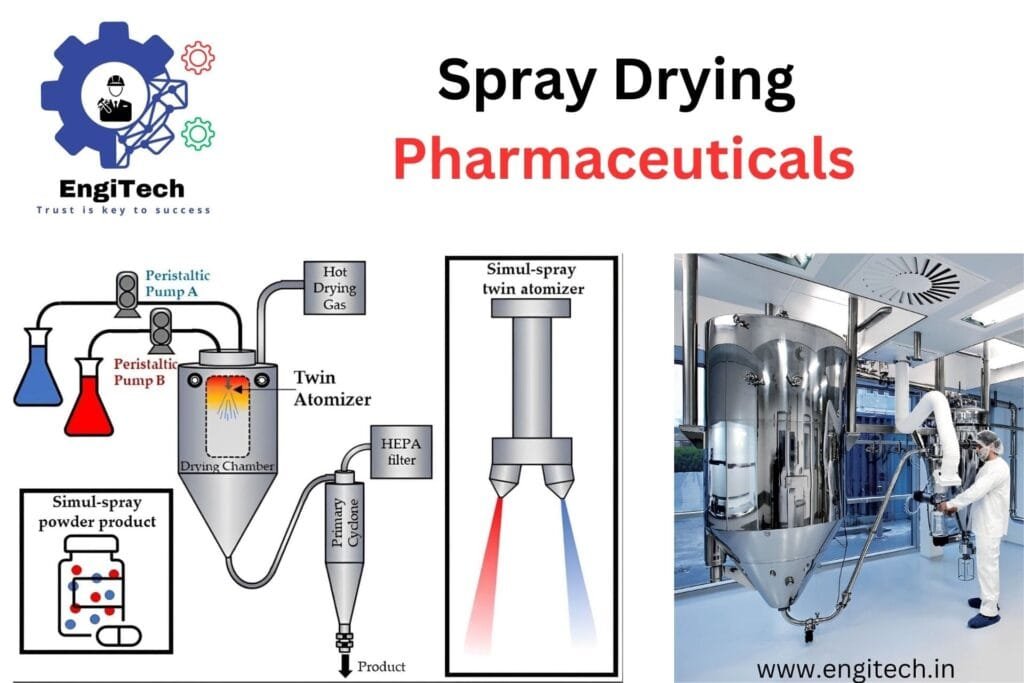
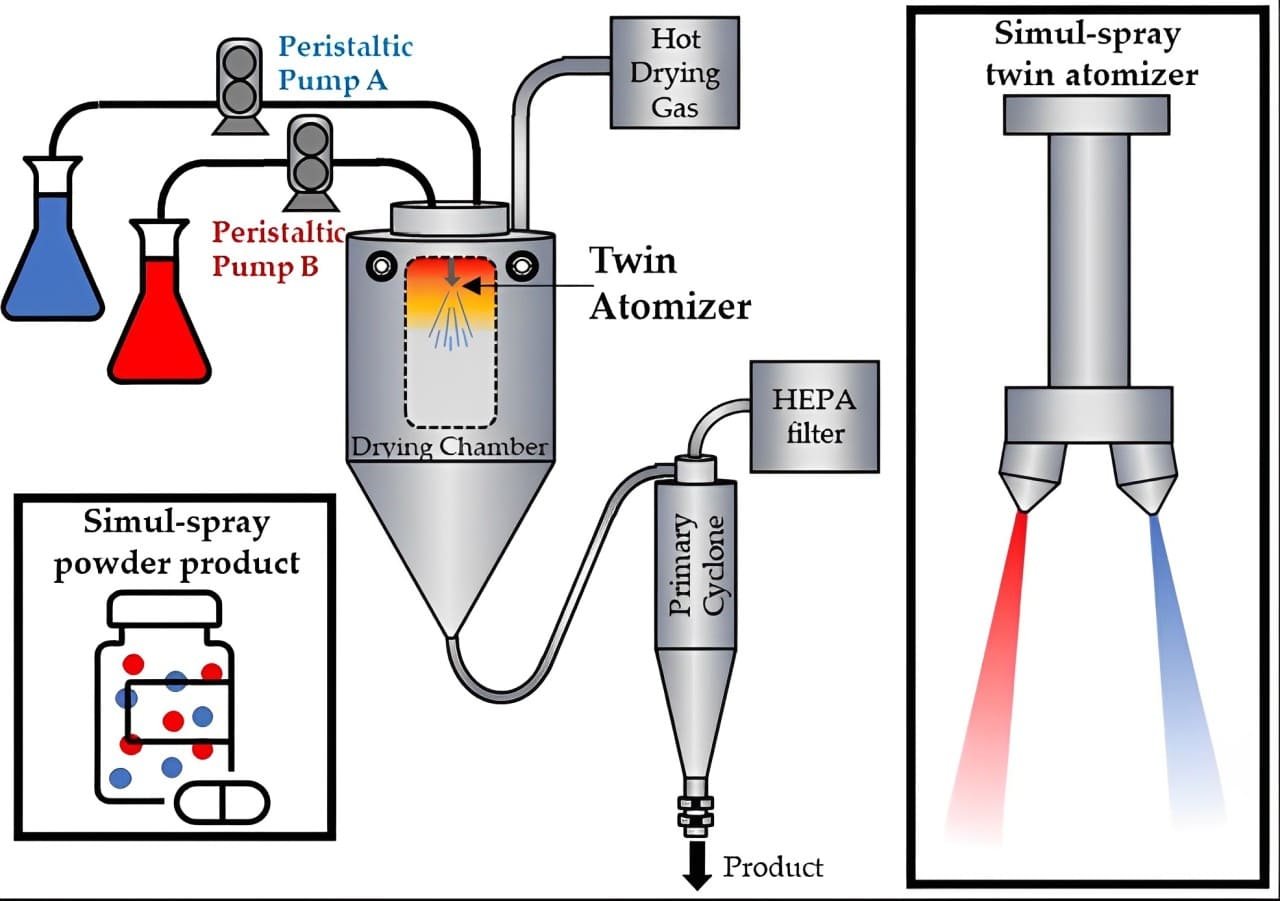
Spray drying converts a liquid or slurry into a dry powder by rapidly drying it with a hot gas. In pharmaceuticals, the primary goal of spray drying is to produce a fine, consistent, and stable powder for various drug formulations. The process involves three main steps: atomization, drying, and collection.
The Spray Drying Process in Pharmaceuticals
1. Atomization: In the first step, you atomize the liquid feed (a solution or suspension of the pharmaceutical compound) into fine droplets using a spray dryer. The atomizer, either a rotary atomizer or a nozzle atomizer, breaks the liquid into tiny droplets, increasing the surface area for efficient drying.
2. Drying: Next, the fine droplets enter a drying chamber where they contact hot air. The hot air temperature ranges from 100°C to 200°C, depending on the thermal sensitivity of the pharmaceutical compound. As the droplets encounter the hot air, the solvent rapidly evaporates, leaving behind solid particles.
3. Collection: Finally, you collect the solid particles using a cyclone separator or a bag filter. These particles, now in the form of a dry powder, are then further processed or formulated into the final pharmaceutical product.
Spray Drying Pharmaceuticals
Applications of Spray Drying in Pharmaceuticals
Spray drying offers a wide range of applications in the pharmaceutical industry:
1. Enhancing Solubility and Bioavailability: By converting drugs into an amorphous state and dispersing them in a polymer matrix, spray drying improves the solubility and bioavailability of poorly water-soluble drugs.
2. Producing Inhalable Powders: Spray drying produces inhalable powders for pulmonary drug delivery. The fine, uniform particles are ideal for delivery to the lungs, where they can be rapidly absorbed into the bloodstream.
3. Formulating Controlled Release Drugs: You can use spray drying to formulate controlled release drug products. The polymer matrix can release the drug at a controlled rate, providing a sustained therapeutic effect over an extended period.
4. Developing Vaccines and Biologics: Spray drying stabilizes sensitive biological molecules and converts them into a dry powder form, making vaccines and biologics easier to store and transport.
5. Encapsulating Active Pharmaceutical Ingredients (APIs): Spray drying encapsulates APIs in a protective matrix, shielding them from environmental factors such as moisture, heat, and light. This encapsulation enhances the stability and shelf life of the drug.
Benefits of Spray Drying in Pharmaceuticals
Spray drying offers several benefits in pharmaceutical development and manufacturing:
1. Enhanced Solubility and Bioavailability: Spray drying significantly improves the solubility and bioavailability of poorly water-soluble drugs, making them more effective for patient use.
2. Improved Stability: The amorphous form of the drug produced by spray drying is more stable than its crystalline counterpart, reducing the risk of degradation and improving shelf life.
3. Uniform Particle Size: Spray drying produces particles with a uniform size and shape, essential for consistent drug formulation and delivery.
See it in 3D
4. Scalability: You can easily scale the spray drying process, making it suitable for both small-scale and large-scale production. This flexibility ensures that spray drying can be used in various stages of drug development, from preclinical studies to commercial manufacturing.
5. Cost-Effective: Spray drying is a cost-effective method for producing high-quality pharmaceutical powders. It allows for efficient use of materials and energy, reducing overall production costs.
Key Considerations in Spray Drying Pharmaceuticals
When implementing spray drying in pharmaceutical development, consider these key factors:
1. Selection of Solvent: Choose a solvent that can dissolve the pharmaceutical compound and be easily removed during the drying process. Common solvents used in spray drying include water, ethanol, and acetone.
2. Optimization of Process Parameters: Optimize the spray drying process parameters, such as inlet temperature, feed rate, and atomization method, to ensure the formation of high-quality spray dried powders. These parameters can significantly impact the particle size, morphology, and stability of the final product.
3. Selection of Polymer: Select a polymer compatible with the drug and enhance its solubility. Commonly used polymers include hydroxypropyl methylcellulose (HPMC), polyvinylpyrrolidone (PVP), and ethyl cellulose.
4. Characterization of Spray Dried Powders: Thoroughly characterize the spray dried powders to ensure they meet the desired specifications. Evaluate the particle size distribution, morphology, solid-state properties, and dissolution rate of the powders.
5. Regulatory Considerations: Consider the regulatory requirements when developing spray dried pharmaceuticals. Ensure the safety and efficacy of the formulation and comply with guidelines set forth by regulatory agencies such as the FDA and EMA.
Advances in Spray Drying Technology for Pharmaceuticals
Recent advances in spray drying technology have further enhanced its capabilities and applications in pharmaceutical development:
1. Advanced Atomization Techniques: New atomization techniques, such as ultrasonic atomization, offer improved control over droplet size and distribution, resulting in more uniform particle sizes and enhanced product quality.
2. Real-Time Process Monitoring: Advanced process monitoring technologies provide real-time data on the spray drying process, allowing for precise control and optimization of the parameters. This ensures the consistent production of high-quality spray dried powders.
3. Integration with Continuous Manufacturing: Integrating spray drying with continuous manufacturing processes offers significant advantages in terms of efficiency and scalability. Continuous manufacturing allows for the production of large quantities of spray dried powders in a streamlined and cost-effective manner.
4. Use of Novel Excipients: The development of novel excipients with enhanced solubilizing properties has expanded the applications of spray drying. These new excipients offer improved compatibility with a wider range of drugs, further enhancing the solubility and bioavailability of challenging compounds.
5. Formulation of Biologics: Spray drying technology is now being applied to the formulation of biologics, including peptides and proteins. This offers new opportunities for improving the stability and delivery of these complex molecules.
The pharmaceutical spray drying process, step by step
- Feed preparation: the drug (API) and any polymer or excipient are dissolved or suspended in water or an organic solvent such as acetone, ethanol or methanol.
- Atomisation: a two-fluid nozzle, pressure nozzle or rotary atomiser breaks the feed into fine droplets, which sets the final particle size.
- Drying: droplets meet hot drying gas in the chamber; the solvent evaporates in seconds, so the product itself stays well below the inlet gas temperature.
- Separation: a cyclone, and often a bag filter, separates the powder from the gas.
- Solvent handling: with organic solvents, the dryer runs as a closed loop with nitrogen and a condenser to recover solvent and keep oxygen below explosive limits.
- Secondary drying: many products are dried further in a vacuum or tray dryer to reduce residual solvent to the limits in ICH Q3C.
What spray drying is used for in pharma
- Amorphous solid dispersions: drug and polymer dried together so a poorly soluble drug stays amorphous and dissolves better.
- Inhalation powders: particles of a few micrometres for dry powder inhalers.
- Biologics and vaccines: a gentler, faster alternative to freeze drying for some proteins and vaccines.
- Taste masking and controlled release: coating or encapsulating the drug in a polymer matrix.
- Excipients: spray-dried lactose and other excipients for direct compression.
Key process parameters
| Parameter | Effect |
|---|---|
| Inlet temperature | Sets the drying capacity; higher means more evaporation per hour. |
| Outlet temperature | The best indicator of product temperature and residual moisture or solvent. |
| Feed solids and rate | Affect particle size, density and yield. |
| Atomisation gas flow or speed | Finer atomisation gives smaller particles. |
| Drying gas flow | Affects residence time and cyclone efficiency. |
GMP and scale-up points
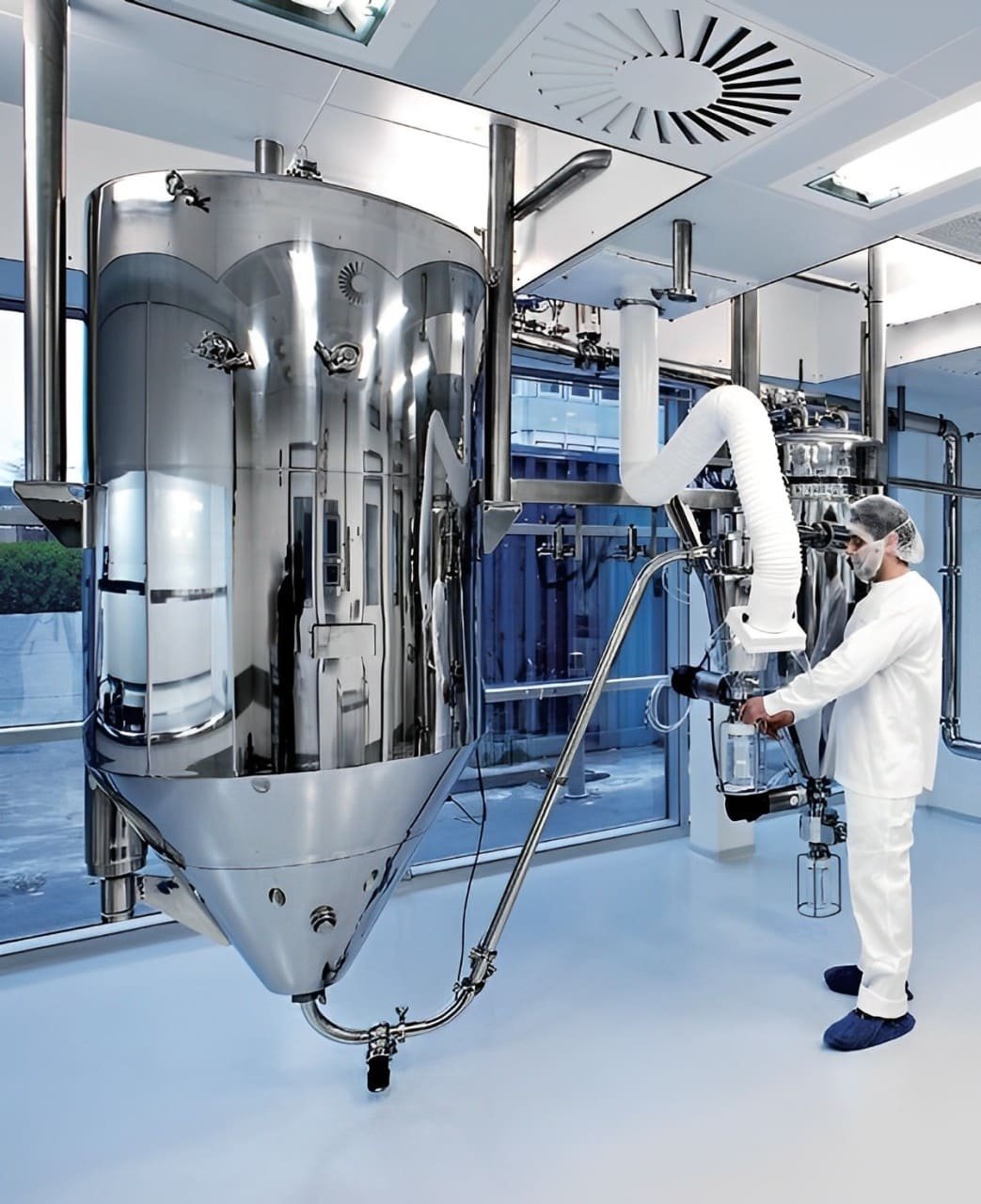
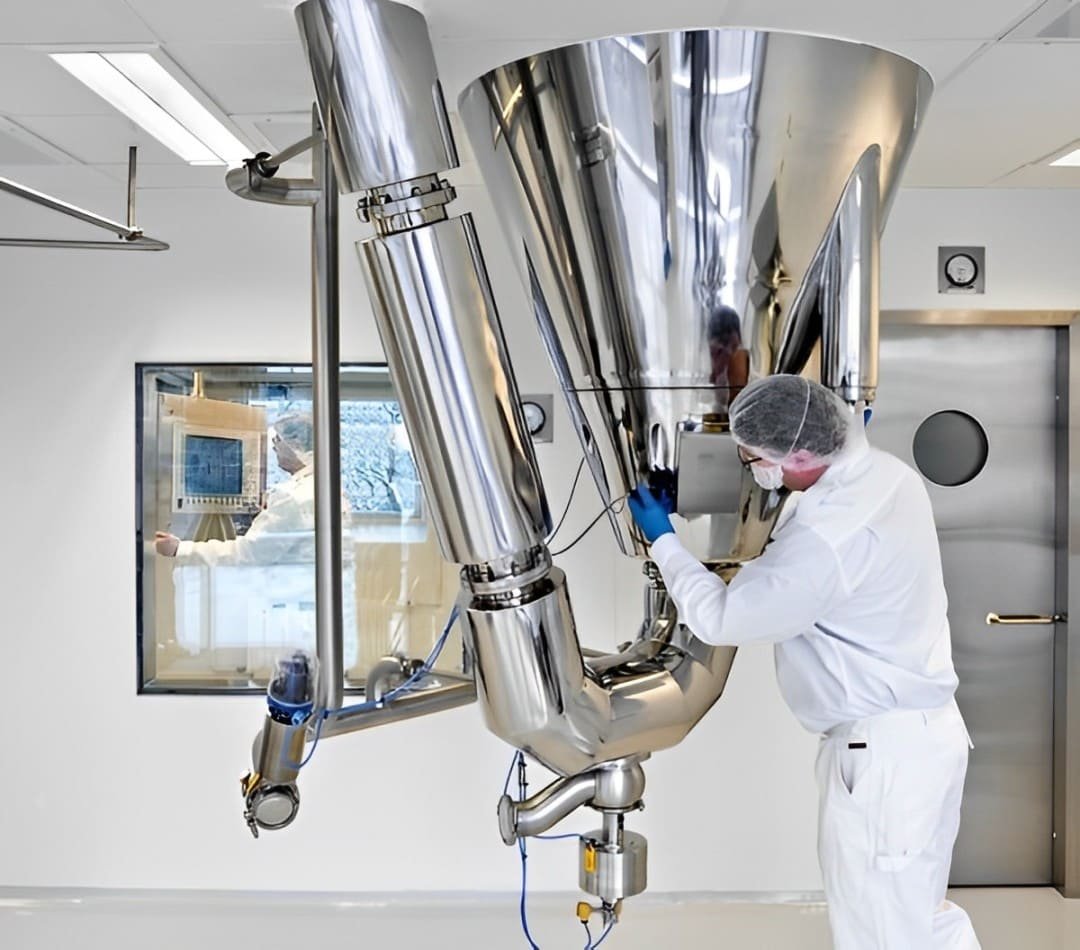
Pharmaceutical spray dryers are built for cleaning (CIP or easy dismantling), with product-contact surfaces in polished stainless steel and full batch records. Scale-up from lab to production keeps the outlet temperature and droplet size similar while increasing gas flow, and is confirmed by comparing particle size, residual solvent and solid form at each scale. See laboratory spray drying and spray dryers, and compare dryer types with the dryer selection tool.
Conclusion
Spray drying plays a powerful role in pharmaceutical development, offering significant benefits in terms of solubility, bioavailability, and stability. By understanding the process and key considerations involved, pharmaceutical professionals can leverage this technology to develop high-quality drug products that meet the needs of patients. Advances in spray drying technology continue to expand its applications and capabilities, making it an essential tool in modern drug development.
For more in-depth articles and resources on pharmaceutical technologies and innovations, visit EngiTech.in. Stay updated on the latest advancements and applications in the industry!
🛠️ Recommended Engineering Guides & Tools
Related reading: Spray Drying of Milk: Process & Benefits Explained; Lab Scale Spray Dryers: A Comprehensive Overview.
Free tools for this topic: Dryer selection tool · Dryer evaporation, heat and fuel calculator · all free engineering tools
Sources and further reading
For standards, data and independent guidance on this topic, see US Department of Energy process heating resources (industrial heating and drying efficiency), The Engineering ToolBox (engineering reference data and calculators) and Bureau of Energy Efficiency (energy audit and efficiency programmes in India). Always check the current edition and your site conditions before applying any figure.
Free tool for this topic
Industrial Dryer Evaporation, Heat & Fuel CalculatorWater evaporation, product output, heat load and fuel or steam consumption for spray, rotary, flash, fluid-bed and paddle dryers. Industrial DryersComprehensive Guide to Kiln Dryers
 Industrial DryersATFD Design Guide: Rotor Speed, Blade Clearances & Zero Liquid Discharge (ZLD)
 Industrial DryersSpin Flash Dryers: Rapid and Efficient Drying Solutions
 Industrial DryersPaddle Dryers: Types, Applications and Selection
 Industrial DryersAgitated Nutsche Filter Dryers (ANFD): Working Principle, Specs & Selection
 Industrial DryersSludge Drying Economics: Cost per Tonne of Water Evaporated