
On this page
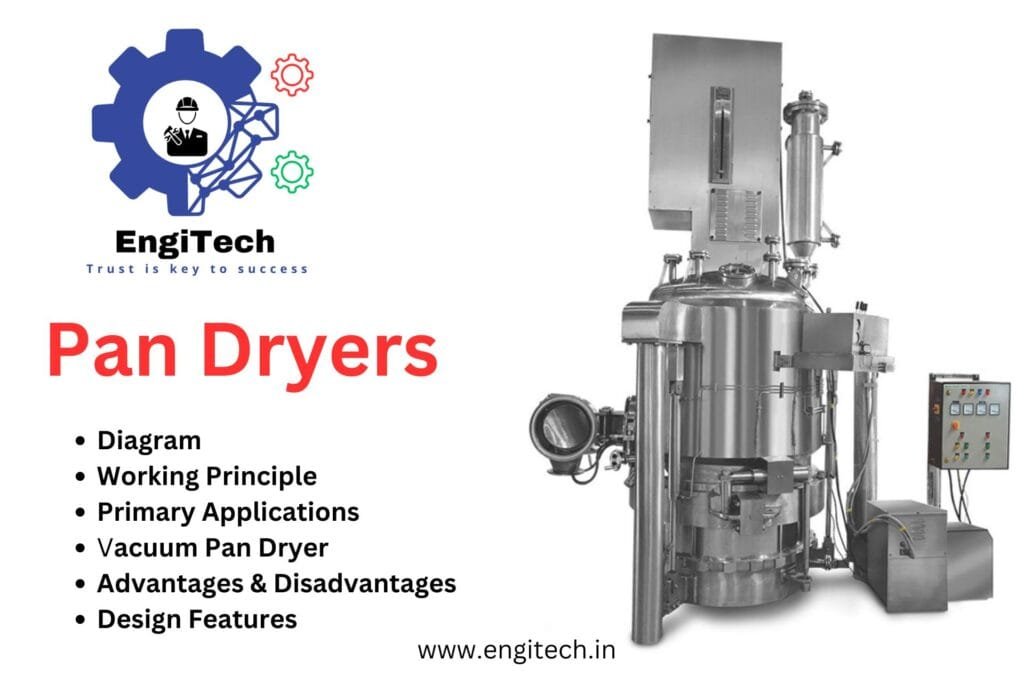
Pan dryers are vital to various industries, offering precise and efficient drying solutions for different materials. These dryers, especially vacuum pan dryers, provide a controlled environment that enhances drying efficiency while maintaining product integrity. This blog examines the detailed working principles of pan dryers, their configurations, and their wide-ranging applications in industries like pharmaceuticals, chemicals, and food processing.
Pan dryer diagram: parts and their functions

| No. | Part | What it does |
|---|---|---|
| 1 | Top drive | Motor and gearbox that turn the agitator slowly. |
| 2 | Charging nozzle | Where the wet cake or slurry is loaded into the pan. |
| 3 | Vapour outlet with dust filter | Vapour leaves through a filter that keeps fine product inside, then goes to a condenser and vacuum pump. |
| 4 | Pan (vessel) | Shallow cylindrical vessel that holds the batch. It usually runs under vacuum, so the liquid evaporates at a lower temperature. |
| 5 | Heating jacket | Steam or hot water in the jacket heats the pan wall and bottom. Heat reaches the product by contact (conduction). |
| 6 | Agitator shaft with seal | Passes through the cover. The seal holds the vacuum around the rotating shaft. |
| 7 | Agitator arms with scraper blades | Stir the bed, keep fresh material against the heated surface and move the product to the discharge. |
| 8 | Product bed | The batch being dried. |
| 9 | Jacket inlet | Steam or hot water enters the jacket. |
| 10 | Jacket outlet | Condensate or return water leaves the jacket. |
| 11 | Side discharge valve | Opened at the end of the batch. The agitator pushes the dry product out. |
| 12 | Supports | Carry the vessel. |
Download this diagram (SVG)Schematic for learning. Real machines vary by maker and duty.
Questions This Blog Will Answer:
- What is a pan dryer?
- How does a pan dryer work?
- What are the specifics of a vacuum pan dryer?
- What are the primary applications of pan dryers?
- What does the diagram of a pan dryer look like?
- What design features are essential in pan dryers?
What is a Pan Dryer?
A pan dryer is an industrial device used to dry solid and semi-solid materials. Commonly used in the pharmaceutical, chemical, and food industries, pan dryers offer high efficiency and can handle sensitive materials. They consist of a cylindrical pan that rotates or remains stationary while drying the material through direct or indirect heat transfer.
Agitated Pan Dryer Engineering Matrix (SI Metric & US Imperial)
Benchmark working batch volume, steam jacket pressure, vacuum rating, agitator shaft torque, and heated-pan evaporation flux.
| Pan Dryer Class | Working Volume (L | US gal) | Jacket Pressure (bar | psig) | Vacuum Level (mbar abs | Torr / inHg) | Agitator Speed & Torque (rpm | N·m / lb·ft) | Specific Evaporation (kg/m²·h | lb/ft²·h) |
|---|---|---|---|---|---|
| Pilot Atmospheric Pan | 100–300 L (26–79 US gal) | 2–4 bar (29–58 psig) | 1,013 mbar (760 Torr / 0 inHg vac) | 15–40 rpm · 150–400 N·m (110–295 lb·ft) | 4–10 kg/m²·h (0.8–2.0 lb/ft²·h) |
| Standard Vacuum Pan | 500–2,000 L (132–528 US gal) | 3–6 bar (44–87 psig) | 20–100 mbar (15–75 Torr / 27–29.3 inHg vac) | 8–25 rpm · 800–3,500 N·m (590–2,580 lb·ft) | 8–18 kg/m²·h (1.6–3.7 lb/ft²·h) |
| High-Torque Cake Pan | 2,500–6,000 L (660–1,585 US gal) | 4–8 bar (58–116 psig) | 10–50 mbar (7.5–38 Torr / 28.4–29.6 inHg vac) | 5–18 rpm · 4,000–14,000 N·m (2,950–10,325 lb·ft) | 10–22 kg/m²·h (2.0–4.5 lb/ft²·h) |
| Sanitary Pharma Nutsche-Pan | 300–4,000 L (79–1,057 US gal) | 2–6 bar (29–87 psig) | 5–30 mbar (3.8–22.5 Torr / 29.0–29.8 inHg vac) | 4–20 rpm · 1,200–9,000 N·m (885–6,640 lb·ft) | 6–16 kg/m²·h (1.2–3.3 lb/ft²·h) |
Pan Dryer Working Principle
The working principle of a pan dryer involves several key steps:
- Material Loading:
- Operators load the material into the pan dryer. This can be done manually or through automated systems for higher efficiency and safety.
- Heating:
- The pan dryer employs either direct or indirect heating methods. In direct heating, hot air passes over the material. Indirect heating involves heating the pan with steam, oil, or electric heaters, ensuring the material is not directly exposed to the heat source.
- Agitation:
- The pan might rotate, or an internal agitator stirs the material. This ensures even heat distribution and prevents clumping, leading to uniform drying.
- Drying Process:
- As the material heats, moisture evaporates and is carried away by an airflow system. The design ensures a controlled and consistent drying environment, maintaining the quality of the material.
- Material Discharge:
- Once the material reaches the desired moisture content, operators discharge it from the pan dryer. This step can also be automated to integrate smoothly into the production line.

Pan Dryer Diagram
Below is a simplified diagram of a typical pan dryer:
- Feed Hopper: Introduces wet material into the pan dryer.
- Heating Jacket: Surrounds the pan and provides indirect heating through steam, oil, or electric heaters.
- Agitator: Stirs the material to ensure even heat distribution and prevent clumping.
- Vacuum System: (For vacuum pan dryers) Reduces the pressure within the drying chamber to lower the boiling point of moisture.
- Air Outlet: Allows evaporated moisture to escape, typically connected to a condenser or exhaust system.
- Discharge Valve: Releases the dried material after the drying process is complete.
- Control Panel: Manages temperature, agitation speed, and vacuum pressure (if applicable).
Design Features of Pan Dryers
Pan dryers come with various design features to enhance their efficiency and usability:
- Construction Material:
- Typically made from stainless steel or other corrosion-resistant materials to withstand high temperatures and moisture.
- Insulated inner surfaces to minimize energy loss and enhance efficiency.
- Heating Systems:
- use various heating methods such as hot air, steam, oil, or electric heaters.
- Equipped with high-quality heat exchangers to ensure consistent heating and low air moisture.
- Air Circulation:
- Designed with an efficient air circulation system to improve airflow and decrease drying time.
- Air patterns can be counterflow, parallel flow, or combined flow to suit different drying requirements.
- Transport Mechanism:
- Use rollers or belt conveyors to move materials through the dryer.
- Conveyor speed and temperature settings can be controlled via a touchscreen panel for precise drying conditions.
- Control Systems:
- Feature advanced control mechanisms for accurate temperature and airflow management.
- Available in automated or semi-automated configurations for ease of operation.
Specifics of Vacuum Pan Dryer
A vacuum pan dryer operates on similar principles but incorporates a vacuum to enhance drying efficiency. Here’s how it works:
See it in 3D
- Vacuum Application:
- A vacuum pump reduces the pressure within the drying chamber, lowering the boiling point of the moisture in the material. This allows drying at lower temperatures, which is essential for heat-sensitive materials.
- Low-Temperature Drying:
- The reduced boiling point due to the vacuum enables drying at lower temperatures, preventing thermal degradation of the material.
- Increased Efficiency:
- The vacuum environment increases the drying rate and improves energy efficiency, making the process faster and more cost-effective.
- Closed System:
- The vacuum pan dryer operates as a closed system, which prevents contamination and ensures a clean drying process.
Primary Applications of Pan Dryers
Pan dryers are versatile and find applications across various industries due to their ability to handle different materials and drying requirements. Here are some primary uses:
- Pharmaceutical Industry:
- Drying Active Pharmaceutical Ingredients (APIs): Pan dryers ensure that APIs achieve the desired moisture content without degradation, essential for maintaining their efficacy.
- Drying Granules and Powders: Pan dryers provide uniform drying, essential for consistent tablet production.
- Chemical Industry:
- Drying Fine Chemicals and Intermediates: Pan dryers offer precise control over drying conditions, vital for chemical processes.
- Handling Temperature-Sensitive Materials: Vacuum pan dryers are particularly beneficial for drying temperature-sensitive chemicals, maintaining their stability and integrity.
- Food Industry:
- Drying Food Ingredients: Pan dryers are used for drying spices, herbs, and other food additives, ensuring they retain their quality and flavor.
- Preserving Nutrients: Vacuum pan dryers help preserve the nutritional content of food products by drying them at lower temperatures.
- Cosmetics Industry:
- Drying Powders and Pastes: Pan dryers ensure uniform consistency and quality in cosmetic products.
- Preserving Active Ingredients: Vacuum drying helps maintain the efficacy of active ingredients in cosmetics, essential for product performance.
Advantages of Pan Dryers
- Uniform Drying:
- Pan dryers ensure even drying of materials due to their design and agitation mechanism, leading to high-quality results.
- Versatility:
- They can handle a wide range of materials, including solids, semi-solids, and pastes, making them suitable for various industrial applications.
- Controlled Environment:
- Pan dryers allow precise control over drying conditions, ensuring the integrity and quality of the dried material.
- Efficiency:
- Vacuum pan dryers offer enhanced drying efficiency and faster drying times, reducing energy consumption and operational costs.
- Heat Sensitivity:
- Vacuum pan dryers are ideal for drying heat-sensitive materials due to their ability to dry at lower temperatures.
Disadvantages of Pan Dryers
- Initial Cost:
- The initial investment for pan dryers, especially vacuum pan dryers, can be high compared to other drying methods.
- Maintenance:
- Regular maintenance is required to ensure optimal performance and prevent downtime, adding to operational costs.
- Complexity:
- Advanced control systems and vacuum components add to the complexity of operation and maintenance, requiring skilled operators and technicians.
Conclusion
Pan dryers, particularly vacuum pan dryers, are essential in industries that require precise and controlled drying processes. Their ability to handle sensitive materials, provide uniform drying, and operate efficiently makes them a preferred choice for many applications. By understanding their working principles and applications, businesses can optimize their drying processes and improve product quality.
Industrial Dryer Evaporation, Heat & Fuel Calculator
Water evaporation, product output, heat load and fuel or steam consumption for spray, rotary, flash, fluid-bed and paddle dryers.
For more in-depth articles and resources on industrial drying technologies and innovations, visit EngiTech.in. Stay updated on the latest advancements and applications in the industry!
🛠️ Recommended Engineering Guides & Tools
Related reading: Infrared Dryers: Working Principles, Design, and Applications.
Free tools for this topic: Dryer selection tool · Dryer evaporation, heat and fuel calculator · all free engineering tools
Sources and further reading
For standards, data and independent guidance on this topic, see US Department of Energy process heating resources (industrial heating and drying efficiency), The Engineering ToolBox (engineering reference data and calculators) and Bureau of Energy Efficiency (energy audit and efficiency programmes in India). Always check the current edition and your site conditions before applying any figure.
Free tool for this topic
Industrial Dryer Evaporation, Heat & Fuel CalculatorWater evaporation, product output, heat load and fuel or steam consumption for spray, rotary, flash, fluid-bed and paddle dryers. Industrial DryersDryer Exhaust Dew Point: Preventing Condensation and Corrosion in Ducts
 Industrial DryersRotary Vacuum Paddle Dryers (RVPD): Solvent Recovery, Heat Transfer & Sizing Guide
 Industrial DryersThe Leading Spray Dryer Manufacturer: Innovation and Quality
 Environmental EngineeringPaddle Dryer for Sludge: A Comprehensive Guide
 Industrial DryersVacuum Drying Basics: Pressure, Boiling Point and Drying Time
 Industrial DryersMaster the Paddle Dryer Working Principle with This Guide