

On this page
- Understanding Industrial Boilers
- Electric Boilers for Industrial Use
- What is an Electric Boiler?
- How Electric Boilers Work
- Advantages of Electric Boilers
- Applications of Electric Boilers in Industry
- Industrial Steam Boilers
- What is an Industrial Steam Boiler?
- How Industrial Steam Boilers Work
- Types of Industrial Steam Boilers
- Advantages of Industrial Steam Boilers
- Applications of Industrial Steam Boilers
- Key Considerations for Choosing an Industrial Boiler
- Maintaining Industrial Boilers
- Types of industrial boilers at a glance
- Worked example: sizing an industrial electric boiler
- Conclusion
- 🛠️ Recommended Engineering Guides & Tools
- Sources and further reading
- More on Boilers, Chillers and Thermal
Industrial boilers play a central role in various industries, providing the necessary steam and heat for manufacturing processes, power generation, and other applications. This guide will provide an in-depth look at industrial boilers, including electric boilers for industrial use and industrial steam boilers. We will cover their working principles, applications, advantages, and considerations for selecting the right boiler for your needs.
Understanding Industrial Boilers
Industrial boilers are large-scale systems designed to generate steam or hot water for industrial processes. They are essential in various sectors, including food processing, chemical manufacturing, power plants, and more. These boilers can be powered by different energy sources, including natural gas, oil, coal, and electricity.
Electric Boilers for Industrial Use
What is an Electric Boiler?
An electric boiler uses electricity to generate heat and produce steam or hot water. These boilers are highly efficient and environmentally friendly since they do not produce emissions during operation. Electric boilers are ideal for applications where natural gas or oil is not available or where emissions regulations are strict.
How Electric Boilers Work
Electric boilers operate using resistance heating elements that convert electrical energy into heat. This heat is then transferred to water, producing steam or hot water. The process is simple and efficient, with minimal heat loss.
- Heating Elements: Electric boilers use heating elements submerged in water to generate heat.
- Control System: A control system regulates the temperature and pressure within the boiler.
- Safety Features: Electric boilers include safety features such as pressure relief valves and temperature sensors to prevent overheating and overpressure.
Advantages of Electric Boilers
- High Efficiency: Electric boilers convert nearly 100% of the electrical energy into heat.
- Environmentally Friendly: They do not produce emissions, making them suitable for areas with strict environmental regulations.
- Compact Design: Electric boilers are typically smaller and more compact than other types of boilers, saving space in industrial settings.
- Low Maintenance: With fewer moving parts and no combustion process, electric boilers require less maintenance than gas or oil boilers.
Applications of Electric Boilers in Industry
Electric boilers are used in various industrial applications, including:
- Food Processing: For pasteurization, sterilization, and cooking processes.
- Chemical Manufacturing: Providing steam for chemical reactions and distillation processes.
- Pharmaceuticals: For sterilizing equipment and preparing ingredients.
- Power Generation: Supporting renewable energy systems and backup power supply.
Industrial Steam Boilers
What is an Industrial Steam Boiler?
An industrial steam boiler generates steam for various industrial processes. Steam is essential in many industries for heating, power generation, and mechanical work. Industrial steam boilers can be powered by natural gas, oil, coal, biomass, or electricity.
How Industrial Steam Boilers Work
Industrial steam boilers operate by heating water to produce steam. The steam is then used for heating, power generation, or other industrial processes.
See it in 3D
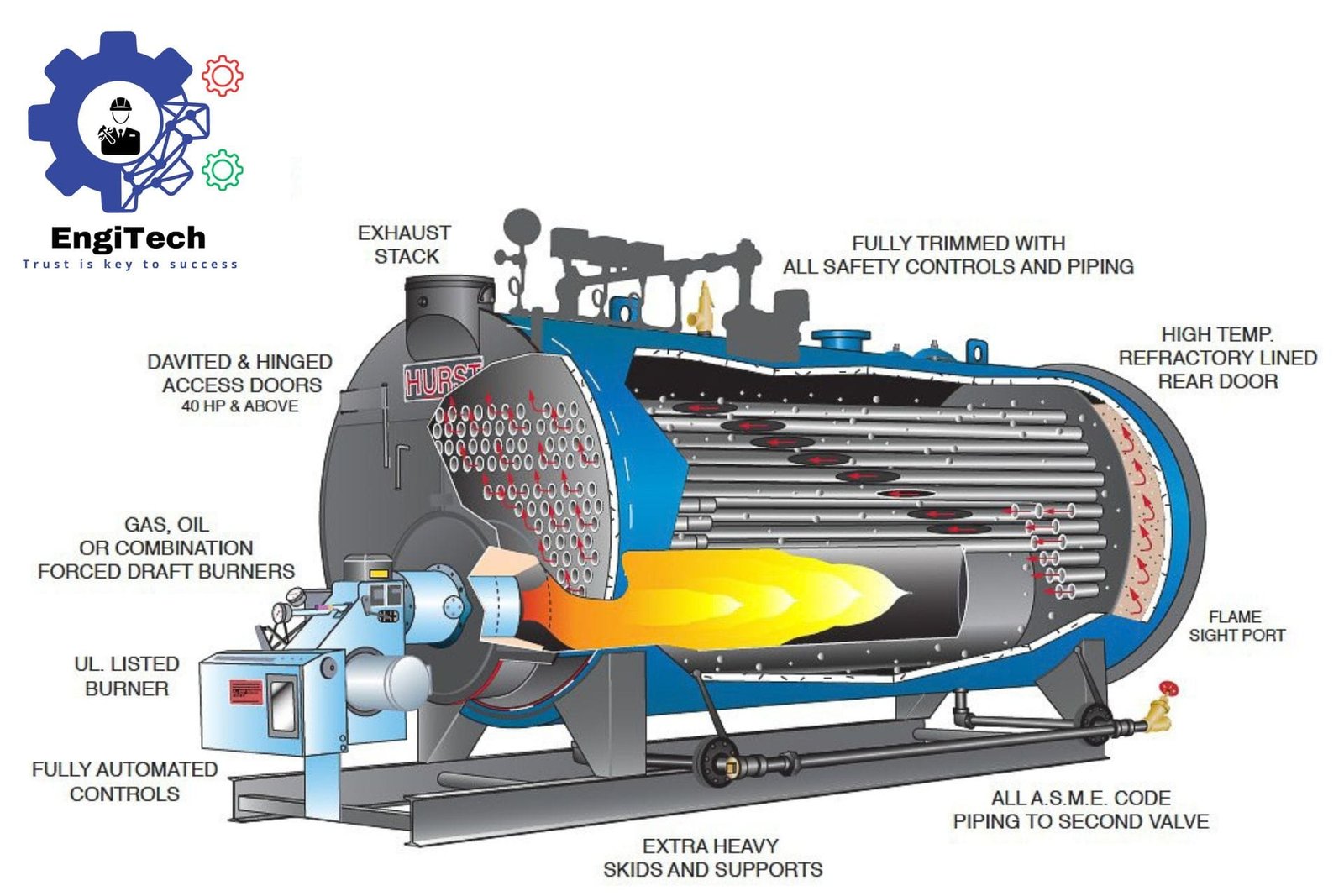
- Combustion Chamber: Fuel burns in the combustion chamber to generate heat.
- Heat Exchanger: The heat transfers to water in the heat exchanger, producing steam.
- Steam Drum: The steam drum collects and distributes the steam.
- Control System: A control system regulates the temperature, pressure, and fuel supply.
Types of Industrial Steam Boilers
- Fire Tube Boilers: Hot gases pass through tubes surrounded by water, transferring heat to the water.
- Water Tube Boilers: Water flows through tubes heated by combustion gases, producing steam.
- Electric Steam Boilers: Use electric heating elements to generate steam without combustion.
Advantages of Industrial Steam Boilers
- High Efficiency: Modern steam boilers are highly efficient, reducing fuel consumption and operational costs.
- Versatility: Steam boilers can use various fuel sources, including renewable fuels like biomass.
- Scalability: Industrial steam boilers are available in different sizes and capacities to meet varying industrial needs.
- Reliability: Industrial steam boilers are designed for continuous operation, providing a reliable source of steam.
Applications of Industrial Steam Boilers
Industrial steam boilers are used in a wide range of applications:
- Power Generation: Producing electricity in power plants.
- Food and Beverage: For sterilization, cooking, and pasteurization.
- Chemical Processing: Providing heat and steam for chemical reactions.
- Textile Industry: For dyeing, drying, and fabric finishing.
- Paper and Pulp: Producing steam for the paper-making process.
Key Considerations for Choosing an Industrial Boiler
When selecting an industrial boiler, consider the following factors:
- Fuel Type: Choose a boiler that uses a readily available and cost-effective fuel source.
- Efficiency: Look for high-efficiency boilers to reduce operational costs and environmental impact.
- Capacity: Ensure the boiler has the capacity to meet your steam or hot water requirements.
- Maintenance: Consider the maintenance requirements and costs associated with the boiler.
- Regulations: Ensure the boiler complies with local emissions and safety regulations.
Maintaining Industrial Boilers
Regular maintenance is essential for the safe and efficient operation of industrial boilers:
- Routine Inspections: Regularly inspect the boiler for signs of wear, leaks, and corrosion.
- Cleaning: Clean the combustion chamber, heat exchanger, and other components to maintain efficiency.
- Testing: Test safety valves, pressure gauges, and control systems to ensure they are functioning correctly.
- Repairs: Address any issues promptly to prevent breakdowns and extend the boiler’s lifespan.
Types of industrial boilers at a glance
| Type | How it works | Typical use |
|---|---|---|
| Fire tube (smoke tube) | Hot gases pass through tubes inside a water shell | Small to medium steam loads, moderate pressures; most common in factories |
| Water tube | Water flows inside tubes surrounded by hot gas | Large capacity and high pressure: power, refineries, sugar mills |
| Electric (resistance or electrode) | Electric elements or electrodes heat water directly | No combustion or emissions on site; clean steam, peak or backup loads, green power users |
| Biomass / solid fuel | Burns rice husk, wood, coal and similar fuels | Low fuel cost where biomass is available |
| Waste heat recovery boiler | Uses exhaust from engines, turbines or furnaces | Cogeneration and process heat recovery |
| Thermic fluid heater | Heats thermal oil instead of making steam | High temperatures at low pressure: textiles, chemicals, food |
Worked example: sizing an industrial electric boiler
To make 1,000 kg/h of saturated steam at about 10 bar(g) from feedwater at 80 °C, each kilogram needs about 2,780 − 335 = 2,445 kJ (steam enthalpy minus feedwater enthalpy). That is 679 kW of heat. An electric boiler converts nearly all its input to heat (about 99%), so it needs about 686 kW of electrical supply, roughly 686 kWh for each tonne of steam. Check that the site’s electrical connection can supply this before choosing electric. See steam piping and trap selection and steam trap surveys.
Conclusion
Industrial boilers, including electric boilers and industrial steam boilers, are essential for various industrial processes. Understanding their working principles, advantages, and applications can help you choose the right boiler for your needs. Regular maintenance ensures safe and efficient operation, maximizing the boiler’s lifespan and performance.
For more detailed articles and resources on industrial boilers and related technologies, visit EngiTech.in. Stay updated on the latest advancements and best practices in the field!
🛠️ Recommended Engineering Guides & Tools
Related reading: Lubrication Systems: A Comprehensive Guide; Expert Guide to Boiler Services and Installation.
Free tools for this topic: Steam consumption calculator · all free engineering tools
Sources and further reading
For standards, data and independent guidance on this topic, see NFPA (combustible dust and fire safety standards), US Chemical Safety Board (dust explosion investigation reports) and IECEx (hazardous area equipment certification). Always check the current edition and your site conditions before applying any figure.
Free tool for this topic
Heat Exchanger LMTD & Area CalculatorHeat duty, log mean temperature difference and required heat-transfer area for counter-flow and parallel-flow exchangers. Boilers, Chillers and ThermalA Comprehensive Guide to Furnaces: Understanding Types, Applications, and Expert Insights
 Boilers, Chillers and ThermalCooling vs Antisolvent Crystallization: How to Compare the Methods
 Boilers, Chillers and ThermalExpert Guide to Boiler Services and Installation
 Boilers, Chillers and ThermalThe Ultimate Guide to Crystallizers and Crystallization: Principles, Types, and Applications
 Boilers, Chillers and ThermalThe Ultimate Guide to Crystallization: Alum, Chemical, Copper Sulphate, and Salt Crystallization
 Boilers, Chillers and ThermalComprehensive Guide to Finned Tube Heat Exchangers