

On this page
- Understanding Fluid Bed Dryers
- Fluid bed dryer diagram: parts and their functions
- How Fluid Bed Dryers Work
- Types of Fluid Bed Dryers
- Key Applications
- Advantages of Using Fluid Bed Dryers
- Selecting the Right Fluid Bed Dryer
- Technological Advances in Fluid Bed Dryers
- What is a fluid bed dryer and how does it work?
- Fluidized bed dryer advantages and disadvantages
- Batch vs continuous fluid bed dryers
- Worked example: evaporation and air load
- Conclusion
- 🛠️ Recommended Engineering Guides & Tools
- Sources and further reading
- More on Industrial Dryers
Understanding Fluid Bed Dryers
Fluid bed dryers (FBDs) revolutionize the drying process for particulate materials across various industries. By using a stream of hot air to fluidize the material, FBDs ensure efficient and uniform drying. This method is essential for improving the quality and consistency of products in pharmaceuticals, food processing, and chemical manufacturing.
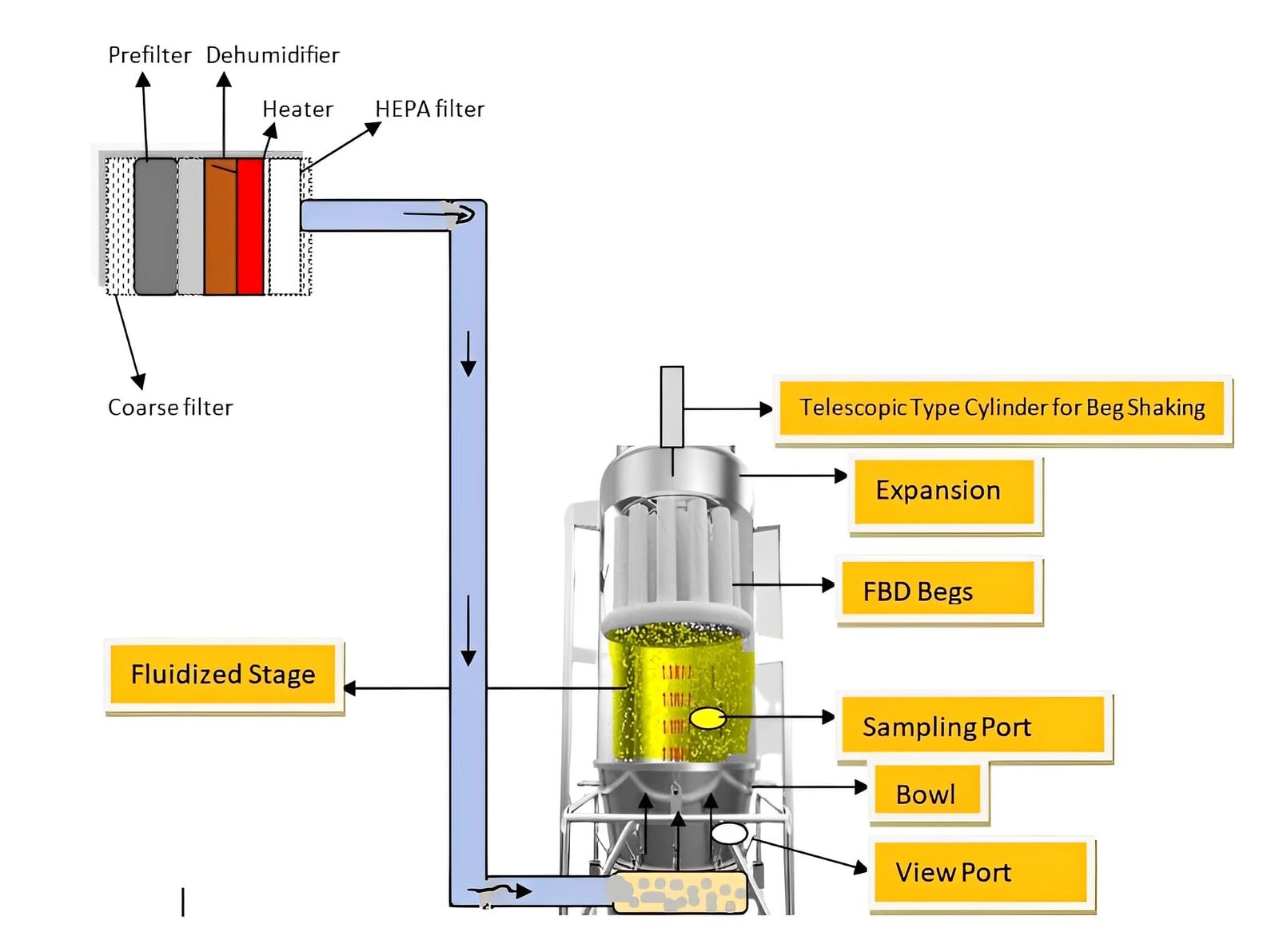
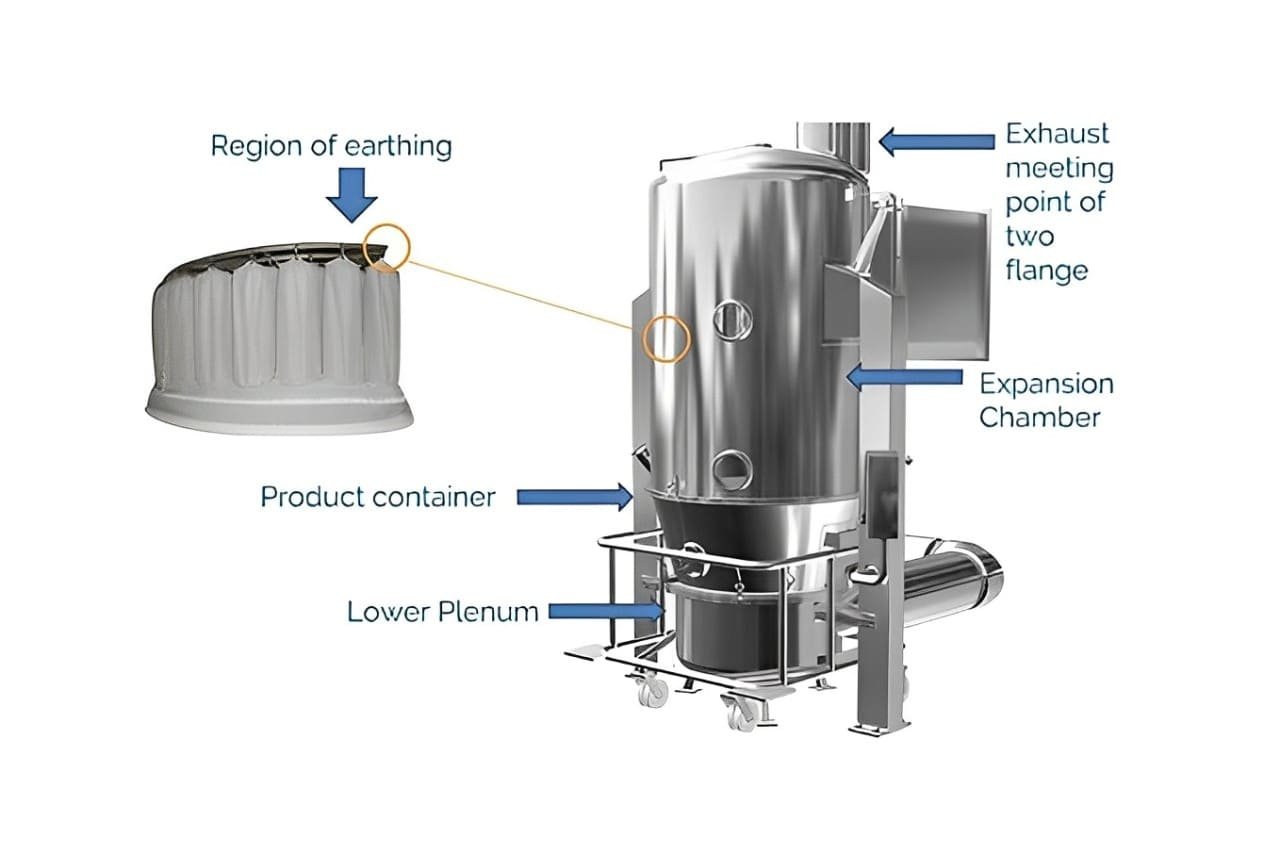
Fluid bed dryer diagram: parts and their functions

| No. | Part | What it does |
|---|---|---|
| 1 | Supply fan | Pushes the drying air through the heater and into the plenum. |
| 2 | Air heater | Heats the air before it enters the dryer. |
| 3 | Plenum | The air chamber under the bed. It spreads the air evenly across the distributor plate. |
| 4 | Perforated distributor plate | The plate with many small holes that lets the air rise through the bed and holds the material up when the air is off. |
| 5 | Fluidised bed | The layer of particles. The rising air lifts and mixes them so they behave like a boiling liquid, which gives fast, even drying. |
| 6 | Expansion chamber | The wider space above the bed. The air slows here, so most particles fall back into the bed. |
| 7 | Filter bags | Catch the fine particles that the air carries upward. |
| 8 | Exhaust outlet | The moist air leaves the dryer here. |
| 9 | Exhaust fan | Draws the exhaust air out and keeps the dryer at a slight negative pressure. |
| 10 | Wet feed inlet | Where the wet material enters the bed. |
| 11 | Product discharge | Dry product leaves from the bed. In a continuous dryer it moves through the bed to the outlet. |
Download this diagram (SVG)Schematic for learning. Real machines vary by maker and duty.
How Fluid Bed Dryers Work
- Fluidization: Place the material in the drying chamber. Introduce hot air from below at high velocity. The air lifts and suspends the particles, causing them to behave like a fluid.
- Heat Transfer: In this fluidized state, particles gain maximum contact with the hot air. This setup allows for rapid and uniform heat transfer, efficiently drying the material.
- Moisture Evaporation: As hot air flows through, it evaporates the moisture from the particles. The air stream carries away the evaporated moisture, leaving dry particles behind.
- Exhaust: The system then filters out any fine particles from the moist air before releasing it, ensuring a clean exhaust.
Types of Fluid Bed Dryers
Batch Fluid Bed Dryers:
- Ideal for small-scale production.
- Process specific amounts of material in each cycle.
Continuous Fluid Bed Dryers:
- Suitable for large-scale operations.
- Provide consistent quality and efficiency by processing materials in a continuous flow.

Vibratory Fluid Bed Dryers:
Effective for drying sticky or cohesive materials.
Use vibrations to assist fluidization.
Rotary Fluid Bed Dryers:
- Combine fluidization with rotary motion.
- Enhance mixing and drying efficiency for thorough processing.
Key Applications
Pharmaceuticals:
- Dry granules, pellets, and powders.
- Essential for producing stable and effective tablets and capsules.
Food Processing:
- Dry grains, cereals, fruits, and vegetables.
- Preserve nutritional value and extend shelf life.
Chemicals:
- Dry powders, crystals, and granules.
- Suitable for heat-sensitive materials, ensuring consistent quality.
Minerals:
See it in 3D
- Dry minerals and ores.
- Improve handling and processing efficiency.
Biotechnology:
- Dry biological materials like enzymes and proteins.
- Maintain the stability and activity of sensitive materials.
Advantages of Using Fluid Bed Dryers
- Uniform Drying: Ensure consistent product quality by promoting maximum contact between hot air and particles.
- High Efficiency: Achieve rapid drying times with effective heat transfer and moisture evaporation.
- Versatility: Handle a wide range of materials, including heat-sensitive and diverse particulate properties.
- Scalability: Available in various sizes, suitable for both small-scale and large-scale production.
- Gentle Drying: Preserve the integrity and quality of delicate materials through a gentle drying process.
- Ease of Maintenance: Simplify cleaning and maintenance, reducing downtime and ensuring continuous operation.
Selecting the Right Fluid Bed Dryer
- Material Properties: Understand particle size, moisture content, and heat sensitivity to choose the right FBD type and optimize the drying process.
- Production Scale: Match the dryer to your production needs, considering batch or continuous processing.
- Energy Efficiency: Look for energy-efficient features like heat recovery systems and variable airflow control to reduce operating costs.
- Control Systems: Opt for advanced control systems that provide real-time monitoring and adjustment of process parameters for consistent product quality.
- Ease of Cleaning: Choose designs that facilitate quick and thorough cleaning to minimize downtime and ensure hygienic operation.
Technological Advances in Fluid Bed Dryers
- Advanced Control Systems: Modern FBDs come with sophisticated control systems for real-time process monitoring and adjustments, ensuring optimal drying conditions.
- Energy Efficiency Innovations: New designs incorporate features like heat recovery systems and variable airflow control to enhance energy efficiency.
- Multi-Stage Drying: Multi-stage FBDs allow precise control over different drying stages within a single unit, improving efficiency and product quality.
- Continuous Manufacturing Integration: Integrating FBDs with continuous manufacturing processes boosts efficiency and scalability, ideal for large-scale production.
- Customization: Advances in technology enable the customization of FBDs to meet specific application requirements, optimizing drying processes for various materials.
What is a fluid bed dryer and how does it work?
A fluid bed dryer (fluidized bed dryer, FBD) blows hot air up through a perforated distributor plate under a bed of wet particles. Once the air velocity is high enough, the particles lift and behave like a boiling liquid. Every particle is surrounded by hot air, so heat and moisture transfer are fast and the bed temperature stays even. Dry product leaves over a weir (continuous) or the bowl is emptied (batch), and fines carried by the exhaust air are caught in a cyclone or bag filter.
Fluidized bed dryer advantages and disadvantages
| Advantages | Disadvantages |
|---|---|
| Fast, uniform drying with good temperature control | Only works for particles that fluidise: sticky, very fine or very wide size ranges need a vibrating or agitated design |
| Gentle enough for heat-sensitive food and pharma granules | High air volumes mean large fans and dust collection |
| Can dry, cool, coat or granulate in one unit | Attrition can create fines; organic dusts need explosion protection |
| Easy to clean in batch (pharma) versions | Energy use rises if exhaust air leaves too hot |
Batch vs continuous fluid bed dryers
Batch fluid bed dryers (bowl type) suit pharmaceutical granules and small food lots, where cleaning and batch records matter. Continuous fluid bed dryers handle steady tonnage such as salts, sugar, fertilisers and polymers, and are often split into a drying zone and a cooling zone. For food-grade drying, specify product-contact parts in stainless steel 316L, polished finishes, filtered inlet air and designs that drain and clean easily. For products that do not fluidise well, see vibrating fluid bed dryers.
Worked example: evaporation and air load
Assumed values: 1,000 kg/h of wet granules dried from 20% to 2% moisture (wet basis). Dry solids are 800 kg/h, so product leaves at 816.3 kg/h and the dryer must evaporate about 183.7 kg/h of water. At roughly 2,400 kJ per kg evaporated, that is about 122 kW of heat before losses. If inlet air at 120 °C leaves at 60 °C, the air must deliver about 7,300 kg/h as a first estimate, more once heat losses and product heating are added. Use the dryer selection tool to compare dryer types.
Conclusion
Fluid bed dryers play a transformative role in industrial drying, offering uniform and efficient drying of particulate materials. Understanding their working principle, types, applications, and benefits helps optimize the drying process. The latest advancements continue to expand the capabilities of FBDs, making them indispensable in modern industrial processes.
For more in-depth articles and resources on industrial drying technologies and innovations, visit EngiTech.in. Stay updated on the latest advancements and applications in the industry!
🛠️ Recommended Engineering Guides & Tools
Related reading: Spin Flash Dryers: Rapid and Efficient Drying Solutions; Vibrating Fluid Bed Dryers: Efficient Drying Solutions.
Free tools for this topic: Dryer selection tool · Dryer evaporation, heat and fuel calculator · all free engineering tools
Sources and further reading
For standards, data and independent guidance on this topic, see US Department of Energy process heating resources (industrial heating and drying efficiency), The Engineering ToolBox (engineering reference data and calculators) and Bureau of Energy Efficiency (energy audit and efficiency programmes in India). Always check the current edition and your site conditions before applying any figure.
Free tool for this topic
Industrial Dryer Evaporation, Heat & Fuel CalculatorWater evaporation, product output, heat load and fuel or steam consumption for spray, rotary, flash, fluid-bed and paddle dryers. Industrial DryersLab Scale Spray Dryers: A Comprehensive Overview
 Industrial DryersAdvancements in Laser-Based Drying Technologies: Shaping the Future of Industrial Efficiency
 Industrial DryersSpray Drying Pharmaceuticals: Process & Benefits
 Industrial DryersDryer Exhaust Dew Point: Preventing Condensation and Corrosion in Ducts
 Industrial DryersRotary Vacuum Paddle Dryers (RVPD): Solvent Recovery, Heat Transfer & Sizing Guide
 Industrial DryersRotary Dryer vs Roller Drum Dryer: What Is the Difference?