
On this page
- Introduction to Air-Cooled Heat Exchangers
- Design and Components of Air-Cooled Heat Exchangers
- Working Principles of Air-Cooled Heat Exchangers
- Types of Air-Cooled Heat Exchangers
- Applications of Air-Cooled Heat Exchangers
- Advantages of Air-Cooled Heat Exchangers
- Maintenance and Troubleshooting of Air-Cooled Heat Exchangers
- Technological Advancements in Air-Cooled Heat Exchangers
- ACHE: forced draft vs induced draft
- Main ACHE components (API 661)
- Worked example: air flow and fan power
- Conclusion
- 🛠️ Recommended Engineering Guides & Tools
- Sources and further reading
- More on Boilers, Chillers and Thermal
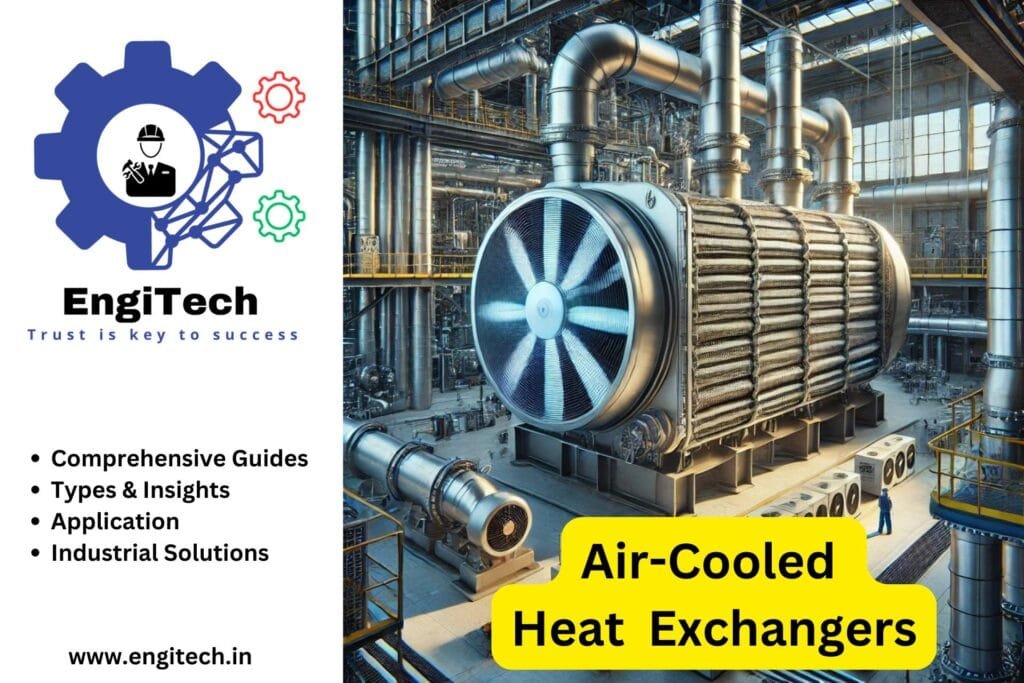
Air-cooled heat exchangers (ACHEs) are critical components in various industrial processes, particularly in applications where water is scarce or expensive. These devices use ambient air to cool process fluids, eliminating the need for water and offering a cost-effective and environmentally friendly alternative to traditional cooling systems.
This comprehensive guide will examine the design, working principles, types, applications, advantages, and maintenance of air-cooled heat exchangers. By understanding these aspects, you can better appreciate the role ACHEs play in modern industrial processes.
Introduction to Air-Cooled Heat Exchangers
Air-cooled heat exchangers are devices that transfer heat from a fluid to the air. Unlike water-cooled systems, which rely on water as the cooling medium, ACHEs use air to absorb and dissipate heat. This makes them particularly useful in regions where water resources are limited or where water conservation is a priority.
Design and Components of Air-Cooled Heat Exchangers
The typical design of an air-cooled heat exchanger includes several key components:
- Finned Tubes: The core of the ACHE, finned tubes increase the surface area for heat transfer. The fins, typically made of aluminum or copper, enhance the efficiency of heat dissipation.
- Headers: These are located at the ends of the tubes and distribute the process fluid into the tubes. Headers also collect the fluid after it has been cooled.
- Fans: Fans are essential for circulating air across the finned tubes. They can be axial or centrifugal, depending on the design requirements and space constraints.
- Plenum Chambers: These chambers guide the air from the fans over the tubes. They can be either forced-draft or induced-draft, influencing the direction of air movement.
- Supports and Structure: The entire setup is supported by a structural framework, which holds the tubes, headers, fans, and other components in place.
Working Principles of Air-Cooled Heat Exchangers
The working principle of an air-cooled heat exchanger is straightforward. Hot process fluid enters the exchanger through the inlet header and flows through the finned tubes. As the fluid moves through the tubes, heat is transferred to the fins, which are exposed to the air. Fans blow ambient air over the fins, absorbing the heat and cooling the fluid inside the tubes. The cooled fluid then exits through the outlet header.
Types of Air-Cooled Heat Exchangers
There are several types of air-cooled heat exchangers, each designed for specific applications and operational requirements:
- Forced-Draft Air-Cooled Heat Exchangers: In this configuration, fans are located at the bottom of the unit and blow air upwards over the finned tubes. Forced-draft ACHEs are commonly used in applications where a high air velocity is required.
- Induced-Draft Air-Cooled Heat Exchangers: Here, fans are placed at the top of the unit and pull air through the finned tubes. This design minimizes the risk of recirculating hot air and is often used in applications where space constraints are a concern.
- Natural Draft Air-Cooled Heat Exchangers: In natural draft systems, the airflow is driven by natural convection rather than mechanical fans. These systems are less common but can be advantageous in specific applications where power consumption needs to be minimized.
- Dry Air-Cooled Heat Exchangers: These are specialized systems designed to cool fluids without adding moisture to the air. They are used in applications where the humidity level needs to be controlled, such as in certain chemical processes.
Applications of Air-Cooled Heat Exchangers
Air-cooled heat exchangers are versatile and find applications in a wide range of industries due to their ability to operate without water and their environmental benefits. Some common applications include:
1. Petrochemical and Refining Industries
In petrochemical plants and refineries, ACHEs are used to cool various process fluids, including hydrocarbons, gases, and chemicals. The ability to cool these fluids without water is particularly advantageous in locations where water is scarce or costly.
2. Power Generation
Air-cooled heat exchangers are widely used in power plants for cooling turbine exhaust steam, lubricating oil, and other fluids. They are especially useful in dry cooling systems, where they eliminate the need for water in cooling cycles, thereby conserving water resources.
3. Natural Gas Processing
In natural gas processing plants, ACHEs are employed to cool and condense natural gas liquids. They are also used to cool compressors and other equipment, ensuring efficient and safe operation.
4. Chemical Processing
Air-cooled heat exchangers are used in chemical processing plants to cool various chemicals and reactants. They are ideal for processes that require precise temperature control and where water contamination must be avoided.
5. HVAC Systems
In HVAC systems, air-cooled heat exchangers are used in air conditioning units and refrigeration systems. They provide efficient cooling without the need for water, making them suitable for use in dry climates.
6. Food and Beverage Industry
In the food and beverage industry, ACHEs are used for cooling products, chilling water, and other cooling applications. Their ability to operate without water makes them a hygienic and efficient solution.
Advantages of Air-Cooled Heat Exchangers
Air-cooled heat exchangers offer several advantages, making them a preferred choice in many industries:
1. Water Conservation
One of the primary benefits of ACHEs is that they do not require water for cooling. This makes them ideal for regions with limited water resources or for industries looking to reduce water usage.
2. Environmental Benefits
By eliminating the need for water, ACHEs reduce the risk of water pollution and minimize the environmental impact of cooling processes. They also help prevent thermal pollution, which can occur with water-cooled systems.
3. Lower Operating Costs
Air-cooled heat exchangers generally have lower operating costs than water-cooled systems. They eliminate the need for water treatment, pumping, and disposal, resulting in significant cost savings.
4. Reduced Maintenance
ACHEs typically require less maintenance than water-cooled systems. There is no need for water treatment chemicals, and the risk of corrosion and scaling is minimized. This leads to lower maintenance costs and longer equipment life.
See it in 3D
5. Flexibility and Adaptability
Air-cooled heat exchangers can be used in a wide range of applications and are easily adaptable to different process conditions. Their modular design allows for easy expansion and modification, making them versatile and scalable.
6. Space Efficiency
With no need for water handling infrastructure, ACHEs can be installed in locations where space is limited. Their compact design makes them suitable for both small and large installations.
Maintenance and Troubleshooting of Air-Cooled Heat Exchangers
Proper maintenance of air-cooled heat exchangers is essential to ensure optimal performance and longevity. Regular inspections, cleaning, and monitoring can prevent common issues and extend the life of the equipment.
1. Inspection
Routine inspections help identify signs of wear, corrosion, or damage. Operators should check for leaks, fan operation, and the condition of the finned tubes. Early detection of issues can prevent more significant problems and costly downtime.
2. Cleaning
Cleaning is vital to prevent fouling and maintain heat transfer efficiency. Depending on the environment, dust, dirt, and other contaminants can accumulate on the fins, reducing airflow and cooling efficiency. Cleaning can be done using compressed air, water, or chemical solutions.
3. Fan Maintenance
Fans are a critical component of air-cooled heat exchangers. Regular maintenance includes checking for proper alignment, lubrication, and balancing. Damaged or worn fan blades should be replaced promptly to maintain efficient airflow.
4. Tube Maintenance
Inspecting and maintaining the finned tubes is essential to prevent leaks and ensure efficient heat transfer. Any signs of corrosion or damage should be addressed immediately. In some cases, damaged tubes may need to be replaced.
5. Troubleshooting Common Issues
Operators may encounter common issues such as reduced heat transfer efficiency, abnormal noise from fans, or vibration. Addressing these issues requires identifying the root cause, which could involve inspecting the fans, cleaning the fins, or checking for mechanical damage.
Technological Advancements in Air-Cooled Heat Exchangers
Technological advancements continue to enhance the performance and capabilities of air-cooled heat exchangers. Innovations in materials, design, and manufacturing processes have led to the development of more efficient and reliable ACHEs.
1. Advanced Materials
The use of advanced materials such as aluminum, copper alloys, and specialized coatings has improved the corrosion resistance and durability of ACHEs. These materials are particularly beneficial in harsh environments where traditional materials may degrade.
2. Enhanced Fan and Motor Designs
Innovations in fan and motor designs have led to more efficient air movement and reduced energy consumption. Variable speed drives and advanced control systems allow for precise airflow control, optimizing the cooling process.
3. Compact and Lightweight Designs
Efforts to reduce the size and weight of ACHEs have resulted in more compact and lightweight models. These designs are ideal for applications with space constraints or where weight is a critical factor.
4. Automation and Control
The integration of automation and control systems allows for real-time monitoring and optimization of ACHE performance. Advanced sensors and control algorithms help maintain optimal operating conditions, improving efficiency and reducing energy consumption.
5. 3D Printing and Additive Manufacturing
3D printing and additive manufacturing technologies have enabled the production of complex tube and fin designs with high precision. These technologies allow for customized solutions and rapid prototyping, accelerating the development of new ACHE models.
ACHE: forced draft vs induced draft
| Forced draft | Induced draft | |
|---|---|---|
| Fan position | Below the tube bundle, pushing air up | Above the bundle, pulling air through |
| Air distribution | Less even | More even; less hot air recirculation |
| Maintenance | Fans and drives easy to reach at grade | Fans in the hot exhaust air; harder access |
| Weather protection | Bundle exposed to sun, rain and hail | Fan ring and plenum shield the bundle |
Main ACHE components (API 661)
- Tube bundle: finned tubes (embedded, extruded or wrapped fins) between two headers.
- Headers: plug type for high pressure, cover plate type for easy cleaning, or manifold type.
- Fans and drives: axial fans with adjustable or auto-variable pitch blades, belt or gear drives, often VFDs.
- Plenum, structure and louvers: control airflow and protect against freezing in cold climates.
Worked example: air flow and fan power
To reject 2,000 kW with the air warming by 20 K, the cooler needs 2,000 ÷ (1.006 × 20) ≈ 99.4 kg/s of air, about 85 m³/s. At an assumed 150 Pa fan pressure and 65% fan efficiency, fan power is about 19.6 kW. A larger air temperature rise cuts airflow and fan power but needs more tube area. See types of heat exchangers and axial fans.
Conclusion
Air-cooled heat exchangers are essential components in various industries, offering efficient heat transfer solutions in a compact and environmentally friendly design. Their ability to operate without water makes them ideal for applications in regions with limited water resources or where water conservation is a priority.
With ongoing technological advancements and a growing focus on energy efficiency and sustainability, air-cooled heat exchangers will continue to play a vital role in industrial processes. As industries evolve and new challenges arise, ACHEs will adapt and innovate, providing reliable and efficient solutions for years to come.
Frequently asked questions (FAQs) about air-cooled heat exchangers:
1. What is an air-cooled heat exchanger and how does it work?
- An air-cooled heat exchanger (ACHE) is a device that transfers heat from a fluid to the air, using finned tubes and fans to enhance heat dissipation. Unlike water-cooled systems, ACHEs use ambient air as the cooling medium, making them suitable for applications where water is scarce or costly.
2. What are the advantages of using air-cooled heat exchangers?
- The main advantages include water conservation, reduced operating costs, lower maintenance requirements, environmental benefits, flexibility in installation, and adaptability to various applications. ACHEs are particularly useful in arid regions or where water resources are limited.
3. Where are air-cooled heat exchangers commonly used?
- ACHEs are commonly used in industries such as petrochemical and refining, power generation, natural gas processing, chemical processing, HVAC systems, and the food and beverage industry. They are suitable for cooling process fluids, air conditioning, and refrigeration.
4. What types of air-cooled heat exchangers are available?
- The main types of ACHEs include forced-draft, induced-draft, natural draft, and dry air-cooled heat exchangers. Each type is designed for specific applications and operational conditions, such as air movement direction, cooling requirements, and environmental factors.
5. How do forced-draft and induced-draft air-cooled heat exchangers differ?
- In forced-draft ACHEs, fans blow air upwards through the finned tubes, while in induced-draft ACHEs, fans pull air through the tubes and exhaust it upwards. Forced-draft systems are typically more efficient in delivering high air velocities, while induced-draft systems reduce the risk of hot air recirculation and are better suited for space-constrained installations.
6. What materials are commonly used in air-cooled heat exchangers?
- Common materials include aluminum, copper alloys, stainless steel, and other specialized coatings. The choice of material depends on the process fluids, operating temperatures, pressure requirements, and environmental conditions.
7. How often should air-cooled heat exchangers be maintained?
- Regular maintenance is essential for optimal performance. The frequency depends on the specific application and environmental conditions. Routine inspections, cleaning of finned tubes and fans, and checking for leaks or damage are essential maintenance tasks.
8. What are the common issues faced with air-cooled heat exchangers?
- Common issues include fouling of finned tubes, reduced airflow due to fan malfunctions, corrosion, and leaks. Addressing these issues promptly through regular maintenance can prevent performance degradation and extend the equipment’s lifespan.
9. How do you clean an air-cooled heat exchanger?
- Cleaning can be done using compressed air, water, or chemical solutions, depending on the type of contaminants. Regular cleaning of the finned tubes and fans helps maintain efficient heat transfer and airflow.
10. What are the differences between air-cooled and water-cooled heat exchangers?
- The primary difference is the cooling medium: air-cooled heat exchangers use air, while water-cooled heat exchangers use water. ACHEs are more environmentally friendly, conserve water, and are easier to maintain, while water-cooled systems generally offer higher cooling efficiency and are used in applications where water is readily available.
11. Can air-cooled heat exchangers be used in HVAC systems?
- Yes, air-cooled heat exchangers are commonly used in HVAC systems for air conditioning, refrigeration, and heat recovery. They provide efficient cooling without the need for water, making them ideal for dry climates.
12. What factors should be considered when selecting an air-cooled heat exchanger?
- Key factors include the type of fluids being cooled, desired temperature and pressure conditions, ambient temperature, airflow requirements, available space, environmental regulations, and overall cost considerations. Consulting with an engineering specialist can help determine the best ACHE for specific applications.
These FAQs address common queries and provide essential information about air-cooled heat exchangers, helping users understand their functionality, benefits, and maintenance requirements.
For an air-cooled heat-exchanger enquiry, record the process duty, fluid conditions, ambient conditions and site constraints. Ask the supplier to state the assumptions and evidence supporting the proposed equipment.
We provide clear, detailed guides and articles that cater to your needs, ensuring you stay informed and ahead of industry trends. Trust EngiTech and our expert writers to deliver the quality information you need to make informed decisions and drive your business forward. Join our community today and experience the expertise that sets us apart.
🛠️ Recommended Engineering Guides & Tools
Related reading: Ultimate Guide to Plate and Frame Heat Exchangers: Maximize Efficiency and Performance.
Free tools for this topic: Heat exchanger LMTD calculator · all free engineering tools
Sources and further reading
For standards, data and independent guidance on this topic, see Bureau of Energy Efficiency (energy audit and efficiency programmes in India), Greenhouse Gas Protocol (the standard method for carbon accounting) and US Department of Energy process heating resources (industrial heating and drying efficiency). Always check the current edition and your site conditions before applying any figure.
Free tool for this topic
Heat Exchanger LMTD & Area CalculatorHeat duty, log mean temperature difference and required heat-transfer area for counter-flow and parallel-flow exchangers. Boilers, Chillers and ThermalExpert Guide to Industrial Boilers: Electric and Steam Systems
 Boilers, Chillers and ThermalHeat Exchangers: An In-Depth Exploration
 Boilers, Chillers and ThermalShell and Tube Heat Exchangers: Types, Components and Maintenance
 Boilers, Chillers and ThermalUltimate Guide to Plate and Frame Heat Exchangers: Maximize Efficiency and Performance
 Boilers, Chillers and ThermalThe Ultimate Guide to Crystallization: Alum, Chemical, Copper Sulphate, and Salt Crystallization
 Boilers, Chillers and ThermalA Comprehensive Guide to Crystallization Equipment: Types, Applications, and Benefits