

On this page
- Boiling point of water against pressure
- Why heat transfer limits the speed
- Worked example: drying time and vapour handling
- Equipment
- Pump and condenser choices
- Practical tips
- What I see in plants
- Frequently asked questions
- What does vacuum drying do?
- Why is vacuum drying slow?
- Do I need a condenser?
- What pressure should I use?
- Is vacuum drying only for pharma?
- Sources and further reading
- Related guides
- More on Industrial Dryers
Short answer: Vacuum drying lowers the pressure so water (or solvent) boils at a lower temperature. At about 12 kPa absolute, water boils at 50 °C instead of 100 °C. This lets you dry heat-sensitive products gently, recover solvents and dry without air, but it needs a sealed vessel, a condenser and a vacuum pump, and drying is limited by how fast heat reaches the product. Estimate drying time from the heat duty and the heat transfer rate, and size the condenser and pump from the vapour volume.
A product that darkens or degrades at 100 °C may dry perfectly well at 40 to 60 °C under vacuum. Pharmaceutical intermediates, food ingredients, solvents-wet cakes and oxygen-sensitive materials are typical cases. In my conversations with process engineers, the pain is not understanding the idea but estimating how long it takes and what pump and condenser to buy. This guide gives the basics and a worked example. It connects with vacuum pump types, agitated nutsche filter dryers and indirect dryer sizing.
Boiling point of water against pressure
| Absolute pressure (kPa) | Boiling point of water (°C) | Latent heat (kJ/kg) | Specific volume of vapour (m³/kg) |
|---|---|---|---|
| 101.3 | 100 | 2,257 | 1.67 |
| 19.9 | 60 | 2,358 | 7.67 |
| 12.3 | 50 | 2,382 | 12.0 |
| 7.4 | 40 | 2,406 | 19.5 |
| 4.2 | 30 | 2,430 | 32.9 |
Values are rounded standard steam table figures. Note the vapour volume: at 40 °C, each kilogram of water becomes nearly 20 m³ of vapour, which the pump and condenser must handle.
Why heat transfer limits the speed
Under vacuum there is little air to carry heat, so heat must reach the product through the walls (jacket, paddles, plates or shelves) by conduction. Radiant heat also helps in tray dryers. The drying rate is therefore set by the heat transfer rate Q = U × A × ΔT, divided by the latent heat. Also, low pressure means moisture and solvent vapour leaves quickly, so the process is rarely limited by mass transfer until the product is nearly dry.
Worked example: drying time and vapour handling
A jacketed agitated vacuum dryer holds 100 kg of wet cake with 20 kg of water to remove. The vessel is held at 12.3 kPa absolute, where the water boils at 50 °C. Latent heat at 50 °C is 2,382 kJ/kg: heat for evaporation = 20 × 2,382 = 47,640 kJ. Ignoring the sensible heat of the solids for simplicity (which would add a few per cent).
- Heat transfer: U = 100 W/m²·K, heated area A = 2 m², hot water in the jacket at 80 °C and product at 50 °C: ΔT = 30 K. Q = 100 × 2 × 30 = 6,000 W = 6.0 kW.
- Drying time ≈ 47,640 kJ / 6.0 kW = 7,940 s = 2.2 hours.
- If the vacuum is deepened to 7.4 kPa (boiling at 40 °C, latent 2,406 kJ/kg, energy 20 × 2,406 = 48,120 kJ) with the same 80 °C jacket, ΔT = 40 K and Q = 8.0 kW: time = 48,120 / 8.0 = 6,015 s = 1.67 hours. Lower pressure speeds the drying here because it widens ΔT, but the vapour volume rises.
- Vapour volume: 20 kg at 12.3 kPa × 12.0 m³/kg = 240 m³ over 2.2 hours, an average of 109 m³/h. At 7.4 kPa the vapour is 20 × 19.5 = 390 m³ over 1.67 hours, about 234 m³/h, more than double the volumetric flow to handle.
Most of the vapour should be condensed before it reaches the pump: a cooled condenser at 5 to 10 °C turns the water to liquid, leaving the pump to handle only air leakage and non-condensable gas. If the condenser is too small or too warm, vapour reaches the pump and raises the pressure, slowing drying. Always check the condenser duty: condensing 20 kg in 2.2 hours = 9.1 kg/h × 2,382 kJ/kg ≈ 21,700 kJ/h = 6.0 kW (the same as the heat input, as expected). The numbers are illustrative; real products have bound moisture, shrinkage and crust formation.
Equipment
| Type | Notes |
|---|---|
| Vacuum tray dryer | Shelves heated by hot water or steam; simple; static material, so slow and labour-intensive |
| Agitated vacuum pan or paddle dryer | Mixing improves heat transfer and uniformity; see pan dryers |
| Conical or rotary vacuum dryer | Gentle tumbling; good for fine powders, pharma and fine chemicals |
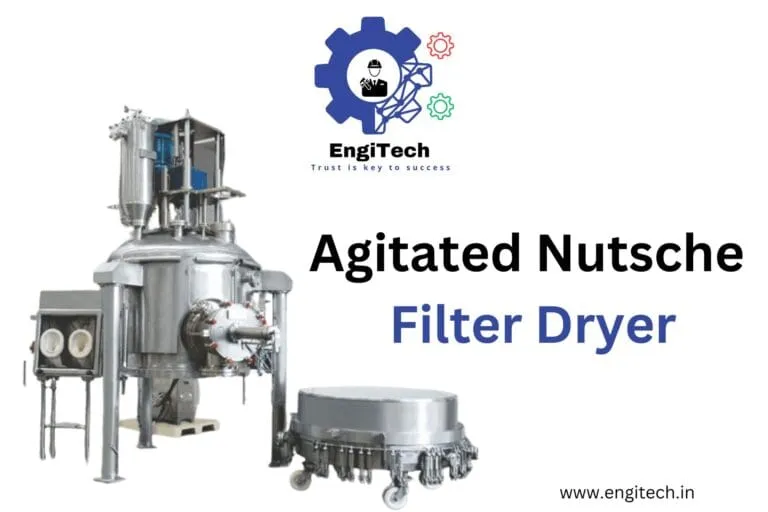
| Agitated nutsche filter dryer | Filtration, washing and drying in one vessel; see agitated nutsche filter dryers |
| Freeze dryer (lyophiliser) | Sublimation under deep vacuum; see freeze drying for industrial buyers |
Pump and condenser choices
- Liquid ring pumps: robust, handle vapour, use sealing liquid; see vacuum pump types.
- Dry screw pumps: no oil or liquid in the gas path, good for solvents recovery, higher cost.
- Rotary vane (oil-sealed) pumps: deep vacuum, but oil contamination by vapour is a risk; use a condenser and cold trap.
- Condenser: sized for the vapour load, cooled with chilled water or brine; add a cold trap if solvent vapour could reach the pump.
Practical tips
- Keep the vessel leak-tight; every kilogram per hour of air leaking in must be removed by the pump.
- Control the vacuum gradually at the start to avoid foaming or boil-over of wet material.
- Control jacket temperature to protect the product.
- Monitor pressure, product temperature and condensate to determine the end point.
- Vent with nitrogen when needed to prevent oxidation or dust explosion hazards; see dust explosion protection basics.
What I see in plants
The vacuum dryers that work well have a good condenser, a pump selected for the vapour load and a recorded pressure profile for each batch. Those that struggle often have a pump that is too small, a warm condenser or leaks, and then drying takes twice as long. Because the drying is slow when poorly controlled, find the end point by test, not by time alone. For solvent-wet products, safety and emissions rules apply; see hazardous chemicals rules.
See it in 3D
Free tools for this topic: Dryer selection tool · Dryer evaporation, heat and fuel calculator · all free engineering tools
Frequently asked questions
What does vacuum drying do?
It lowers the pressure so liquid boils at a lower temperature, drying products without high heat.
Why is vacuum drying slow?
Without air to carry heat, drying relies on conduction from heated surfaces, which limits the rate.
Do I need a condenser?
Almost always. It removes vapour before the pump, protecting the pump and recovering solvent.
What pressure should I use?
The pressure that gives a boiling point comfortably below the product’s limit, balanced against pump and condenser capacity.
Is vacuum drying only for pharma?
No. It is also used for foods, chemicals, polymers and any heat-sensitive or solvent-wet material.
Sources and further reading
For standards, data and independent guidance on this topic, see US Department of Energy process heating resources (industrial heating and drying efficiency), The Engineering ToolBox (engineering reference data and calculators), Bureau of Energy Efficiency (energy audit and efficiency programmes in India) and Society of Tribologists and Lubrication Engineers (lubrication and tribology resources). Always check the current edition and your site conditions before applying any figure.
Related reading: Indirect Dryer Sizing: Heat Transfer Area from a Mass and Energy Balance; Residence Time Distribution in Dryers: Tracer Tests and Tanks in Series; Hot Air Generation for Dryers: Direct-Fired, Indirect and Electric Compared; Rotary Dryer Shell Sizing: Hold-Up, Retention Time and Speed.
This article is general information from my experience with dryers and is not a design. Steam table values are rounded; heat transfer coefficients and times in the example are assumed.
Free tool for this topic
Industrial Dryer Evaporation, Heat & Fuel CalculatorWater evaporation, product output, heat load and fuel or steam consumption for spray, rotary, flash, fluid-bed and paddle dryers.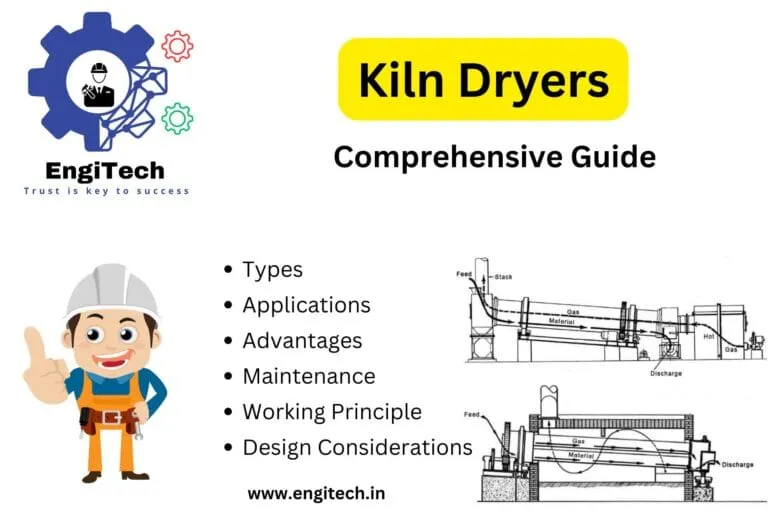 Industrial DryersComprehensive Guide to Kiln Dryers
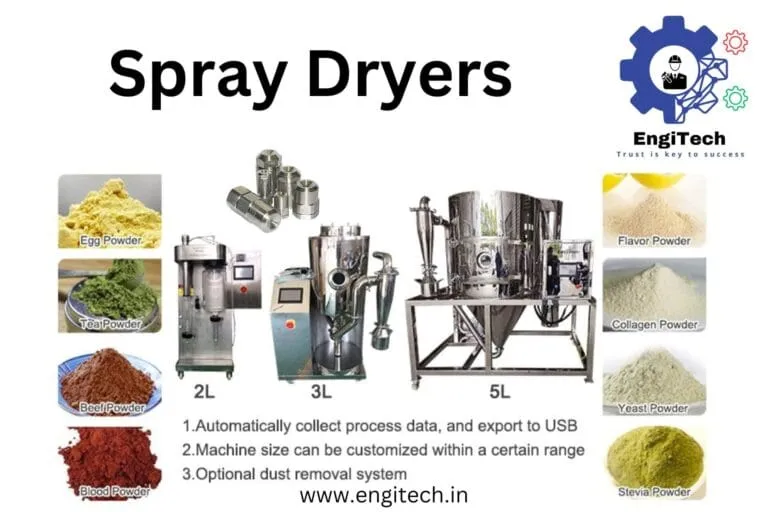 Industrial DryersSpray Dryers: Principles, Types, Applications, and Considerations
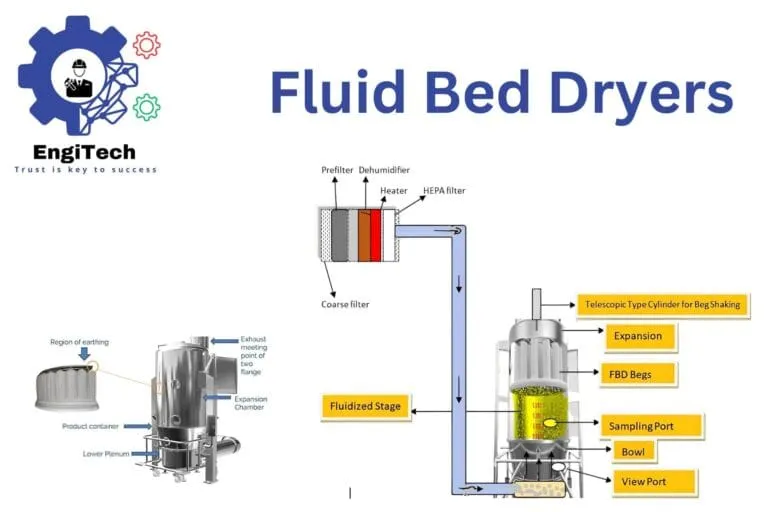 Industrial DryersFluid Bed Dryers: Efficient Drying Solutions Explained
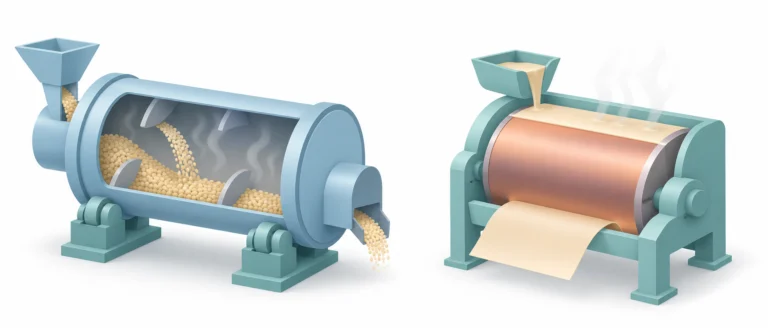 Industrial DryersRotary Dryer vs Roller Drum Dryer: What Is the Difference?
 Industrial DryersAgitated Nutsche Filter Dryers (ANFD) : Comprehensive Guide
 Industrial DryersPaddle Dryers: Types, Applications and Selection