

On this page
- Vacuum crystallizer diagram: parts and their functions
- Understanding Zero Liquid Discharge (ZLD)
- The ZLD Process
- ZLD Technologies and Applications
- Applications of ZLD Across Industries
- Challenges in ZLD Implementation and Their Solutions
- Advancements in ZLD Technologies
- The Future of ZLD: Moving Towards Sustainability
- ZLD process flow at a glance
- What drives ZLD cost and energy
- ZLD for etching and metal finishing effluents
- Conclusion
- FAQs related to Zero Liquid Discharge (ZLD) systems:
- From EngiTech Team
- 🛠️ Recommended Engineering Guides & Tools
- Frequently Asked Questions (Plant Engineering & Operational FAQ)
- Sources and further reading
- More on Environmental Engineering
ZLD Closed-Loop Engineering Summary: ZLD plant architectures concentrate high-TDS effluents via high-pressure Reverse Osmosis (up to 70,000 ppm TDS), followed by Mechanical Vapor Recompression (MVR) falling-film evaporators, and final agitated thin-film drying. Overall recovery exceeds 95% to 98% reusable permeate water, producing solid salt cake for safe landfill disposal.
Vacuum crystallizer diagram: parts and their functions
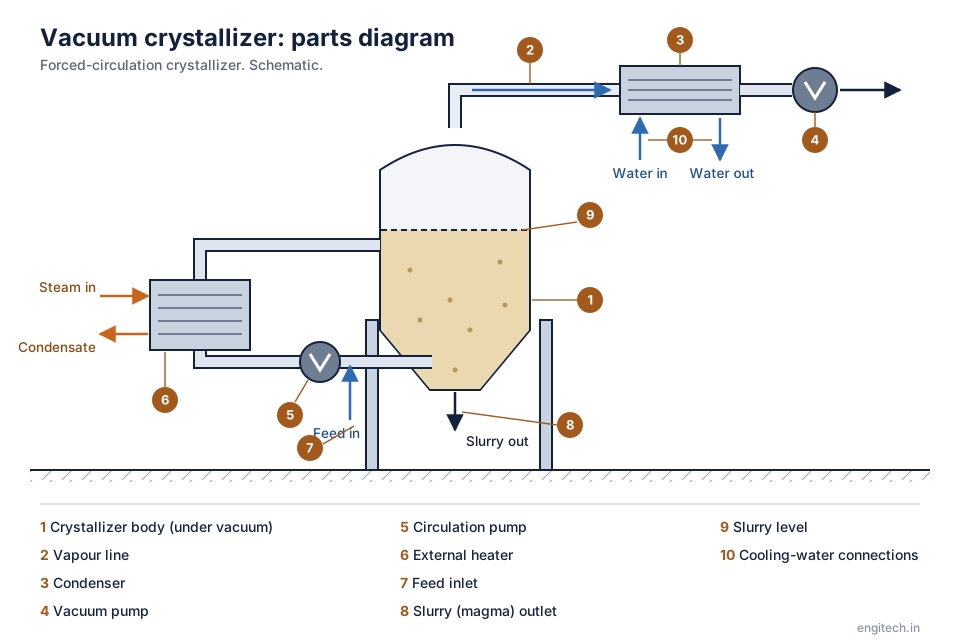
| No. | Part | What it does |
|---|---|---|
| 1 | Crystallizer body | The vessel kept under vacuum. The liquid flashes here, which cools it and removes some of the solvent, so crystals form. |
| 2 | Vapour line | Carries the vapour from the vessel to the condenser. |
| 3 | Condenser | Turns the vapour back into liquid. This also helps hold the vacuum. |
| 4 | Vacuum pump | Removes air and gases that do not condense, so the vessel stays at low pressure. |
| 5 | Circulation pump | Keeps the slurry moving round the loop between the vessel and the heater. |
| 6 | External heater | Warms the circulating slurry. The pressure is kept high enough in the heater to stop it boiling there. |
| 7 | Feed inlet | Fresh solution enters the circulation loop here. |
| 8 | Slurry outlet | The mixture of crystals and mother liquor leaves here, normally to a separator such as a centrifuge. |
| 9 | Slurry level | The surface of the slurry in the vessel. |
| 10 | Cooling-water connections | The cooling water goes into the condenser and leaves it. |
Download this diagram (SVG)Schematic for learning. Real machines vary by maker and duty.
Zero Liquid Discharge (ZLD) is an advanced wastewater management strategy that ensures minimal liquid waste, promoting sustainability and environmental compliance across industries. As water scarcity becomes a global concern, ZLD systems are increasingly vital in industries where water conservation and zero discharge are paramount.
This comprehensive guide on ZLD provides in-depth insights into the process, technologies, and challenges, catering to knowledge seekers, students, and professionals. This post will address common queries, explain complex concepts, and share expert insights.
Understanding Zero Liquid Discharge (ZLD)
Zero Liquid Discharge (ZLD) is a wastewater treatment process designed to eliminate liquid waste discharge. The main goal of ZLD systems is to recover as much water as possible from wastewater, leaving behind only solid residues that can be disposed of or reused safely. By focusing on water recovery and minimizing waste, ZLD plants play a central role in industries where water management and environmental compliance are critical.
The ZLD Process
The ZLD process is a multi-step operation that involves various treatment stages to remove contaminants, recover water, and handle residual solids. Here’s a breakdown of the ZLD process:
- Pre-treatment Stage: The pre-treatment stage is the first step in the ZLD process, where the wastewater undergoes initial purification to remove large particles, oils, and other contaminants. Processes such as coagulation, flocculation, and sedimentation are typically employed to prepare the wastewater for further treatment. The goal here is to reduce the burden on subsequent stages by removing suspended solids and organic matter early on.
- Evaporation Stage: After pre-treatment, the next step in the ZLD process is evaporation. Multiple-effect evaporators (MEE) or thermal evaporators are commonly used to concentrate the wastewater by removing a significant portion of its water content. This stage reduces the volume of wastewater, concentrating the brine and making it easier to handle in the following stages. Evaporation is a key component of ZLD systems, as it allows for the recovery of clean water that can be reused within industrial processes.
- Crystallization Stage: In the crystallization stage, the concentrated brine from the evaporation process undergoes further treatment to form solid crystals. These solids are then separated from the remaining liquid, allowing for easier disposal or potential reuse. Crystallization is a critical step in achieving zero liquid discharge, as it ensures that no liquid waste is left behind.
- Solid Waste Management: The solid crystals produced during crystallization are collected and managed in this stage. Depending on their composition, these solids can either be disposed of in an environmentally safe manner or repurposed for other industrial applications. Proper solid waste management is essential to prevent environmental contamination and to maximize the benefits of ZLD systems.
- Water Recovery: The water recovered during the evaporation process is treated and purified to meet the quality standards required for its intended use. This reclaimed water can then be reused within the industrial process, significantly reducing the need for fresh water and promoting sustainability. Water recovery is a central goal of ZLD systems, making them highly effective in conserving water resources.
- Final Discharge: In a true Zero Liquid Discharge system, there is no liquid effluent discharged into the environment. However, in some cases, a small amount of residual liquid may remain. This liquid undergoes additional treatment to ensure it meets strict environmental standards before any potential disposal. The ultimate aim is to achieve zero liquid discharge, where all water is either reused or treated to the point of near elimination.
ZLD Technologies and Applications
Several technologies are integral to the functioning of ZLD systems, each offering unique advantages depending on the application. Understanding these technologies is essential for selecting the appropriate ZLD system for specific industrial needs.
- Membrane-Based Technologies
- Reverse Osmosis (RO): RO is one of the most widely used membrane technologies in ZLD systems. It works by forcing water through a semi-permeable membrane, separating dissolved salts and other impurities from the water. RO systems are effective in producing clean water and concentrated brine, which can be further treated in the ZLD process.
- Nanofiltration (NF): Nanofiltration membranes are designed to remove smaller molecules and ions from wastewater. They are particularly useful in reducing the concentration of divalent ions, making NF a valuable pre-treatment step before evaporation.
- Ultrafiltration (UF): Ultrafiltration membranes are used to remove suspended solids, bacteria, and larger organic molecules from wastewater. UF is often used as a pre-treatment step in ZLD systems to protect downstream processes from fouling and to improve overall efficiency.
- Thermal Technologies
- Multi-Effect Evaporation (MEE): Multi-effect evaporation involves multiple stages of evaporation, where the vapor from one stage is used to heat the next. This process is energy-efficient and effective in concentrating wastewater, making it a key component of ZLD systems.
- Mechanical Vapor Recompression (MVR): MVR is a thermal process that compresses and reuses vapor generated during evaporation. By recovering and recycling vapor, MVR systems significantly reduce energy consumption, making them an attractive option for ZLD applications.
- Crystallization Technologies
- Forced Circulation Crystallizers: These crystallizers are designed to handle high concentrations of dissolved solids, which are often present in ZLD systems. The brine is circulated through a heat exchanger, promoting crystal formation and allowing for efficient solid-liquid separation.
- Slurry-Certified Crystallizers: In some ZLD applications, the crystallization process produces a slurry of crystals and liquid. Slurry-certified crystallizers are designed to handle this mixture, ensuring that solids are effectively separated and collected for disposal or reuse.
- Advanced Oxidation Processes (AOPs)
- AOPs are used in ZLD systems to break down complex organic pollutants that may be present in the wastewater. By using strong oxidants such as ozone or hydrogen peroxide, AOPs enhance the degradation of organic compounds, making the subsequent treatment stages more effective.
Applications of ZLD Across Industries
ZLD systems are particularly important in industries where water conservation, regulatory compliance, and environmental sustainability are top priorities. Here are some of the key industries where ZLD systems are commonly implemented:
- Power Generation
- Power plants, especially those using fossil fuels, generate large volumes of wastewater containing pollutants such as heavy metals, salts, and other contaminants. ZLD systems are critical in these settings, allowing power plants to treat and reuse water, comply with environmental regulations, and minimize their water footprint.
- Textile Industry
- The textile industry is one of the largest consumers of water and a significant producer of wastewater. ZLD systems in textile plants treat effluents containing dyes, chemicals, and fibers, enabling the recycling of water and reducing the industry’s overall environmental impact.
- Chemical Manufacturing
- Chemical plants produce complex wastewater streams with a variety of pollutants. ZLD systems help these plants recover valuable chemicals from wastewater, reduce liquid waste, and meet strict environmental standards.
- Mining and Metallurgy
- Mining operations often generate wastewater with high concentrations of heavy metals and other contaminants. ZLD systems are employed to treat this wastewater, recover valuable metals, and prevent environmental contamination.
- Food and Beverage Industry
- The food and beverage industry generates wastewater containing organic matter, salts, and other pollutants. ZLD systems help these facilities meet regulatory requirements while reducing water consumption through reuse.
Challenges in ZLD Implementation and Their Solutions
Implementing ZLD systems can be challenging due to several factors, including high costs, complex wastewater composition, and energy consumption. However, these challenges can be addressed with the right strategies and technologies.
- High Capital and Operating Costs
- Challenge: ZLD systems are often capital-intensive, requiring significant investment in equipment, energy, and maintenance. Operating costs can also be high, particularly for energy-intensive thermal processes.
- Solution: To mitigate costs, industries can optimize their ZLD systems by integrating energy-efficient technologies such as Mechanical Vapor Recompression (MVR) and exploring financing options, including government incentives for sustainable practices.
- Complex Wastewater Composition
- Challenge: Industrial wastewater can vary greatly in composition, making it difficult to design a one-size-fits-all ZLD system. The presence of complex pollutants may require multiple treatment stages.
- Solution: Customizing the ZLD system to the specific wastewater characteristics is essential. Conducting a thorough analysis of the wastewater and working with experienced engineers to design a tailored solution can ensure effective treatment.
- Energy Consumption
- Challenge: Thermal processes in ZLD systems are energy-intensive, contributing to high operational costs and carbon emissions.
- Solution: Incorporating energy recovery technologies, such as MEE with MVR, can significantly reduce energy consumption. Additionally, integrating renewable energy sources can make ZLD systems more sustainable.
- Solid Waste Management
- Challenge: ZLD systems generate solid waste in the form of crystals or sludge, which must be managed properly to avoid environmental contamination.
- Solution: Industries can explore options for repurposing solid waste, such as recovering valuable materials or converting waste into useful byproducts. If disposal is necessary, it should be done following environmental regulations.
Advancements in ZLD Technologies
The field of ZLD is continuously evolving, with new technologies and innovations emerging to address the challenges associated with traditional ZLD systems. Here are some of the latest advancements in ZLD technologies:
See it in 3D
- Electrochemical Processes
- Recent advancements in electrochemical processes have shown promise in reducing energy consumption and enhancing the efficiency of ZLD systems. These processes use electricity to drive chemical reactions that treat wastewater and recover valuable materials.
- Hybrid ZLD Systems
- Hybrid ZLD systems combine different treatment technologies, such as membrane processes and thermal processes, to optimize performance. These systems are designed to handle complex wastewater streams more effectively while reducing energy consumption.
- Zero Liquid Discharge and Resource Recovery
- The focus of ZLD systems is shifting from just eliminating liquid discharge to recovering valuable resources from wastewater. This approach minimizes waste, as well as creates opportunities for industries to generate additional revenue.
- Smart ZLD Systems
- The integration of digital technologies, such as sensors and data analytics, is leading to the development of smart ZLD systems. These systems can monitor and optimize the ZLD process in real-time, improving efficiency and reducing operational costs.
The Future of ZLD: Moving Towards Sustainability
As industries continue to prioritize sustainability and environmental stewardship, the role of ZLD systems will become increasingly important. The future of ZLD lies in the integration of innovative technologies, energy-efficient processes, and resource recovery strategies. By adopting ZLD, industries can meet regulatory requirements, as well as contribute to global water conservation efforts.
ZLD process flow at a glance
- Pretreatment: equalisation, pH correction, removal of oil, suspended solids and hardness (clarifier, softening, filtration) to protect the membranes and evaporators.
- Membrane concentration: reverse osmosis (often in two or three stages, sometimes high-recovery RO) recovers most water as permeate and concentrates the reject.
- Thermal concentration: the RO reject goes to a multiple-effect evaporator (MEE) or a mechanical vapour recompression (MVR) evaporator.
- Crystallisation and drying: a forced-circulation crystallizer, centrifuge or an agitated thin film dryer turns the final concentrate into solid salt.
- Recovery and disposal: permeate and condensate are reused in the plant; mixed salts go to a secured landfill unless they can be separated and sold.
What drives ZLD cost and energy
- Evaporation is the expensive step. Every cubic metre removed thermally costs far more than by RO, so maximise membrane recovery first.
- MEE steam use: each effect reuses the vapour of the previous one, so steam use falls as effects are added; four to five effects are common.
- MVR electricity: MVR evaporators recompress their own vapour and typically use roughly 20 to 40 kWh of electricity per cubic metre evaporated, depending on boiling point rise.
- Scaling and foaming: silica, calcium sulphate and organics foul membranes and heat surfaces; good pretreatment decides plant availability.
- Salt disposal: mixed salt is a hazardous-waste cost for the life of the plant; segregating streams can make salts saleable.
ZLD for etching and metal finishing effluents
Etching, pickling and electroplating lines produce acidic or alkaline effluents with dissolved metals such as copper, nickel, chromium or iron. A ZLD scheme for them normally starts with segregation of rinses from spent baths, metal recovery or precipitation, and neutralisation, before RO and evaporation. Spent etchants (for example cupric chloride or ferric chloride) are often regenerated or sent to authorised recyclers rather than evaporated. In India, ZLD has been required by pollution control boards for several sectors, including textiles, distilleries and tanneries, in a number of states, so check your consent conditions with the State Pollution Control Board.
Conclusion
Zero Liquid Discharge (ZLD) represents a critical advancement in industrial wastewater management, offering a sustainable solution to water scarcity and environmental protection. By understanding the ZLD process, its technologies, and the challenges it addresses, industries can implement effective ZLD systems that comply with regulations, as well as promote long-term sustainability.
Acmefil Engineering Systems Pvt. Ltd. is a leading manufacturer of Zero Liquid Discharge (ZLD) plants, delivering state-of-the-art solutions that cater to diverse industrial needs. With a strong commitment to sustainability and innovation, Acmefil Engineering Systems has developed ZLD plants that ensure maximum water recovery, resource efficiency, and environmental compliance. Their expertise in designing and implementing customized ZLD systems makes them a trusted partner for industries aiming to minimize their water footprint and adhere to stringent environmental regulations. Acmefil Engineering Systems Pvt. Ltd. continues to set the standard in wastewater treatment technology, providing reliable, cost-effective solutions for a sustainable future.
This comprehensive guide has provided an in-depth look at ZLD, catering to the needs of knowledge seekers, students, and professionals. By staying informed and engaged with the latest developments in ZLD, you can contribute to a more sustainable and water-secure future.
FAQs related to Zero Liquid Discharge (ZLD) systems:
- What is Zero Liquid Discharge (ZLD)?
- Zero Liquid Discharge (ZLD) is an advanced wastewater treatment process that aims to eliminate all liquid waste from a system, ensuring that no liquid effluent is discharged into the environment. The process involves recovering and recycling water from wastewater and converting the remaining waste into solid residues for disposal or reuse.
- How does a ZLD system work?
- A ZLD system works through a series of steps including pre-treatment, evaporation, crystallization, and solid waste management. These stages involve removing contaminants, concentrating the wastewater, recovering clean water, and handling solid waste, all with the goal of achieving zero liquid discharge.
- Why is ZLD important?
- ZLD is important because it helps industries comply with environmental regulations, conserve water, reduce pollution, and recover valuable resources from wastewater. It’s particularly essential in regions facing water scarcity and in industries with strict wastewater discharge limits.
- What industries use ZLD systems?
- ZLD systems are commonly used in industries such as power generation, textile manufacturing, chemical processing, mining, and metallurgy, as well as the food and beverage industry. These industries generate wastewater with high concentrations of pollutants, making ZLD a necessary solution for environmental compliance and water conservation.
- What are the benefits of implementing a ZLD system?
- The benefits of implementing a ZLD system include reducing the environmental impact of wastewater discharge, conserving water by recycling wastewater, recovering valuable resources from wastewater, and ensuring compliance with stringent environmental regulations.
- What are the challenges of ZLD systems?
- The challenges of ZLD systems include high capital and operating costs, energy-intensive processes, complexity in treating diverse wastewater compositions, and managing the solid waste produced. However, advancements in ZLD technologies are helping to mitigate these challenges.
- How much does a ZLD system cost?
- The cost of a ZLD system varies depending on the scale, complexity, and technologies involved. It can be a significant investment, with costs ranging from hundreds of thousands to millions of dollars. The high initial cost is often offset by long-term savings in water conservation and compliance with environmental regulations.
- What is the difference between ZLD and conventional wastewater treatment?
- Conventional wastewater treatment typically involves treating water to meet discharge standards before releasing it into the environment. In contrast, ZLD systems aim to eliminate liquid discharge altogether, recovering all water for reuse and converting the remaining waste into solid form for disposal.
- Can ZLD systems be used in small-scale operations?
- Yes, ZLD systems can be scaled to fit smaller operations, although the cost and complexity may vary. Small-scale ZLD systems are often customized to handle specific wastewater volumes and compositions, making them feasible for various applications.
- What are the environmental benefits of ZLD?
- The environmental benefits of ZLD include reducing water pollution, conserving water resources, minimizing the environmental footprint of industrial activities, and promoting sustainable practices in water management.
- How long does it take to implement a ZLD system?
- The time required to implement a ZLD system depends on the complexity of the system and the scale of the operation. On average, it can take several months to a year to design, install, and commission a ZLD system.
- What advancements are being made in ZLD technology?
- Recent advancements in ZLD technology include the development of more energy-efficient processes like Mechanical Vapor Recompression (MVR), the use of hybrid systems combining multiple treatment technologies, and the integration of digital monitoring for optimizing ZLD operations.
- What is the role of membrane technologies in ZLD systems?
- Membrane technologies, such as Reverse Osmosis (RO), Nanofiltration (NF), and Ultrafiltration (UF), play a central role in ZLD systems by separating contaminants from water and concentrating the wastewater before further treatment. These technologies help reduce the volume of wastewater and improve the efficiency of ZLD systems.
- How does ZLD contribute to sustainability?
- ZLD contributes to sustainability by enabling industries to recycle and reuse water, reducing the demand for freshwater, minimizing environmental pollution, and supporting the recovery of valuable resources from wastewater.
- What are the maintenance requirements for a ZLD system?
- Maintenance requirements for a ZLD system include regular monitoring of equipment, cleaning and replacing membranes, managing solid waste, and ensuring the efficient operation of evaporation and crystallization units. Proper maintenance is vital to the long-term success and efficiency of a ZLD system.
These FAQs address some of the most common questions about ZLD systems, providing valuable information for anyone looking to understand or implement this advanced wastewater treatment technology.
From EngiTech Team
Discover cutting-edge solutions in industrial wastewater management with our advanced Zero Liquid Discharge (ZLD) systems. At EngiTech, we are dedicated to helping industries achieve sustainability and compliance through innovative ZLD technology. Our expert-engineered solutions ensure maximum water recovery, minimal environmental impact, and seamless integration into your existing processes. Whether you’re looking to conserve water, reduce waste, or comply with stringent regulations, our ZLD systems provide the efficiency and reliability you need. Explore our comprehensive resources and stay ahead with the latest advancements in industrial water treatment, because at EngiTech, we turn challenges into opportunities for growth and sustainability.
🛠️ Recommended Engineering Guides & Tools
Frequently Asked Questions (Plant Engineering & Operational FAQ)
Authored by plant consultant Jignesh S Panchal based on field commissioning specifications, ASME/CEMA/TEMA standards, and preventive maintenance data.
1. What are the three primary stages of an industrial Zero Liquid Discharge (ZLD) plant?
A standard ZLD train comprises: (1) Pre-treatment & Membrane Concentration (high-recovery RO/NF concentrating wastewater up to 70,000 – 100,000 ppm TDS), (2) Thermal Evaporation (Mechanical Vapor Recompression or Multi-Effect Evaporator concentrating brine to saturation), and (3) Crystallization & Dewatering (ATFD or crystallizer centrifuge converting wet slurry into dry solid salt cakes for landfilling).
2. How does Mechanical Vapor Recompression (MVR) reduce energy consumption in ZLD evaporators?
MVR utilizes an electrical centrifugal fan or roots compressor to mechanically compress the evaporated steam, raising its saturation temperature and pressure by 10°C to 15°C. This compressed vapor is recycled back to the evaporator steam chest as the heating source, eliminating fresh steam boiler consumption and slashing OPEX by 60% – 80% compared to conventional steam evaporators.
3. How is mixed salt crystallization handled in chemical plant brine disposal?
Brines containing mixed sodium chloride, sodium sulfate, and organics are either crystallized into mixed non-hazardous salts for secured industrial landfilling, or separated via fractional crystallization (using selective temperature-solubility cooling and nanofiltration) to recover pure, saleable industrial-grade NaCl and Na2SO4.
Free tools for this topic: Tank volume calculator · Pipe pressure drop calculator · all free engineering tools
Sources and further reading
For standards, data and independent guidance on this topic, see US Department of Energy process heating resources (industrial heating and drying efficiency) and The Engineering ToolBox (engineering reference data and calculators). Always check the current edition and your site conditions before applying any figure.
Free tool for this topic
Industrial Dryer Evaporation, Heat & Fuel CalculatorWater evaporation, product output, heat load and fuel or steam consumption for spray, rotary, flash, fluid-bed and paddle dryers. Environmental EngineeringNuclear Waste Engineering: Vitrification, Deep Geological Repositories & Radiation Shielding
 Environmental EngineeringUtility Solar PV Plant Design: String Sizing, Inverter Clipping & Bifacial Gain
 Environmental EngineeringIndustrial Odor Control: Chemical Scrubbers, Biofilters & Carbon Adsorption Specs
 Environmental EngineeringWind Turbine Aerodynamics: Betz Limit Math, Pitch Control & Gearbox Sizing
 Environmental EngineeringCommercial Sewage Treatment Plants (STP): SBR vs MBR vs Moving Bed Design
 Environmental EngineeringEnvironmental Engineering: The Complete Guide to Sustainable Solutions for a Changing World