

On this page
- Flash dryer diagram: parts and their functions
- What is a Spin Flash Dryer?
- How Spin Flash Dryers Work
- Applications of Spin Flash Dryers
- Benefits of Using Spin Flash Dryers
- Key Considerations in Selecting a Spin Flash Dryer
- Advances in Spin Flash Dryer Technology
- Spin flash dryer working principle, step by step
- Spin flash dryer diagram: the main parts
- Worked example: how much water a spin flash dryer removes
- Spin flash vs flash vs spray dryer
- Conclusion
- 🛠️ Recommended Engineering Guides & Tools
- Sources and further reading
- More on Industrial Dryers
Spin flash dryers have transformed drying processes in various industries by providing a quick and efficient method for drying moist materials. These dryers combine mechanical agitation and hot air to rapidly evaporate moisture, making them ideal for drying heat-sensitive materials, pastes, and filter cakes. This guide will explore the concept, working principle, applications, benefits, and advancements of spin flash dryers.
Flash dryer diagram: parts and their functions
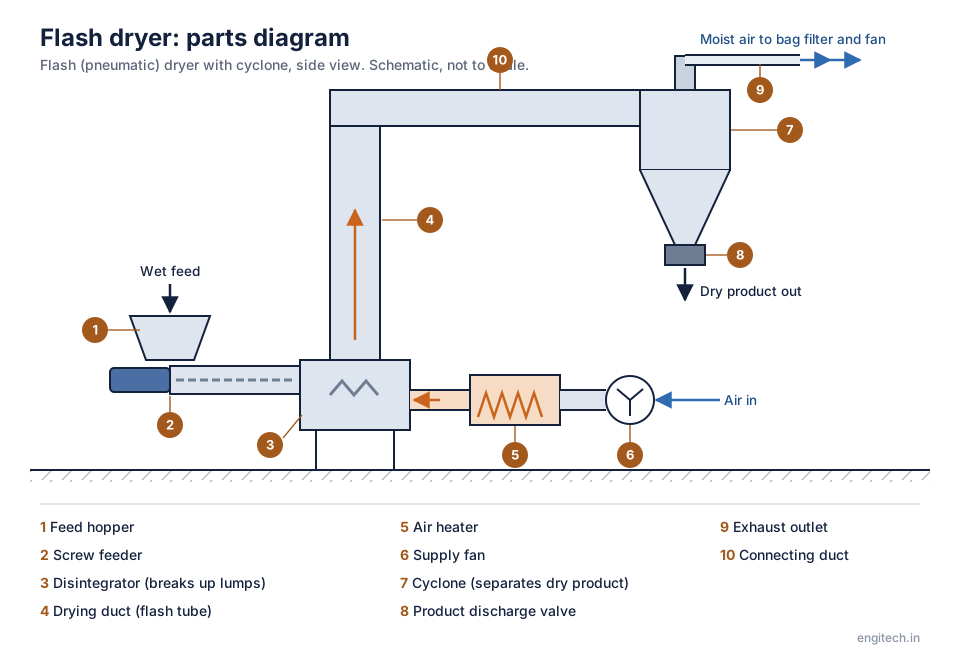
| No. | Part | What it does |
|---|---|---|
| 1 | Feed hopper | Holds the wet material before it is fed in. |
| 2 | Screw feeder | Meters the wet material into the dryer at a steady rate. |
| 3 | Disintegrator | Breaks up lumps so the particles are small enough to be carried by the hot gas and dry quickly. |
| 4 | Drying duct | The vertical tube in which the particles are carried upward by the hot gas. Drying takes only a few seconds. |
| 5 | Air heater | Heats the air before it reaches the disintegrator. |
| 6 | Supply fan | Moves the air through the heater and the drying duct. |
| 7 | Cyclone | Separates the dried product from the moist air. |
| 8 | Product discharge valve | A rotary valve that lets the dry product out while keeping air out. |
| 9 | Exhaust outlet | The moist air leaves here. It usually goes on to a bag filter and an exhaust fan to catch the finest dust. |
| 10 | Connecting duct | Carries the gas and product stream from the drying duct to the cyclone. |
Download this diagram (SVG)Schematic for learning. Real machines vary by maker and duty.
What is a Spin Flash Dryer?
A spin flash dryer uses a combination of mechanical agitation and hot air to dry moist materials rapidly. The dryer consists of a vertical drying chamber where the material is introduced and subjected to intense mechanical agitation and hot air. This process ensures quick drying and produces a fine, dry powder.
How Spin Flash Dryers Work
- Feed Introduction: You introduce the moist material into the drying chamber through a feed screw or pump. The material enters the chamber at the bottom.
- Mechanical Agitation: The dryer uses a high-speed rotating agitator to disperse the material and break it into fine particles. This mechanical action increases the surface area for drying and prevents material agglomeration.
- Hot Air Injection: Simultaneously, you inject hot air into the drying chamber. The hot air flows upwards, contacting the dispersed material particles, causing rapid moisture evaporation.
- Drying and Classification: As the hot air evaporates the moisture, the drying chamber’s design ensures the lighter, dry particles are carried upwards while heavier, moist particles remain in the lower part for further drying.
- Product Collection: The dry particles are carried out of the drying chamber by the hot air and collected in a cyclone separator or bag filter. The final product is a fine, dry powder suitable for various applications.

Applications of Spin Flash Dryers
1. Chemicals:
- Dry chemicals such as dyes, pigments, and catalysts.
- Ideal for heat-sensitive and hygroscopic materials.
2. Pharmaceuticals:
- Dry active pharmaceutical ingredients (APIs), intermediates, and excipients.
- Produce fine, uniform powders essential for drug formulation.
3. Food Processing:
- Dry food products like starch, proteins, and spices.
- Preserve nutritional value and improve shelf life.
4. Minerals:
- Dry minerals and clays.
- Improve handling and processing efficiency.
5. Ceramics:
- Dry ceramic powders and slurries.
- Produce high-quality ceramic products.
Benefits of Using Spin Flash Dryers
Rapid Drying: Spin flash dryers offer quick moisture evaporation due to the combination of mechanical agitation and hot air. This reduces drying time significantly compared to traditional drying methods.
Energy Efficiency: The process efficiently uses energy, as the mechanical agitation ensures even heat distribution and rapid moisture removal. This leads to lower energy consumption and reduced operating costs.
Uniform Product Quality: The mechanical agitation and controlled hot air flow produce a uniform, fine powder. This consistency is essential for applications requiring precise particle size and quality.
Compact Design: Spin flash dryers have a compact design, requiring less floor space compared to other drying equipment. This makes them suitable for facilities with limited space.
Versatility: These dryers can handle a wide range of materials, including heat-sensitive and sticky substances. This versatility makes them applicable across various industries.
Minimal Maintenance: The robust design and minimal moving parts reduce maintenance requirements, ensuring long-term reliability and continuous operation.
Key Considerations in Selecting a Spin Flash Dryer
Material Characteristics: Understand the properties of the material to be dried, including moisture content, particle size, and heat sensitivity. This knowledge helps in selecting the appropriate dryer configuration and operating parameters.
See it in 3D
Production Capacity: Determine the required production capacity and choose a spin flash dryer that can handle the desired throughput. Ensure the dryer can meet your production needs efficiently.
Energy Efficiency: Evaluate the energy efficiency of the dryer. Look for features such as heat recovery systems and optimized airflow to reduce energy consumption and operating costs.
Control Systems: Opt for a dryer with advanced control systems that allow precise monitoring and adjustment of process parameters. This ensures consistent product quality and efficient drying.
Cleaning and Maintenance: Consider the ease of cleaning and maintenance when selecting a spin flash dryer. Choose designs that facilitate quick and thorough cleaning to minimize downtime and ensure hygienic operation.
Advances in Spin Flash Dryer Technology
Advanced Control Systems: Modern spin flash dryers come equipped with advanced control systems that provide real-time monitoring and adjustment of process parameters. This ensures optimal drying conditions and consistent product quality.
Energy Efficiency Innovations: New designs incorporate energy-efficient features such as heat recovery systems and variable airflow control. These innovations enhance energy efficiency and reduce operating costs.
Material Handling Improvements: Advances in material handling technology have improved the feeding and discharge mechanisms of spin flash dryers, ensuring smooth and continuous operation.
Integration with Continuous Manufacturing: Spin flash dryers are increasingly integrated with continuous manufacturing processes, boosting efficiency and scalability for large-scale production.
Customization: Advances in spin flash dryer technology enable customization to meet specific application requirements. This includes tailoring the design, airflow, and temperature control to optimize the drying process for various materials.
Spin flash dryer working principle, step by step
A spin flash dryer dries pastes, filter cakes and sludges that are too sticky for a normal flash dryer and too thick to pump to a spray dryer. It combines a rotor that breaks up the wet feed with a swirling stream of hot air, so drying takes seconds.
- Feed: a feed tank with an agitator and a screw conveyor pushes the wet cake into the bottom of the drying chamber.
- Disintegration: a rotor at the base of the chamber breaks lumps apart and keeps the material moving.
- Hot air in: hot air enters tangentially at the bottom, creating a swirling, fluidised zone where the surface of each particle dries almost at once.
- Classification: a ring (classifier) at the top lets only fine, dry particles leave; heavier, wetter lumps fall back to be broken up again.
- Collection: dry powder leaves with the air to a bag filter or cyclone, and the clean air goes to the exhaust fan.
Because wet material sits where the air is hottest and dry fines leave quickly, high inlet temperatures can be used while the product itself stays near the outlet air temperature.
Spin flash dryer diagram: the main parts
| Part | What it does |
|---|---|
| Feed tank and screw feeder | Meters wet cake into the chamber at a steady rate |
| Air heater and inlet duct | Supplies hot air tangentially at the chamber base |
| Drying chamber with rotor | Breaks up lumps and keeps the bed moving |
| Classifier ring | Controls the particle size and moisture of the powder leaving |
| Bag filter or cyclone, exhaust fan | Collects product and pulls air through the system |
Worked example: how much water a spin flash dryer removes
Assumed values: 1,000 kg/h of filter cake at 50% moisture dried to 1% (wet basis). Dry solids are 500 kg/h, product is 505.1 kg/h, and the dryer must evaporate about 494.9 kg/h of water. That evaporation load, not the feed rate, sets the size of the chamber, air heater and fan.
Spin flash vs flash vs spray dryer
| Dryer | Feed it handles |
|---|---|
| Spin flash dryer | Sticky pastes, filter cakes, sludges (pigments, dyes, fillers, some food and pharma powders) |
| Flash dryer | Free-flowing, non-sticky wet powders and crystals |
| Spray dryer | Pumpable liquids, solutions and slurries |
When comparing spin flash dryer manufacturers, ask for a test run on your own cake, the guaranteed final moisture and particle size, the evaporation rate per m³ of chamber, explosion protection for organic powders, and local service. The spin flash design was originally developed by Anhydro (now part of SPX FLOW), and several manufacturers now build similar swirl-type dryers.
Conclusion
Spin flash dryers play a transformative role in industrial drying, offering rapid and efficient drying for a wide range of materials. By understanding their working principle, applications, benefits, and key considerations, you can optimize your drying process and achieve high-quality results. The latest advancements in spin flash dryer technology continue to expand their capabilities and applications, making them an essential tool in modern industrial processes.
For more in-depth articles and resources on industrial drying technologies and innovations, visit EngiTech.in. Stay updated on the latest advancements and applications in the industry!
🛠️ Recommended Engineering Guides & Tools
Related reading: Vibrating Fluid Bed Dryers: Efficient Drying Solutions.
Free tools for this topic: Dryer selection tool · Dryer evaporation, heat and fuel calculator · all free engineering tools
Sources and further reading
For standards, data and independent guidance on this topic, see US Department of Energy process heating resources (industrial heating and drying efficiency), The Engineering ToolBox (engineering reference data and calculators) and Bureau of Energy Efficiency (energy audit and efficiency programmes in India). Always check the current edition and your site conditions before applying any figure.
Free tool for this topic
Industrial Dryer Evaporation, Heat & Fuel CalculatorWater evaporation, product output, heat load and fuel or steam consumption for spray, rotary, flash, fluid-bed and paddle dryers. Industrial DryersRotary Vacuum Paddle Dryers (RVPD): Solvent Recovery, Heat Transfer & Sizing Guide
 Industrial DryersDryer Exhaust Dew Point: Preventing Condensation and Corrosion in Ducts
 Industrial DryersSpray Dryers: Principles, Types, Applications, and Considerations
 Industrial DryersFluid Bed Dryers: Efficient Drying Solutions Explained
 Industrial DryersHot Air Generation for Dryers: Direct-Fired, Indirect and Electric Compared
 Industrial DryersSpray Dried Dispersion: Enhance Drug Solubility