
On this page
- Paddle dryer diagram: parts and their functions
- The key idea: count water, not sludge
- Worked example: the fuel cost per tonne of dry solids
- Disposal savings to set against the cost
- Choosing the drying route
- Lowering the cost
- What I see in plants
- Frequently asked questions
- How much water must be evaporated per tonne of sludge?
- Is mechanical dewatering cheaper than drying?
- Can I dry sludge with waste heat?
- Is dried sludge safe to store?
- What dryness should I aim for?
- Sources and further reading
- Related guides
- More on Industrial Dryers
Short answer: Drying sludge costs most for the water, so the cost per tonne of dry solids depends on how wet the sludge enters the dryer. For sludge at 20 per cent dry solids dried to 90 per cent, about 3.9 tonnes of water must be evaporated per tonne of dry solids, costing roughly ₹15,000 in fuel at the assumed prices below. Dewatering to 30 per cent first cuts that evaporation load by about 43 per cent. Dryers pay when they use cheap or waste heat, or when disposal costs are high.
Paddle dryer diagram: parts and their functions
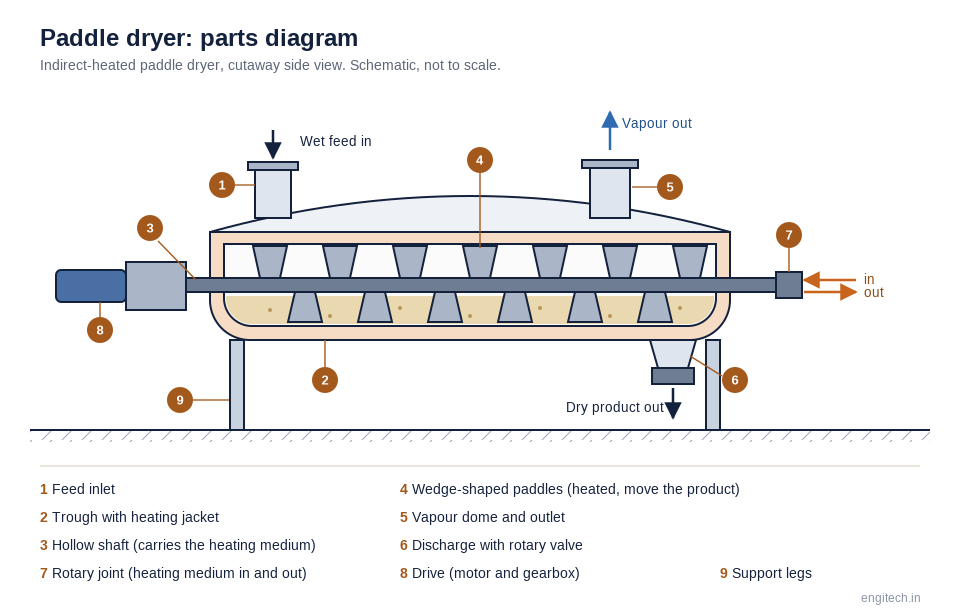
| No. | Part | What it does |
|---|---|---|
| 1 | Feed inlet | Where the wet material, such as sludge or cake, enters the trough. |
| 2 | Trough with heating jacket | The jacket carries steam or thermal oil that heats the wall. This is indirect heating, so the material does not meet the heating medium. |
| 3 | Hollow shaft | The shaft is hollow so the heating medium also flows inside it. This adds more heating surface. |
| 4 | Wedge-shaped paddles | Heated paddles on the shaft stir the material, bring it onto hot surfaces and move it along the trough. |
| 5 | Vapour dome and outlet | The evaporated water leaves here. A small amount of vapour or carrier gas takes it away, so the exhaust volume is low. |
| 6 | Discharge with rotary valve | Dried product leaves at the end of the trough. |
| 7 | Rotary joint | Lets the heating medium flow into and out of the rotating shaft. |
| 8 | Drive | Motor and gearbox that turn the shaft slowly. |
| 9 | Support legs | Carry the dryer. |
Download this diagram (SVG)Schematic for learning. Real machines vary by maker and duty.
Many plants consider a sludge dryer because the cost of hauling and disposing of wet sludge keeps rising. The decision often hinges on one figure that nobody has calculated: the cost of evaporating a tonne of water. In my conversations with effluent plant managers, the dryer is sometimes bought on the supplier’s promise, and then the fuel bill arrives. This guide gives a clear way to estimate the economics before you decide. It follows our guides to paddle dryers for sludge, industrial sludge handling and indirect dryer sizing.
The key idea: count water, not sludge
Sludge is mostly water. To dry it, every kilogram of water has to be evaporated, using about 2,300 to 2,500 kJ/kg of heat at minimum, plus inefficiencies. So the cost depends on the water load per tonne of dry solids (ts).
| Feed dry solids | Water per tonne of dry solids (t) | Water to evaporate to reach 90% DS (t per ts) |
|---|---|---|
| 15% | 5.67 | 5.56 |
| 20% | 4.00 | 3.89 |
| 25% | 3.00 | 2.89 |
| 30% | 2.33 | 2.22 |
| 35% | 1.86 | 1.75 |
Water in dried product at 90 per cent dry solids = 0.111 t per ts, which is why the last column is 0.111 less than the second. Check: at 20 per cent, 1 / 0.20 − 1 = 4.0 tonnes of water per tonne of solids; dried to 90 per cent, 1 / 0.90 − 1 = 0.111; evaporated = 3.89 t.
Worked example: the fuel cost per tonne of dry solids
Take 1 tonne of dry solids (ts) at 20 per cent feed solids and a dried product at 90 per cent solids.
- Water to evaporate = 3.89 t.
- Heat at 2,500 MJ per tonne of water (including some sensible heat) = 3.89 × 2,500 = 9,722 MJ = 9.72 GJ.
- With a dryer thermal efficiency of 75 per cent: fuel heat = 9.72 / 0.75 = 12.96 GJ.
- At an assumed fuel cost of ₹1,200 per GJ: 12.96 × 1,200 = ₹15,556 per ts.
- Electrical energy at an assumed 150 kWh per tonne of water for the dryer, conveyors, fans and condenser (indicative): 3.89 × 150 = 584 kWh; at ₹8 = ₹4,670 per ts. Total energy cost ≈ ₹20,200 per ts, or about ₹5,200 per tonne of water evaporated.
Now with dewatering to 30 per cent solids first (for example with a better filter press or centrifuge): water to evaporate = 2.22 t. Heat = 2.22 × 2,500 = 5,556 MJ; fuel heat = 5.556 / 0.75 = 7.41 GJ; fuel cost = 7.41 × 1,200 = ₹8,889 per ts. Electricity = 2.22 × 150 = 333 kWh = ₹2,664. Total ≈ ₹11,550 per ts. The saving of ₹8,650 per tonne of dry solids (about 43 per cent) comes from mechanical dewatering, which uses much less energy per kg of water removed than thermal drying. For a plant producing 1,000 tonnes of dry solids a year, that is ₹86 lakh a year.
Disposal savings to set against the cost
Suppose wet sludge at 20 per cent solids costs ₹1,500 per tonne to transport and dispose of. One tonne of dry solids is 5 tonnes of wet sludge: ₹7,500. After drying to 90 per cent, the product mass is 1.11 tonnes; at the same rate it would cost 1.11 × 1,500 = ₹1,667, a saving of ₹5,833 per ts. That is less than the energy cost of drying (₹20,200 per ts at purchased fuel), so drying does not pay on disposal savings alone in this example. It pays if one or more of these holds:
- Heat is cheap or free: waste heat, biogas, biomass or solar; at ₹200 per GJ, the fuel cost falls to about ₹2,600 per ts.
- Disposal is expensive (hazardous waste, long distances, strict landfill rules).
- The dried sludge has value: as fuel for a boiler or kiln, a soil conditioner or a raw material, at the right moisture.
- Dewatering is improved first, as in the second case.
All prices here are assumptions; the structure of the calculation is what to reuse.
Choosing the drying route
| Option | Notes |
|---|---|
| Solar or greenhouse drying | Very low cost where land and sun are available; slow, weather-dependent, odour management |
| Paddle or disc dryer (indirect) | Compact, closed, steam or thermal oil heating; good for sludge; see paddle dryers for sludge |
| Belt dryer (direct) | Uses hot air from waste heat sources; large footprint |
| Thin film or other dryers | For special sludges |
| Incineration or co-processing | Uses the sludge’s own energy; needs permits |
Lowering the cost
- Improve dewatering: polymer dosing, press or centrifuge selection and operation; see the solid-liquid separation decision guide.
- Reduce the water at source by good process control and thickening.
- Use waste heat or low-cost fuel, and recover heat from the dryer exhaust; see heat recovery from dryer exhaust.
- Dry only to the moisture needed; 90 per cent is not always required for disposal; for use as fuel the target depends on the burner.
- Check the odour, dust, vapour condensation and safety requirements; see dryer exhaust dew point and condensation and dust explosion protection basics.
What I see in plants
The plants that make sludge drying work have normally done the arithmetic first: water per tonne, heat available, disposal route. They often start by improving dewatering and then size a dryer for the smaller load. Plants that skip this step buy a dryer sized for wet sludge and find the energy cost higher than the disposal cost they hoped to avoid. For the effluent system around it, see industrial effluent treatment, and for compliance, the environmental compliance calendar.
See it in 3D
Free tools for this topic: Dryer selection tool · Dryer evaporation, heat and fuel calculator · Tank volume calculator · all free engineering tools
Frequently asked questions
How much water must be evaporated per tonne of sludge?
For sludge at 20 per cent solids dried to 90 per cent, about 778 kg per tonne of wet sludge (3.89 tonnes per tonne of dry solids).
Is mechanical dewatering cheaper than drying?
Yes. Removing a kilogram of water mechanically uses far less energy than evaporating it, so dewater as much as possible first.
Can I dry sludge with waste heat?
Yes, if the waste heat is at a suitable temperature and quantity, and the system is designed for it. This can transform the economics.
Is dried sludge safe to store?
Dried sludge can self-heat or burn and its dust can explode; store and handle it with care.
What dryness should I aim for?
Whatever the next step needs: for disposal, as dry as is economic; for use as fuel, the level the boiler or kiln accepts.
Sources and further reading
For standards, data and independent guidance on this topic, see US Department of Energy process heating resources (industrial heating and drying efficiency), The Engineering ToolBox (engineering reference data and calculators), Bureau of Energy Efficiency (energy audit and efficiency programmes in India) and US EPA wastewater permitting programme (effluent treatment guidance). Always check the current edition and your site conditions before applying any figure.
Related reading: Indirect Dryer Sizing: Heat Transfer Area from a Mass and Energy Balance; Residence Time Distribution in Dryers: Tracer Tests and Tanks in Series; Vacuum Drying Basics: Pressure, Boiling Point and Drying Time; Hot Air Generation for Dryers: Direct-Fired, Indirect and Electric Compared.
This article is general information from my experience with effluent and dryers and is not a design or investment advice. Fuel prices, energy use and disposal costs are assumed for illustration.
Free tool for this topic
Industrial Dryer Evaporation, Heat & Fuel CalculatorWater evaporation, product output, heat load and fuel or steam consumption for spray, rotary, flash, fluid-bed and paddle dryers. Industrial DryersFluid Bed Dryers: Efficient Drying Solutions Explained
 Industrial DryersSpray Drying of Milk: Process & Benefits Explained
 Industrial DryersAgitated Thin Film Dryers: Industrial Drying
 Industrial DryersHot Air Generation for Dryers: Direct-Fired, Indirect and Electric Compared
 Industrial DryersDryer Moisture Control: Online Measurement and Feed Control
 Industrial DryersATFD Design Guide: Rotor Speed, Blade Clearances & Zero Liquid Discharge (ZLD)