
On this page
- Introduction to Jackhammers
- Types of Jackhammers
- 1. Pneumatic Jackhammers
- 2. Hydraulic Jackhammers
- 3. Electric Jackhammers
- 4. Gasoline-powered Jackhammers
- Applications of Jackhammers
- Advantages of Using Jackhammers
- Design Considerations for Jackhammers
- Maintenance of Jackhammers
- How does a pneumatic jackhammer work?
- Jackhammer types by weight and use
- What materials can you break with a pneumatic jackhammer?
- Worked example: impact power
- Conclusion
- FAQs About Jackhammers
- 🛠️ Recommended Engineering Guides & Tools
- Sources and further reading
- More on Machinery and Equipment
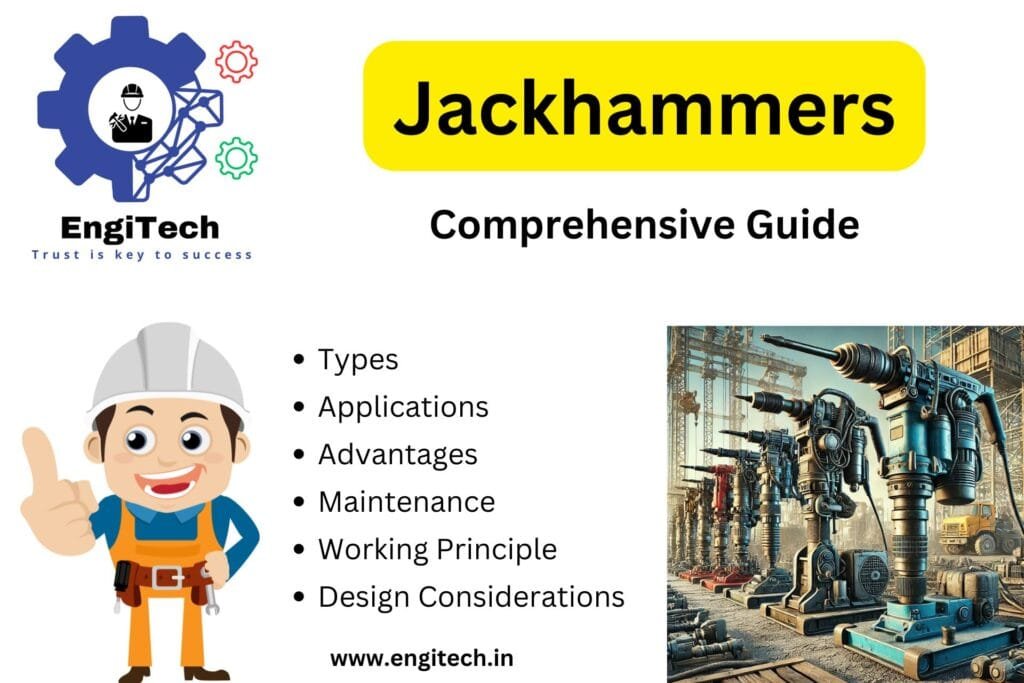
Jackhammers, also known as pneumatic drills or demolition hammers, are powerful tools used in construction, demolition, and mining industries. They are designed to break up hard surfaces such as concrete, asphalt, and rock. This comprehensive guide will examine the different types of jackhammers, their designs, working principles, applications, advantages, and maintenance practices.
Introduction to Jackhammers
Jackhammers are indispensable tools in the construction and demolition industries. They combine a hammer and chisel action to deliver powerful impacts, making them highly effective for breaking up hard materials. The primary advantage of jackhammers is their ability to perform heavy-duty tasks with relative ease, reducing manual labor and increasing efficiency.
Types of Jackhammers
Jackhammers come in several types, each designed to meet specific requirements and operational conditions. The main types include:
- Pneumatic Jackhammers
- Hydraulic Jackhammers
- Electric Jackhammers
- Gasoline-powered Jackhammers
1. Pneumatic Jackhammers
Design and Working Principle
Pneumatic jackhammers are powered by compressed air. They are connected to an air compressor that provides the necessary air pressure to drive the hammer mechanism. The main components of a pneumatic jackhammer include:
- Air Compressor: Supplies compressed air to the jackhammer.
- Piston: Moves back and forth to create the hammering action.
- Chisel: The working end that breaks up the material.
The compressed air drives the piston, which strikes the chisel, producing rapid and powerful blows. Pneumatic jackhammers are known for their high impact force and are widely used in heavy-duty applications.
Advantages
- High impact force
- Suitable for heavy-duty tasks
- Durable and reliable
Applications
- Road construction and repair
- Demolition of concrete structures
- Quarrying and mining
2. Hydraulic Jackhammers
Design and Working Principle
Hydraulic jackhammers are powered by hydraulic fluid. They are commonly used in heavy machinery such as excavators and backhoes. The main components of a hydraulic jackhammer include:
- Hydraulic Pump: Supplies hydraulic fluid to the jackhammer.
- Hydraulic Piston: Moves back and forth to create the hammering action.
- Chisel: The working end that breaks up the material.
The hydraulic fluid drives the piston, which strikes the chisel, producing powerful impacts. Hydraulic jackhammers are known for their high efficiency and ability to handle tough materials.
Advantages
- High efficiency
- Suitable for heavy machinery
- Capable of handling tough materials
Applications
- Construction and demolition projects
- Mining and quarrying
- Underwater construction
3. Electric Jackhammers
Design and Working Principle
Electric jackhammers are powered by electricity. They are suitable for lighter tasks compared to pneumatic and hydraulic jackhammers. The main components of an electric jackhammer include:
- Electric Motor: Powers the hammer mechanism.
- Piston: Moves back and forth to create the hammering action.
- Chisel: The working end that breaks up the material.
The electric motor drives the piston, which strikes the chisel, producing rapid and controlled blows. Electric jackhammers are known for their ease of use and portability.
Advantages
- Easy to use
- Portable
- Suitable for lighter tasks
Applications
- Home renovation projects
- Breaking up small concrete slabs
- Light demolition work
4. Gasoline-powered Jackhammers
Design and Working Principle
Gasoline-powered jackhammers are powered by gasoline engines. They offer mobility and are suitable for outdoor use where electricity or compressed air may not be available. The main components of a gasoline-powered jackhammer include:
- Gasoline Engine: Powers the hammer mechanism.
- Piston: Moves back and forth to create the hammering action.
- Chisel: The working end that breaks up the material.
The gasoline engine drives the piston, which strikes the chisel, producing powerful impacts. Gasoline-powered jackhammers are known for their mobility and ability to operate independently of external power sources.
Advantages
- Mobile and independent
- Suitable for outdoor use
- High impact force
Applications
- Remote construction sites
- Outdoor demolition projects
- Road repair and maintenance
Applications of Jackhammers
Jackhammers are versatile tools with a wide range of applications across various industries. Some common applications include:
1. Road Construction and Repair
Jackhammers are extensively used in road construction and repair projects. They are employed to break up old concrete and asphalt pavements, making way for new construction. Their high impact force and efficiency make them ideal for these tasks.
2. Demolition Projects
In demolition projects, jackhammers are used to dismantle concrete structures, walls, and foundations. Their ability to deliver powerful blows ensures the efficient removal of unwanted structures.
3. Quarrying and Mining
In the quarrying and mining industries, jackhammers are used to break up rocks and extract valuable minerals. Their durability and high impact force make them suitable for these demanding environments.
4. Home Renovation
For home renovation projects, electric jackhammers are commonly used to break up small concrete slabs, remove tiles, and perform light demolition work. Their portability and ease of use make them a popular choice for DIY enthusiasts.
5. Underwater Construction
Hydraulic jackhammers are used in underwater construction projects, such as bridge and pier construction. Their ability to operate efficiently in underwater conditions makes them invaluable in these applications.
Advantages of Using Jackhammers
Jackhammers offer several advantages that make them a preferred choice in various industries:
- Efficiency: Jackhammers provide efficient and rapid breaking of hard materials, reducing labor time and effort.
- Versatility: They are adaptable to a wide range of applications, from construction and demolition to mining and home renovation.
- Mobility: Gasoline-powered jackhammers offer mobility, allowing them to be used in remote and outdoor locations.
- Power: Jackhammers deliver powerful impacts, making them capable of handling tough materials and heavy-duty tasks.
- Durability: These tools are designed to withstand demanding environments and heavy use, ensuring long-term reliability.
Design Considerations for Jackhammers
When selecting a jackhammer, several factors must be considered to ensure optimal performance and efficiency:
- Type of Jackhammer: Choose the appropriate type based on the specific application and available power sources. Pneumatic, hydraulic, electric, and gasoline-powered jackhammers each have their advantages and are suited to different tasks.
- Impact Force: Consider the required impact force based on the material to be broken. Higher impact force is needed for tougher materials.
- Weight and Portability: Evaluate the weight and portability of the jackhammer, especially for tasks that require mobility and ease of use.
- Noise Levels: Consider the noise levels produced by the jackhammer, as some models may require hearing protection for operators.
- Maintenance Requirements: Choose a jackhammer that is easy to maintain and has readily available replacement parts.
Maintenance of Jackhammers
Regular maintenance of jackhammers is essential to ensure efficient operation and longevity. Here are some maintenance practices to follow:
- Inspection: Regularly inspect the jackhammer for signs of wear, damage, and loose components. Check the chisel, piston, and other critical parts.
- Cleaning: Keep the jackhammer clean by removing dust, debris, and residues. This helps maintain optimal performance and prevents damage.
- Lubrication: Properly lubricate moving parts to reduce friction and wear. Follow the manufacturer’s recommendations for lubrication intervals and types of lubricants.
- Fuel and Air Filters: For pneumatic and gasoline-powered jackhammers, check and replace fuel and air filters as needed to ensure efficient operation.
- Safety Checks: Conduct regular safety checks, including inspecting safety features, testing emergency shutdown systems, and ensuring proper ventilation.
How does a pneumatic jackhammer work?
Compressed air from a portable compressor enters the hammer through a hose. A valve directs the air alternately to each side of a free piston inside the cylinder, so the piston shoots back and forth hundreds of times a minute. On each forward stroke it strikes the end of the tool (chisel, moil point or spade), which passes the blow into the concrete or rock. Exhaust air leaves through ports, often with a muffler. The operator only guides the tool and lets the hammer’s weight hold it on the work.
Jackhammer types by weight and use
| Type | Typical weight | Use |
|---|---|---|
| Chipping hammer | About 5 to 10 kg | Chipping, trimming, light demolition, often used horizontally |
| Medium breaker | About 15 to 25 kg | Floors, slabs, trenching in asphalt |
| Heavy breaker | About 25 to 40 kg | Thick concrete, roads, foundations |
| Hydraulic breaker | Hand-held or machine-mounted | Powered from a hydraulic pack or excavator; heavy, continuous work |
| Electric breaker | Up to about 30 kg | Indoor work and sites without a compressor |
What materials can you break with a pneumatic jackhammer?
Concrete (plain and reinforced, though rebar must be cut separately), asphalt, brick and block masonry, stone paving, frozen ground, hard clay and soft to medium rock. Very hard rock and mass concrete are better handled by machine-mounted breakers or drilling and splitting.
Worked example: impact power
A breaker delivering 50 J per blow at 1,200 blows per minute puts about 50 × 1,200 ÷ 60 = 1,000 W of impact power into the material. Heavier hammers hit harder per blow; lighter ones hit faster. Match the compressor’s air delivery to the hammer’s rated air consumption; see types of air compressors.
Conclusion
Jackhammers are powerful and versatile tools that play a central role in construction, demolition, and mining industries. Understanding the different types of jackhammers and their specific applications helps in selecting the most suitable tool for any task.
FAQs About Jackhammers
1. What is a jackhammer?
A jackhammer is a powerful tool used for breaking up hard surfaces such as concrete, asphalt, and rock. It combines a hammer and chisel action to deliver powerful impacts, making it essential in construction, demolition, and mining industries.
2. How does a jackhammer work?
A jackhammer works by driving a piston back and forth to strike a chisel, creating rapid and powerful blows that break up hard materials. Depending on the type, it can be powered by compressed air, hydraulic fluid, electricity, or gasoline.
3. What are the different types of jackhammers?
The different types of jackhammers include pneumatic jackhammers, hydraulic jackhammers, electric jackhammers, and gasoline-powered jackhammers. Each type has specific advantages and is suited to different applications.
4. What is a pneumatic jackhammer?
A pneumatic jackhammer is powered by compressed air. It is commonly used for heavy-duty tasks such as road construction and demolition due to its high impact force and durability.
5. How do hydraulic jackhammers work?
Hydraulic jackhammers use hydraulic fluid to drive a piston that strikes the chisel. They are often attached to heavy machinery like excavators and are used for large-scale construction and demolition projects.
6. What are the advantages of electric jackhammers?
Electric jackhammers are easy to use, portable, and suitable for lighter tasks. They are powered by electricity, making them ideal for home renovation projects and light demolition work.
7. Where are gasoline-powered jackhammers used?
Gasoline-powered jackhammers are used in remote and outdoor locations where electricity or compressed air may not be available. They offer mobility and are suitable for road repair, construction sites, and outdoor demolition projects.
8. What safety measures should be taken when using a jackhammer?
When using a jackhammer, safety measures include wearing protective gear (such as safety goggles, ear protection, and gloves), ensuring proper ventilation, securing the work area, and following the manufacturer’s instructions for operation and maintenance.
9. How do you maintain a jackhammer?
To maintain a jackhammer, regularly inspect for wear and damage, clean the tool to remove dust and debris, lubricate moving parts, check and replace fuel and air filters (for pneumatic and gasoline-powered models), and conduct regular safety checks.
10. What is the impact force of a jackhammer?
The impact force of a jackhammer varies depending on the type and model. Pneumatic and hydraulic jackhammers typically have higher impact forces compared to electric and gasoline-powered models, making them suitable for heavier tasks.
11. Can jackhammers be used underwater?
Yes, hydraulic jackhammers can be used underwater for construction projects such as bridge and pier construction. Their ability to operate efficiently in underwater conditions makes them suitable for these applications.
12. What are the common applications of jackhammers?
Common applications of jackhammers include road construction and repair, demolition of concrete structures, quarrying and mining, home renovation projects, and underwater construction.
13. What is the difference between a jackhammer and a demolition hammer?
A jackhammer combines a hammer and chisel action for breaking up hard surfaces, while a demolition hammer generally refers to any tool used for demolition purposes, which can include jackhammers, sledgehammers, and other heavy-duty tools.
14. How do you choose the right jackhammer for a specific task?
To choose the right jackhammer, consider the type of material to be broken, the required impact force, the available power source (compressed air, hydraulic fluid, electricity, or gasoline), the weight and portability of the tool, and the specific application (e.g., road construction, demolition, home renovation).
From Our Team
For a jackhammer enquiry, describe the task, working material, available supply and site constraints. Check model-specific operating instructions, required training and the controls needed for the intended work.
At EngiTech, we prioritize quality, innovation, and customer satisfaction, ensuring you have the best tools to enhance your operations. Join the countless professionals who rely on us for reliable, efficient, and powerful industrial solutions. Visit EngiTech.in today and take your projects to the next level.
🛠️ Recommended Engineering Guides & Tools
Free tools for this topic: Engineering unit converter · Engineering reference tables · Engineering glossary · all free engineering tools
Sources and further reading
For standards, data and independent guidance on this topic, see Bureau of Indian Standards (Indian standards catalogue), NIST (measurement and calibration standards) and The Engineering ToolBox (engineering reference data and calculators). Always check the current edition and your site conditions before applying any figure.
Free tool for this topic
Motor Running Cost & Energy CalculatorElectrical input power, annual energy use and running cost of a motor from its rating, load, efficiency and operating hours. Machinery and EquipmentThe Ultimate Guide to Paper Making Machinery: Types, Applications, and Buying Considerations
 Machinery and EquipmentHow to Choose the Best Laser Engraving Machine for Your Business: A Comprehensive Guide
 Machinery and EquipmentThe Best Acrylic Cutting Machines for DIY Projects: A Complete Guide
 Machinery and EquipmentUncoilers: Comprehensive Guide & Working Principle | Learn All About Uncoiler Machines
 Machinery and EquipmentRoll Crushers: A Comprehensive Guide for Knowledge Seekers and Professionals
 Machinery and EquipmentZigzag Sewing Machines: A Comprehensive Guide for Knowledge Seekers, Students, and Working Professionals