
On this page
- Paddle dryer diagram: parts and their functions
- What is a Paddle Dryer for Sludge?
- Working Principle of Paddle Dryer for Sludge
- Working Principle of Paddle Dryer for Sludge
- 5. Dried Sludge Discharge:
- Benefits of Using Paddle Dryers for Sludge
- 1. Efficient Drying Process:
- 2. Reduced Sludge Volume:
- 3. Energy Efficiency:
- 4. Vapor Removal:
- 5. Dried Sludge Discharge:
- Benefits of Using Paddle Dryers for Sludge
- 1. Efficient Drying Process:
- 2. Reduced Sludge Volume:
- 3. Energy Efficiency:
- 4. Versatility:
- 5. Environmental Compliance:
- Applications of Paddle Dryers in Sludge Management
- 1. Municipal Wastewater Treatment:
- 2. Industrial Waste Treatment:
- 3. Biological Sludge Management:
- Choosing the Right Paddle Dryer for Sludge
- 1. Capacity and Throughput:
- 2. Heating Medium:
- 3. Material Compatibility:
- 4. Automation and Control:
- 5. Energy Efficiency:
- Why sludge needs a paddle dryer: the sticky phase
- Full drying vs partial drying of sludge
- Worked example: steam needed by a sludge paddle dryer
- Conclusion
- 🛠️ Recommended Engineering Guides & Tools
- Sources and further reading
- More on Environmental Engineering
Efficient handling of sludge is an essential step in both wastewater treatment and industrial processes. Through better drying of the sludge, you are practically reducing the bulk and weight of it, thus making all the processes around it easier to manage, move, and get rid of it. Paddle dryers by the way are some of the most efficient machines in this regard. The blog below will outline the specific benefits of the paddle dryers for this element, it shall also describe the working of the paddle dryers.
Paddle dryer diagram: parts and their functions
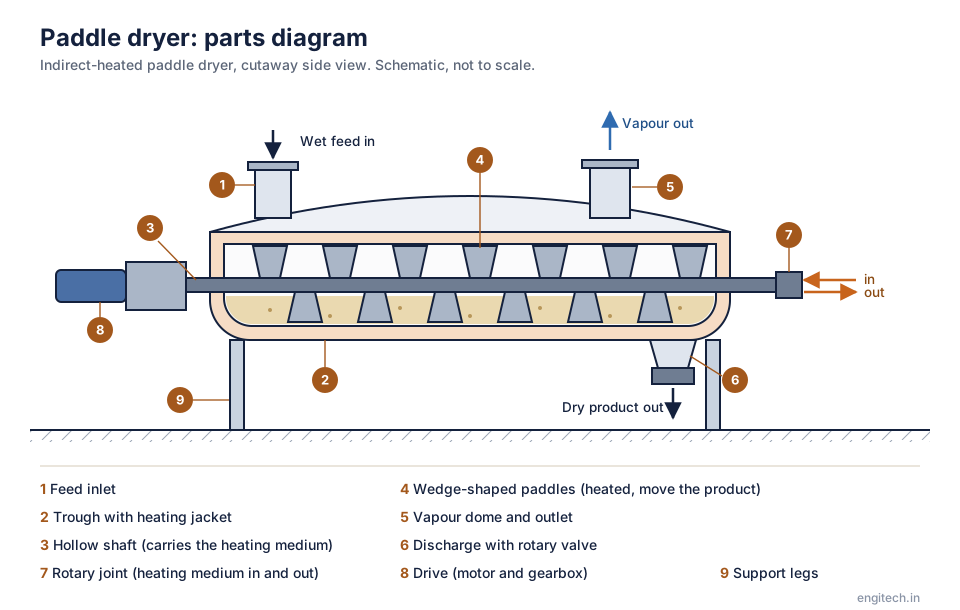
| No. | Part | What it does |
|---|---|---|
| 1 | Feed inlet | Where the wet material, such as sludge or cake, enters the trough. |
| 2 | Trough with heating jacket | The jacket carries steam or thermal oil that heats the wall. This is indirect heating, so the material does not meet the heating medium. |
| 3 | Hollow shaft | The shaft is hollow so the heating medium also flows inside it. This adds more heating surface. |
| 4 | Wedge-shaped paddles | Heated paddles on the shaft stir the material, bring it onto hot surfaces and move it along the trough. |
| 5 | Vapour dome and outlet | The evaporated water leaves here. A small amount of vapour or carrier gas takes it away, so the exhaust volume is low. |
| 6 | Discharge with rotary valve | Dried product leaves at the end of the trough. |
| 7 | Rotary joint | Lets the heating medium flow into and out of the rotating shaft. |
| 8 | Drive | Motor and gearbox that turn the shaft slowly. |
| 9 | Support legs | Carry the dryer. |
Download this diagram (SVG)Schematic for learning. Real machines vary by maker and duty.
What is a Paddle Dryer for Sludge?
A paddle dryer for sludge is a special device that does this thing efficiently through indirect heating. The equipment consists of a horizontally placed cylindrical vessel in which the sludge is weaved by the rotating paddles. The indirect heating system makes sure that the heating medium is kept away from the sludge. It can be steam/thermic fluid that is heated up to the required temperature and does not touch the sludge. This aids in giving a more controlled and efficient drying process.
Working Principle of Paddle Dryer for Sludge
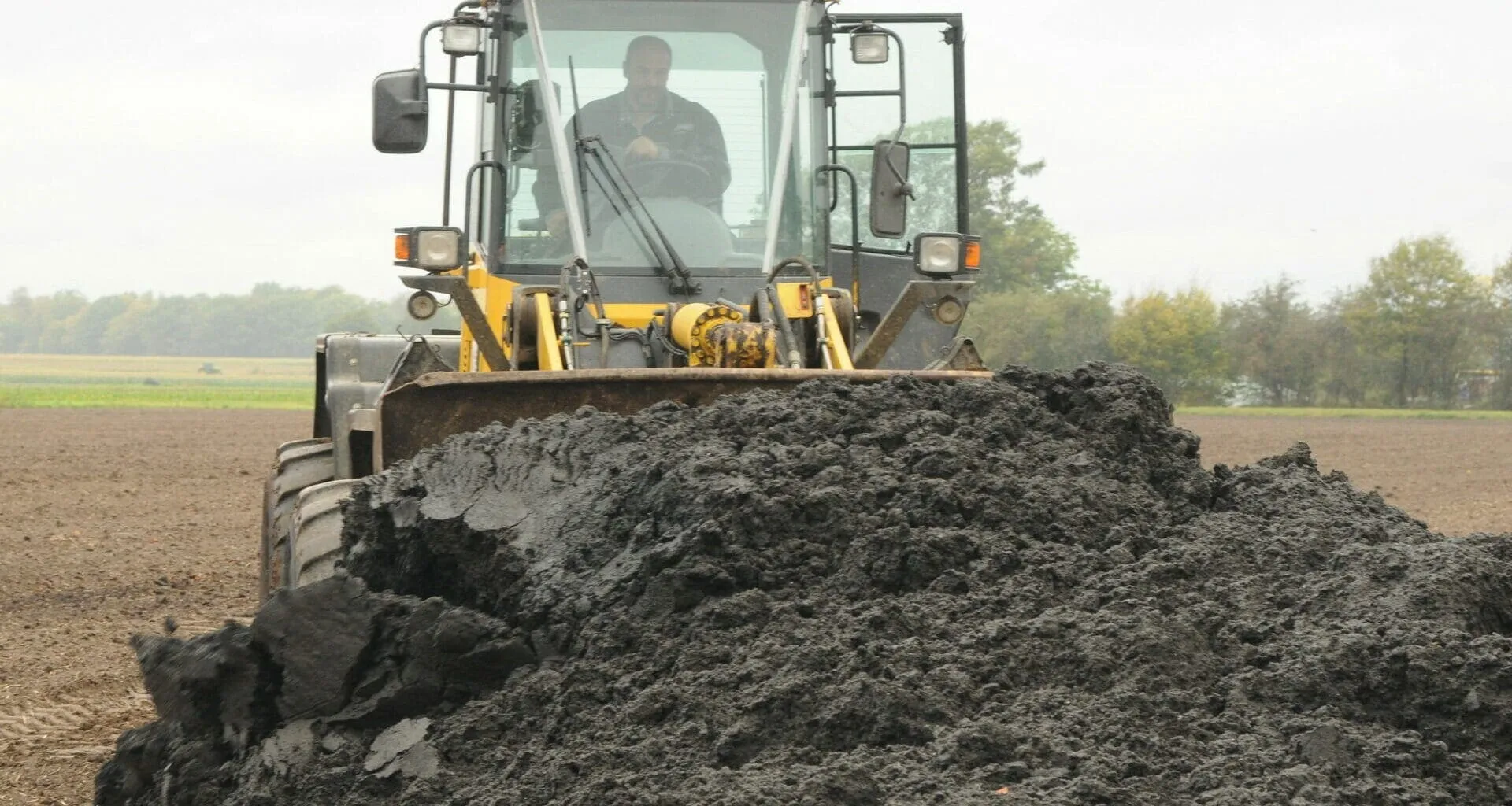
Working Principle of Paddle Dryer for Sludge
- In the system, the evaporated moisture is captured and drawn away through the vapor outlet.
- Some systems may incorporate a vacuum to facilitate evaporation and in addition to that a condenser for the separation of vapor generated in the dryer may also be included.
5. Dried Sludge Discharge:
- The system operates continuously shedding dried sludge thus ensuring a constant production flow.
Benefits of Using Paddle Dryers for Sludge
1. Efficient Drying Process:
- Paddle dryers are highly efficient heat transfer units due to their ability to provide mixing, which ensures a uniform drying process.
- The sludge indirect heating method provides the dried product with no contact with the heater, thus avoiding cross-contamination.
2. Reduced Sludge Volume:
- Sludge drying in a paddle dryer leads to an extreme reduction in its volume and weight.
- This method together with the reduced sludge volume, makes its handling, transportation, and disposal easy and inexpensive.
3. Energy Efficiency:
- Scuts mainly reduce the energy usage and consequently the total costs by the optimum energy design.
- The mixing process is semi-empirical and very efficient which allows to transfer of more heat and thus requires less energy.
4. Vapor Removal:
- In the system, the evaporated moisture is captured and drawn away through the vapor outlet.
- Some systems may incorporate a vacuum to facilitate evaporation and in addition to that a condenser for the separation of vapor generated in the dryer may also be included.
5. Dried Sludge Discharge:
- The system operates continuously shedding dried sludge thus ensuring a constant production flow.
Benefits of Using Paddle Dryers for Sludge
1. Efficient Drying Process:
- Paddle dryers are highly efficient heat transfer units due to their ability to provide mixing, which ensures a uniform drying process.
- The sludge indirect heating method provides the dried product with no contact with the heater, thus avoiding cross-contamination.
2. Reduced Sludge Volume:
- Sludge drying in a paddle dryer leads to an extreme reduction in its volume and weight.
- This method together with the reduced sludge volume, makes its handling, transportation, and disposal easy and inexpensive.
3. Energy Efficiency:
- Scuts mainly reduce the energy usage and consequently the total costs by the optimum energy design.
- The mixing process is semi-empirical and very efficient which allows to transfer of more heat and thus requires less energy.
4. Versatility:
- Paddle dryers can handle various types of sludge, including municipal, industrial, and biological sludge.
- Their robust design and adaptability make them suitable for different sludge drying applications.
5. Environmental Compliance:
- Efficient sludge drying helps meet environmental regulations by reducing the volume of waste that needs to be disposed of.
- You can safely landfill properly dried sludge or use it in other applications, such as soil conditioning or energy recovery.
Best sludge management solution
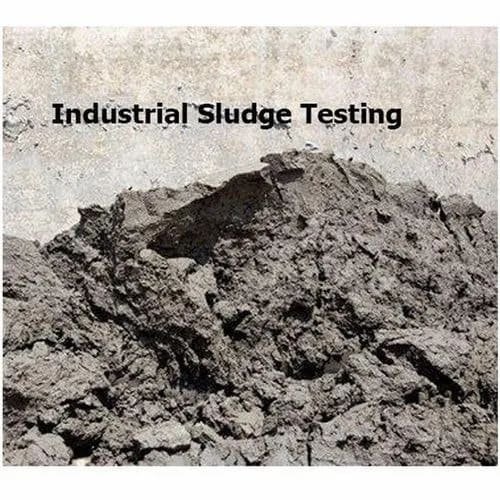
Applications of Paddle Dryers in Sludge Management
Paddle dryers are widely used in various industries for effective sludge management:
1. Municipal Wastewater Treatment:
- Municipal wastewater treatment plants commonly use paddle dryers to dry sewage sludge.
- You can safely dispose of or use the dried sludge in agricultural applications.
2. Industrial Waste Treatment:
- Industries producing large volumes of sludge, such as chemical, pharmaceutical, and food processing industries, use paddle dryers for sludge management.
- Efficient sludge drying helps reduce waste disposal costs and meet environmental regulations.
3. Biological Sludge Management:
- Paddle dryers effectively dry biological sludge generated from various biological treatment processes.
- You can use the dried biological sludge for energy recovery or as a soil conditioner.
Choosing the Right Paddle Dryer for Sludge
When selecting a paddle dryer for sludge, consider several factors to ensure optimal performance and efficiency:
1. Capacity and Throughput:
- Determine the volume of sludge you need to process to choose a paddle dryer with the appropriate capacity and throughput.
2. Heating Medium:
- Decide whether to use steam, thermic fluid, or hot water as the heating medium based on your specific drying requirements and available resources.
3. Material Compatibility:
- Ensure that the materials used in constructing the paddle dryer are compatible with the type of sludge being processed to prevent corrosion and wear.
4. Automation and Control:
- Consider paddle dryers with advanced automation and control features for precise temperature and process control, ensuring consistent drying quality.
5. Energy Efficiency:
- Look for paddle dryers designed to optimize energy usage and reduce operational costs.
Why sludge needs a paddle dryer: the sticky phase
Most sewage and industrial sludges pass through a sticky, glue-like phase at roughly 40 to 60% dry solids. In that range they smear onto heated surfaces, form lumps and can stall dryers. Paddle dryers cope with it because their slow, heavy-duty shafts keep kneading and breaking the mass, and the self-cleaning wedge paddles keep the heating surfaces renewed. Some plants also back-mix dried product into the wet feed to start drying above the sticky range.
Full drying vs partial drying of sludge
| Option | Typical final dry solids | Used for |
|---|---|---|
| Partial drying | About 40 to 65% | Reducing haulage weight; feeding incinerators or co-processing |
| Full drying | About 85 to 95% | Fuel for cement kilns and boilers, fertiliser use, long-term storage |
Worked example: steam needed by a sludge paddle dryer
Assumed values: the dryer evaporates 500 kg/h of water, needing about 2,600 kJ per kg including heating the sludge and losses, from steam that gives up about 2,000 kJ/kg when it condenses. Steam use is about 500 × 2,600 ÷ 2,000 ≈ 650 kg/h, or about 1.3 kg of steam per kg of water evaporated. Low-pressure waste steam can cut running cost sharply. See paddle dryer working principle and sizing, sludge dryer technologies and sludge drying economics.
See it in 3D
Conclusion
Paddle dryers offer an efficient and effective solution for sludge management in various industries. By providing uniform drying through indirect heating, they significantly reduce sludge volume and weight, making handling and disposal more manageable. The versatility, energy efficiency, and environmental compliance of paddle dryers make them invaluable tools for municipal wastewater treatment, industrial waste treatment, and biological sludge management.
Understanding the working principle and benefits of paddle dryers for sludge is essential for industries seeking to improve their sludge management processes. By choosing the right paddle dryer and maintaining optimal operating conditions, you can achieve consistent, high-quality drying outcomes, contributing to a more sustainable and cost-effective waste management strategy.
For more detailed information on paddle dryers and other industrial drying equipment, visit EngiTech. Stay updated with our latest blogs to enhance your knowledge and improve your industrial processes.
🛠️ Recommended Engineering Guides & Tools
Related reading: Comprehensive Guide to Sludge Dryer Manufacturers; Comprehensive Guide to Kiln Dryers; Master the Paddle Dryer Working Principle with This Guide.
Free tools for this topic: Dryer selection tool · Dryer evaporation, heat and fuel calculator · all free engineering tools
Sources and further reading
For standards, data and independent guidance on this topic, see US Department of Energy process heating resources (industrial heating and drying efficiency) and The Engineering ToolBox (engineering reference data and calculators). Always check the current edition and your site conditions before applying any figure.
Free tool for this topic
Industrial Dryer Evaporation, Heat & Fuel CalculatorWater evaporation, product output, heat load and fuel or steam consumption for spray, rotary, flash, fluid-bed and paddle dryers. Environmental EngineeringRenewable Energy Grid Integration: Solar PV, Battery Storage (BESS) & LCOE Math
 Environmental EngineeringNuclear Waste Engineering: Vitrification, Deep Geological Repositories & Radiation Shielding
 Industrial DryersAgitated Nutsche Filter Dryers (ANFD) : Comprehensive Guide
 Industrial DryersDryer Exhaust Dew Point: Preventing Condensation and Corrosion in Ducts
 Environmental EngineeringSludge Dewatering Equipment: Centrifuge vs Filter Press vs Screw Press Sizing
 Environmental EngineeringCommercial Sewage Treatment Plants (STP): SBR vs MBR vs Moving Bed Design