
On this page
- What is an Agitated Nutsche Filter Dryer?
- How Does an Agitated Nutsche Filter Dryer Work?
- Filtration
- Washing
- Drying
- ANFD operation, step by step
- ANFD vs centrifuge plus separate dryer
- Key Components of an Agitated Nutsche Filter Dryer
- Primary Applications of Agitated Nutsche Filter Dryers
- Pharmaceutical Industry
- Chemical Industry
- Food Industry
- Specialty Chemicals
- Advantages of Using Agitated Nutsche Filter Dryers
- Efficiency
- Versatility
- Quality Control
- Safety
- Maintenance and Troubleshooting of ANFDs
- Regular Inspection
- Cleaning
- Lubrication
- Calibration
- Troubleshooting Common Issues
- Future Trends in Agitated Nutsche Filter Dryers
- Automation and Control Systems
- Enhanced Materials and Coatings
- Energy Efficiency
- Integration with Digital Technologies
- Conclusion
- 🛠️ Recommended Engineering Guides & Tools
- Sources and further reading
- More on Industrial Dryers
Agitated Nutsche Filter Dryers (ANFDs) serve as versatile equipment in the pharmaceutical, chemical, and food industries, enabling efficient solid-liquid separation processes. By integrating filtration, washing, and drying in a single unit, ANFDs enhance efficiency, cost-effectiveness, and safety. This guide explores the working principles, applications, advantages, and maintenance of agitated nutsche filter dryers.
What is an Agitated Nutsche Filter Dryer?
An agitated nutsche filter dryer (ANFD) is a sophisticated piece of equipment used for solid-liquid separation. It combines the functions of filtration, washing, and drying in one unit, making it highly efficient and versatile for various industries.
- Nutsche Filter: This is a batch filtration device that uses pressure or vacuum to separate solids from liquids.
- Agitated Nutsche Filter: This type incorporates an agitator to improve the filtration process and facilitate washing and drying.
- Agitated Filter Dryer: By integrating drying capabilities, the agitated nutsche filter becomes a comprehensive solution for processing wet solids.
How Does an Agitated Nutsche Filter Dryer Work?
ANFDs operate through several key stages:
Filtration
You feed the slurry containing solid and liquid phases into the filter. The agitator helps distribute the slurry evenly over the filter media. Pressure or vacuum is applied to force the liquid through the filter, leaving the solid cake on the filter media.
Washing
To remove impurities, you wash the solid cake with a solvent. The agitator ensures thorough mixing, improving the washing efficiency. Multiple washing cycles can be performed to achieve the desired purity.
Drying
After washing, the drying phase begins. The agitator keeps the solids in motion, enhancing heat transfer and drying efficiency. The drying can be carried out under vacuum or atmospheric conditions, depending on the process requirements.
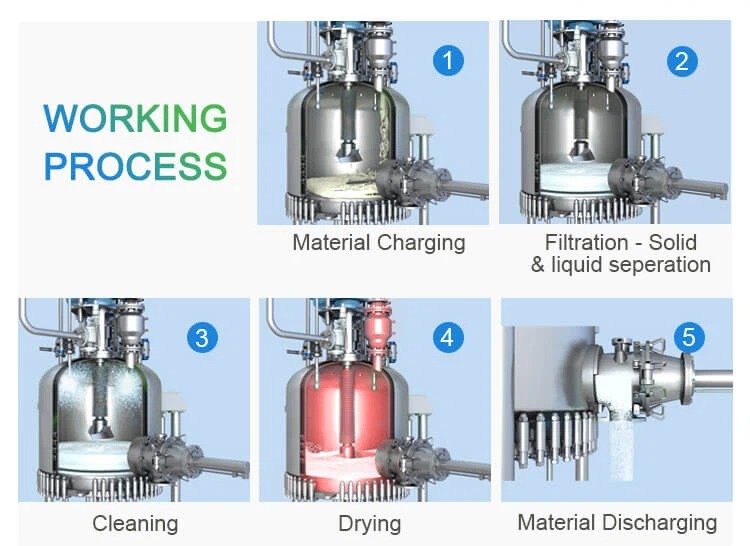
ANFD operation, step by step
- Charging: the slurry from the reactor or crystalliser is transferred into the closed vessel above the filter plate or mesh.
- Filtration: pressure (nitrogen) above the cake, vacuum below the filter, or both, drive the mother liquor through the filter medium.
- Smoothing: the agitator is lowered to level the cake so it filters and washes evenly without cracks.
- Washing: wash solvent is added; the agitator can reslurry the cake for thorough displacement washing, then the wash is filtered off.
- Drying: the jacket, filter plate and sometimes the agitator are heated while vacuum is applied; the agitator turns slowly to bring fresh cake to the heated surfaces.
- Discharge: the agitator blades turn to push the dry powder out through a side discharge valve into a closed container.
- Cleaning: CIP spray balls and solvent rinses prepare the vessel for the next batch or product.
ANFD vs centrifuge plus separate dryer
| Point | Agitated nutsche filter dryer | Centrifuge + separate dryer |
|---|---|---|
| Product handling | One closed vessel; no manual transfer of wet cake | Wet cake transferred between machines |
| Containment | Excellent for potent, toxic or solvent-wet products | Harder; transfer points need isolators |
| Cycle time | Longer drying, since heat transfer area is limited | Faster dewatering; dryer chosen for the product |
| Cake moisture after filtration | Higher than a centrifuge | Lower, saving drying time |
| Best for | Pharma APIs, fine chemicals, multi-product batch plants | Larger volumes, fast-filtering crystals |
Compare other batch dryers with the dryer selection tool, or see the rotary vacuum paddle dryer.
Key Components of an Agitated Nutsche Filter Dryer
ANFDs consist of several essential components:
- Agitator: A motor-driven mechanism that stirs the contents of the filter, ensuring even distribution and efficient mixing during washing and drying.
- Filter Media: A porous material that allows liquid to pass through while retaining solid particles.
- Pressure/Vacuum System: Used to apply the necessary force for filtration and drying.
- Heating System: Provides the heat required for drying the solid cake.
- Control System: Manages the operation of the ANFD, including temperature, pressure, and agitation speed.
Primary Applications of Agitated Nutsche Filter Dryers
ANFDs find applications in various industries due to their versatility and efficiency:
Pharmaceutical Industry
In pharmaceuticals, ANFDs are used to produce active pharmaceutical ingredients (APIs) and intermediates. They ensure high purity and controlled particle size distribution, essential for drug formulations.
Chemical Industry
ANFDs handle various chemicals, including dyes, pigments, and catalysts. They provide efficient solid-liquid separation and drying, essential for product quality and process efficiency.
Food Industry
In the food industry, ANFDs process ingredients such as flavors, colors, and additives. They help maintain product quality by ensuring thorough washing and efficient drying.
Specialty Chemicals
For specialty chemicals like agrochemicals and fine chemicals, ANFDs offer precise control over the filtration, washing, and drying processes, ensuring consistent product quality.
Advantages of Using Agitated Nutsche Filter Dryers
Efficiency
ANFDs combine multiple process steps into one unit, reducing the need for additional equipment and handling. This integration improves process efficiency and reduces operational costs.
See it in 3D
Versatility
ANFDs can handle a wide range of materials, from fine powders to coarse crystals. Their adaptable design makes them suitable for various applications across different industries.
Quality Control
The closed system of ANFDs minimizes contamination risks, ensuring high product purity. The controlled environment allows precise adjustments to process parameters, improving product quality.
Safety
ANFDs operate in a closed system, reducing exposure to hazardous substances. This design enhances worker safety and complies with stringent industrial safety regulations.
Maintenance and Troubleshooting of ANFDs
Proper maintenance and troubleshooting are essential to ensure the optimal performance of ANFDs:
Regular Inspection
Regularly inspect the agitator, filter media, and pressure/vacuum systems. Look for signs of wear and tear, leaks, or blockages.
Cleaning
Thoroughly clean the ANFD after each batch to prevent contamination. Ensure all components, including the filter media and agitator, are free from residue.
Lubrication
Lubricate moving parts, such as the agitator and drive mechanism, to prevent mechanical failures. Use appropriate lubricants recommended by the manufacturer.
Calibration
Regularly calibrate the control systems to ensure accurate temperature, pressure, and agitation speed settings. Calibration helps maintain process consistency and product quality.
Troubleshooting Common Issues
- Reduced Filtration Efficiency: Check for clogged filter media or insufficient pressure/vacuum. Clean or replace the filter media and ensure proper system calibration.
- Incomplete Drying: Verify the heating system and agitation speed settings. Ensure the drying phase is conducted for an adequate duration.
- Mechanical Failures: Inspect and replace worn-out or damaged components. Regular maintenance and timely repairs prevent unexpected breakdowns.
Future Trends in Agitated Nutsche Filter Dryers
The future of ANFDs lies in technological advancements and improved process efficiency. Some emerging trends include:
Automation and Control Systems
Advanced automation and control systems enhance the precision and efficiency of ANFD operations. These systems allow real-time monitoring and adjustments, ensuring optimal performance.
Enhanced Materials and Coatings
The use of advanced materials and coatings improves the durability and performance of ANFDs. Corrosion-resistant coatings and high-strength alloys extend the lifespan of the equipment.
Energy Efficiency
Developing energy-efficient heating systems and optimizing process parameters reduce the energy consumption of ANFDs. These improvements align with sustainability goals and reduce operational costs.
Integration with Digital Technologies
Integrating ANFDs with digital technologies, such as IoT and data analytics, provides valuable insights into process optimization and predictive maintenance. These technologies improve overall efficiency and reduce downtime.
Conclusion
Agitated nutsche filter dryers (ANFDs) are essential equipment in various industries, offering efficient solid-liquid separation, washing, and drying processes. Their versatility, efficiency, and safety make them a preferred choice for pharmaceutical, chemical, and food applications. By understanding the working principles, key components, applications, and maintenance of ANFDs, industries can optimize their processes and improve product quality. As technology advances, ANFDs will continue to evolve, offering even greater efficiency and sustainability.
For more in-depth articles and resources on agitated nutsche filter dryers and related technologies, visit EngiTech.in. Stay updated on the latest advancements and applications in the field!
🛠️ Recommended Engineering Guides & Tools
Free tools for this topic: Dryer selection tool · Dryer evaporation, heat and fuel calculator · Bag filter sizing calculator · all free engineering tools
Sources and further reading
For standards, data and independent guidance on this topic, see US Department of Energy process heating resources (industrial heating and drying efficiency), The Engineering ToolBox (engineering reference data and calculators) and Bureau of Energy Efficiency (energy audit and efficiency programmes in India). Always check the current edition and your site conditions before applying any figure.
Free tool for this topic
Industrial Dryer Evaporation, Heat & Fuel CalculatorWater evaporation, product output, heat load and fuel or steam consumption for spray, rotary, flash, fluid-bed and paddle dryers. Industrial DryersMaster the Paddle Dryer Working Principle with This Guide
 Industrial DryersVacuum Drying Basics: Pressure, Boiling Point and Drying Time
 Industrial DryersComprehensive Guide to Kiln Dryers
 Industrial DryersSpray Dryers: Principles, Types, Applications, and Considerations
 Industrial DryersSpin Flash Dryers: Rapid and Efficient Drying Solutions
 Industrial DryersATFD Design Guide: Rotor Speed, Blade Clearances & Zero Liquid Discharge (ZLD)