

On this page
- Screw air compressor diagram: parts and their functions
- 1. Why Air Compressor Accessories Matter
- 2. Must-Have Air Compressor Accessories
- 1. Air Hoses
- 2. Air Filters
- 3. Pressure Regulators
- 4. Quick-Connect Couplers
- 5. Lubricators
- 6. Air Tanks
- 7. Air Blow Guns
- 3. Specialized Air Compressor Attachments
- 1. Nail Guns and Staplers
- 2. Paint Sprayers
- 3. Sandblasters
- 4. Maintenance Accessories
- 1. Drain Valves
- 2. Vibration Pads
- 5. Factors to Consider When Choosing Accessories
- 6. Safety Tips for Using Accessories
- 7. The Future of Air Compressor Accessories
- Air compressor accessories and what each one does
- Worked example: sizing an air receiver
- Conclusion
- 🛠️ Recommended Engineering Guides & Tools
- Sources and further reading
- More on Air Handling and Filtration
In short: Air compressor accessories that matter: dryers, filters, drains, receivers, hoses, couplers and regulators, and how each one affects air quality and cost.
Screw air compressor diagram: parts and their functions
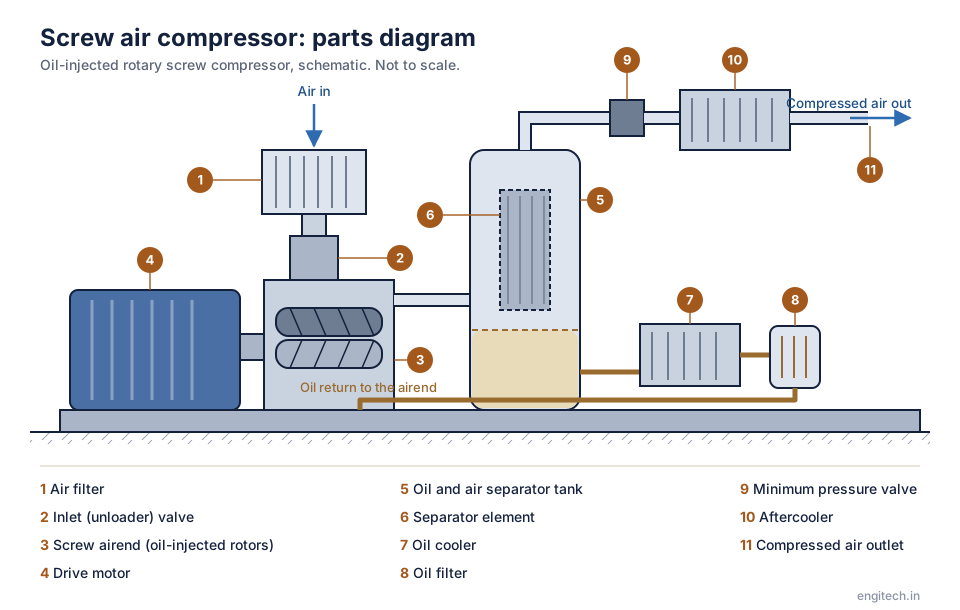
| No. | Part | What it does |
|---|---|---|
| 1 | Air filter | Removes dust from the intake air before it enters the compressor. |
| 2 | Inlet (unloader) valve | Opens and closes the air intake to load and unload the compressor as demand changes. |
| 3 | Screw airend | Two meshing helical rotors trap the air and squeeze it as they turn. Oil is injected to seal the gaps, cool the air and lubricate the rotors. |
| 4 | Drive motor | Turns the male rotor, directly or through a gear or belt drive. |
| 5 | Oil and air separator tank | The air and oil leave the airend together. The tank slows the mixture so most of the oil drops out and collects at the bottom. |
| 6 | Separator element | A fine filter that removes the remaining oil mist from the compressed air. |
| 7 | Oil cooler | Cools the oil before it returns to the airend, which keeps the discharge temperature under control. |
| 8 | Oil filter | Removes particles from the oil before it is injected back into the airend. |
| 9 | Minimum pressure valve | Keeps a minimum pressure in the separator tank so that oil circulates correctly, and prevents backflow from the system. |
| 10 | Aftercooler | Cools the compressed air so that much of its water vapour condenses and can be drained. |
| 11 | Compressed air outlet | Where the compressed air leaves the package to go to the air receiver and dryer. |
Download this diagram (SVG)Schematic for learning. Real machines vary by maker and duty.
Air compressors are indispensable in a wide range of industries, but to truly harness their potential, choosing the right accessories and attachments is essential. These tools enhance efficiency, as well as improve the versatility and safety of air compressors.
Whether you’re a professional seeking to optimize your operations or a DIY enthusiast, understanding the available accessories can transform your air compressor into a multitasking powerhouse. In this detailed guide, we’ll explore the top air compressor accessories, their functions, and how to select the best ones for your needs.
1. Why Air Compressor Accessories Matter
Accessories and attachments expand the capabilities of your air compressor. Here’s why they are essential:
- Enhanced Functionality: Tools like nail guns, paint sprayers, and sanders depend on specific attachments.
- Improved Safety: Accessories like pressure regulators and safety valves ensure controlled and secure operation.
- Increased Efficiency: Quality hoses and filters reduce energy waste, ensuring consistent performance.
- Longevity of Equipment: Proper maintenance tools like air filters and lubricators reduce wear and tear.
2. Must-Have Air Compressor Accessories
1. Air Hoses
Air hoses are the lifeline of any air compressor system.
- Types of Air Hoses:
- Rubber Hoses: Durable and flexible, ideal for heavy-duty applications.
- PVC Hoses: Lightweight and affordable, suitable for light to medium use.
- Hybrid Hoses: A combination of rubber and PVC, offering flexibility and durability.
- Tips for Selection:
- Choose the appropriate diameter and length for your compressor’s CFM rating.
- Ensure the hose has reinforced layers for high-pressure applications.
2. Air Filters
Air filters prevent contaminants like dust, oil, and moisture from entering the compressor system.
- Types of Filters:
- Particulate Filters: Capture solid particles.
- Coalescing Filters: Remove oil and water aerosols.
- Activated Carbon Filters: Eliminate odors and chemical vapors.
- Benefits:
- Maintain air quality for sensitive applications.
- Extend the life of air tools by preventing clogging.
3. Pressure Regulators
Pressure regulators control the output pressure, ensuring consistent performance for different tools.
- Why You Need Them:
- Protect tools from damage due to overpressure.
- Optimize energy consumption by matching pressure to task requirements.
- How to Choose:
- Look for adjustable regulators with precise pressure gauges.
- Ensure compatibility with your compressor’s pressure range.
4. Quick-Connect Couplers
Quick-connect couplers simplify tool changes by allowing fast and secure connections.
- Types of Couplers:
- Industrial (Type M): Suitable for high-flow applications.
- Automotive (Type T): Common in automotive workshops.
- Universal: Compatible with multiple plug types.
- Tips for Use:
- Select couplers with corrosion-resistant materials.
- Use matching plugs to avoid air leaks.
5. Lubricators
Lubricators ensure that air tools receive proper lubrication during operation.
- Benefits:
- Reduce friction and wear in pneumatic tools.
- Prevent rust and corrosion in air systems.
- Tips for Maintenance:
- Use manufacturer-recommended oil.
- Check and refill oil levels regularly.
6. Air Tanks
Auxiliary air tanks increase air storage capacity for demanding applications.
- Benefits:
- Provide consistent airflow for tools requiring high CFM.
- Reduce compressor cycling, saving energy.
- How to Choose:
- Match the tank size to your compressor and usage patterns.
- Look for tanks with rust-resistant coatings.
7. Air Blow Guns
Air blow guns are versatile tools for cleaning and drying applications.
- Uses:
- Remove debris from surfaces and machinery.
- Dry painted or cleaned surfaces.
- Features to Look For:
- Adjustable nozzles for variable pressure.
- Ergonomic designs for comfortable handling.
3. Specialized Air Compressor Attachments
1. Nail Guns and Staplers
Ideal for construction and carpentry projects.
- Benefits:
- Speeds up tasks like framing, roofing, and finishing.
- Ensures precision and reduces manual effort.
- Tips for Use:
- Match the tool’s air requirements with your compressor’s CFM rating.
- Use the appropriate nail or staple size for the job.
2. Paint Sprayers
Perfect for automotive, furniture, and wall painting.
- Types of Paint Sprayers:
- HVLP (High Volume, Low Pressure): Offers fine, controlled spray patterns.
- Conventional Sprayers: Suitable for high-speed applications.
- Tips for Selection:
- Choose a sprayer compatible with your paint type.
- Opt for adjustable spray patterns for versatility.
3. Sandblasters
Used for surface preparation, such as rust and paint removal.
- Benefits:
- Clean and smooth surfaces efficiently.
- Prepare materials for painting or welding.
- Safety Tips:
- Wear protective gear, including goggles and gloves.
- Ensure proper ventilation during use.
4. Maintenance Accessories
1. Drain Valves
Drain valves remove accumulated moisture from the air tank.
- Automatic vs. Manual:
- Automatic valves save time and reduce maintenance effort.
- Manual valves are cost-effective but require regular checks.
2. Vibration Pads
Placed under the compressor to reduce vibration and noise.
- Benefits:
- Enhance stability and reduce wear on components.
- Minimize noise for quieter operation.
5. Factors to Consider When Choosing Accessories
- Compressor Compatibility:
Ensure accessories match your compressor’s CFM, PSI, and connection sizes. - Durability:
Choose high-quality materials like stainless steel or reinforced rubber. - Application Requirements:
Select tools suited for your specific tasks, such as painting or sanding. - Ease of Use:
Look for ergonomic designs and quick-connect systems for efficiency.
6. Safety Tips for Using Accessories
- Always follow the manufacturer’s guidelines.
- Regularly inspect hoses and connectors for leaks or damage.
- Use protective gear during high-pressure applications.
- Store tools and attachments properly to prevent damage.
7. The Future of Air Compressor Accessories
The development of smart air compressor accessories is revolutionizing the industry. Innovations include:
- IoT-Enabled Tools: Real-time monitoring and control of air systems.
- Eco-Friendly Attachments: Designed to reduce energy consumption.
- Advanced Safety Features: Automated shutdown in case of malfunctions.
Air compressor accessories and what each one does
| Accessory | Purpose | Selection tip |
|---|---|---|
| Air receiver (tank) | Stores air, smooths demand peaks, reduces compressor cycling | Size from demand and pressure band (example below) |
| Refrigerated or desiccant dryer | Removes moisture | Refrigerated for general use (about +3 °C dew point); desiccant for instrument air and cold areas |
| Line filters (particle, coalescing, carbon) | Remove dust, oil aerosols and vapour | Match to the ISO 8573-1 air quality you need |
| Automatic drains | Remove condensate from tanks, dryers and filters | Zero-loss drains waste no compressed air |
| Filter-regulator-lubricator (FRL) | Cleans, sets pressure and lubricates at each tool | Skip the lubricator for paint and food uses |
| Hoses and quick couplings | Connect tools | Oversize long hoses; small couplings cause big pressure drops |
| Oil-water separator | Treats condensate before discharge | Required for oil-lubricated compressors |
Worked example: sizing an air receiver
A simple formula is V = t × Q × Pa ÷ (P1 − P2), where t is the time the tank must supply air (minutes), Q the demand (m³/min of free air), Pa atmospheric pressure and P1 − P2 the allowed pressure fall. To supply 1 m³/min for 1 minute while pressure falls from 7 to 6 bar, V = 1 × 1 × 1.013 ÷ 1 ≈ 1.01 m³ (about 1,000 litres). See types of air compressors, compressed air piping and receivers and troubleshooting.
Conclusion
Equipping your air compressor with the right accessories and attachments enhances its efficiency, versatility, and lifespan. From basic tools like hoses and filters to specialized attachments like paint sprayers and sandblasters, the possibilities are endless.
Investing in high-quality accessories tailored to your applications ensures optimal performance and safety. Explore the wide range of air compressor accessories to unlock the full potential of your equipment.
For more detailed guides and industry insights, visit EngiTech, your trusted resource for all things industrial engineering.
🛠️ Recommended Engineering Guides & Tools
Related reading: The Ultimate Guide to HVAC Filtration Systems: A Deep Dive into HVAC Air Filters for Maximum Efficiency.
Free tools for this topic: Compressed air leak cost calculator · Air receiver size calculator · all free engineering tools
Sources and further reading
For standards, data and independent guidance on this topic, see Compressed Air and Gas Institute (compressed air standards and guidance), US Department of Energy motor systems resources (motor and fan efficiency) and NIST (measurement and calibration standards). Always check the current edition and your site conditions before applying any figure.
Free tool for this topic
Compressed Air Leak Cost CalculatorAir lost, compressor power wasted and annual energy cost of compressed-air leaks by hole size and pressure. Air Handling and FiltrationComprehensive Guide to Bag Filters: Functionality, Types, and Benefits
 Air Handling and FiltrationHow to Choose the Right Air Compressor for Your Industry
 Air Handling and FiltrationTop Applications of Air Compressors in Various Industries
 Air Handling and FiltrationThe Ultimate Guide to Hydrocyclone Filters: Technology, Applications, and Maintenance
 Air Handling and FiltrationVariable Speed Drives for Fans: A Comprehensive Guide
 Air Handling and FiltrationThe Ultimate Guide to HVAC Filtration Systems: A Deep Dive into HVAC Air Filters for Maximum Efficiency